MaryGSykes.com

CONFIRMED BY ILL. SUPREME COURT– YOU ARE VIEWING THE MOST DANGEROUS BLOG IN ILLINOIS. This blog warranted a 3 year suspension by the ARDC/Jerome Larkin! Mottos: "Sunlight is the best disinfectant". Justice Louis Brandeis ; "If the truth can destroy something, then it deserves to be destroyed" Carl Sagan; "Justice is Truth in Action" Benjamin Disraeli. Illinois uses the ARDC to quash dissenting attorney activist blogs ; "The freedom of the press is one of the greatest bulwarks of liberty, and can never be restrained but by despotic Governments" — (1776-First Amendment preamble adopted by 8 US colonies)

MaryGSykes.com

From FB: convicted judge still a judge one week later.

https://chicago.suntimes.com/news/convicted-judge-still-a-judge-one-week-later-but-effort-to-remove-her-afoot/

However, at least one regulatory body is preparing to take action against O’Brien.

The Attorney Registration & Disciplinary Commission plans to notify the state supreme court of O’Brien’s conviction and seek an interim suspension of her law license, ARDC spokesman James Grogan said. First it must receive paperwork documenting O’Brien’s conviction from the federal court, he said.

U.S. District Judge Thomas Durkin ordered Thursday afternoon that a certified copy of the jury’s verdict be delivered to the ARDC.

The move has significance because the Illinois Constitution requires judges to hold a law license.

Still, while other agencies might be preparing behind the scenes to take action, no other public effort appears to be underway to remove the judge from office. Complicating matters is the rarity of a sitting judge being convicted in federal court.

Kathy Twine, executive director and general counsel for the Judicial Inquiry Board, said all matters “are confidential unless there is the filing of a formal complaint against any judge with the Illinois Courts Commission.” Before taking such an action, the JIB must give a judge notice and an opportunity to appear before the board, according to its rules of procedure.

O’Brien has been assigned to administrative duties ever since her indictment in April 2017. Cook County Chief Judge Timothy C. Evans’ communications director has said that “is the strongest action” the court’s executive committee can take.

O’Brien did not respond to multiple messages from the Chicago Sun-Times. Her defense attorney, Ricardo Meza, declined to comment. He has signaled that O’Brien would ask Durkin to acquit her despite the jury’s verdict. However, he and other lawyers representing O’Brien in the criminal case have sought to withdraw from the matter.

The judge was convicted last week of bank fraud and mail fraud affecting a financial institution. Federal prosecutors said she pocketed $325,000 during a mortgage fraud scheme that took place more than a decade ago — before she became a judge.

O’Brien, 50, is not set to be sentenced until July 6. Tim Blair, executive secretary of the Judges’ Retirement System of Illinois, said his organization typically doesn’t begin considering whether a conviction affects a pension until that happens.

“We’ve not been notified that she’s been removed from the bench,” Blair said.

But Blair also said O’Brien is not eligible to collect a pension.

At trial, Meza called the charges against O’Brien a “cockamamie concoction.” He previously accused the feds of targeting O’Brien because of her seat on the bench.

Prosecutors told jurors O’Brien lied repeatedly as she bought, refinanced and sold properties in the 600 block of West 46th and 800 block of West 54th between 2004 and 2007. They said she inflated her income as she applied for loans and at one point failed to mention a $260,000 mortgage on her primary residence.

From Joanne:
This woman was indicted over a year ago (criminal complaint filed) and the ARDC and JIB have taken no action for a year–until she is convicted.
But if you run a blog complaining about corruption in the courts, the ARDC will go right after you and claim wrongfully everything on your blog is false and that it is “akin to crying ‘fire’ in a crowded theater”–which is utterly preposterous.
Actually, this blog is the one link between the public crying out for justice and the ARDC and JIB which do nothing–generally until it is too late, for sitting judges and tied in attorneys stealing on the job.
But I think the public is not surprised this woman still has a law license and is drawing a salary since April 2017 on “administrative duties.”

From AP: Complaints against corrupt attorneys David Martin, Andrew Dobszyn and Joanne Bruzgul–will the ARDC do anything when presented with valid attorney complaints?

Anthony Phillips
6128 N Monticello Ave
Chicago, IL 60659
VIA First Class Mail, USPS prepaid, with tracking
cc: JIB FAX 312 814 5719
February 23, 2018
RE: Complaint against attorneys Joanne Bruzgul, David Martin and Andrew
Dobszyn and Wendy Cappaletto
Estate of Lorraine Phillips 2011 P 1044
To: Complaint Intake
Dear Sir/Madam;
I wish to file a complaint against Joanne Bruzgul on two grounds 1) malpractice in
handling the above estate matter; 2) theft, conversion and embezzlement because she
was paid in full by the Estate of Phillips, she obtained liens on my mother’s property for
the full amount she charged, and in fact the probate court approved 100% of her fees,
but she never returned the $22,000 in upfront or bill payments made during the time
she worked on the estate. She never provided me with an accounting after numerous
demands to do so.
On or about March 2012, I hired Attorney Joanne Bruzgul to represent me in a
guardianship matter where she was supposed to have me appointed sole Guardian of
the estate of my mother. A copy of her retainer agreement is attached hereto.
She presented fee petitions to the Guardianship court, and they approved 100% of her
fees. At the time, the Estate had insufficient funds to pay all the attorneys, and the
approval of those liens and court orders were on the basis that once a property located
at 630-32 S. Wabash was sold, all the attorney liens were to be paid in full.
In January 2016, the 630-32 S. Wabash Property was in fact sold. Atty Bruzgul should
have bee paid in full. Andrew Dobszyn was the attorney for Associated Bank, the
guardian of the estate.
It is not known why attorney Dobszyn did not pay Ms. Bruzgul. He had court approval
to do so. Atty Dobszyn was represented by Atty David Martin. Paul Franciszkowicz
was the GAL. All the attorneys were promptly paid what was approved by the court and
none sought any interest payment on the balance.
A title report was pulled sometime prior to the closing, indicating the Bruzgul liens. DM
claims he tried to work this out with Atty Bruzgul, but at no time prior to closing, did DM
Page 1 of 7
Anthony Phillips
February 13, 2018
Complaint against Bruzgul, Martin and Dobzyn
tell the probate court or myself that Bruzgul refused to release the lien upon payment to
her. I believe he breached his fiduciary duty to myself by not informing me of the fact
that Bruzgul refused to release her lien, and was not paid in full.
Accordingly, unbeknownst to me, the Title Company (Chicago Title Land Trust
Company–CTLTC) had their insurance company (Chicago Title Insurance Co.–CTIO)
hold back $100,000 at the closing. Neither I nor the probate court was told of any of
this. The judge could have straightened all of this out prior to closing, had she been fully
informed.
Recently, Atty Bruzgul filed a foreclosure action 2017 CH 16577 against 630-32 S.
Wabash alleging she was owed some $76,752 in interest and principal, despite the f act
she was told that no attorney would get interest in the case, they could only have a lien.
In addition, the computation of 9% interest is nothing but a bald faced lie. The Illinois
law pertaining to prejudgment interest only allows 9% per annum compounded
annually, not daily, not by the minute, not by the second.
Accordingly, Bruzgul has lied at least three times to the chancery court in her Complaint
(attached hereto) and grossly inflated what was owed to her ab initio 1) she fails to
mention the $22,000 that I paid her in up f ront fees; 2) she is compounding interest on
a daily basis, which is not permitted by statue; 3) she knows that the probate court sets
the manner in which fee petitions are paid, and these are presumably what is fair and
reasonable, and no attorney receives interest, it was not allowed for in any of her court
ordered judgments and no other attorney was paid prejudgment interest.
David Martin and Andrew Dobszyn knew all along about the problems at closing and did
not reveal any of these facts to the court, before, during or after closing. In fact, this
entire screw up was only mentioned in the probate court after attorney Bruzgul filed suit.
DM’s client is my sister, Tina Phillips, and I believe she was not told about this mess.
DM has a fiduciary duty to inform me as coguardian of all assets and liability of the
estate in a prompt and timely manner. His client is a coguradian. I was never told of
any of this until recently. This matter should have been fully disclosed in the probate
court and handled before closing. Instead it turned into a $100,000 screw up and the
estate is likely to lose that money to lawyers for CTLTC and CTIC.
B. Bruzgul took $22,000, more or less from me and refuses to provide an
accounting.
I am further attaching 4 email demands to Atty Bruzgul to provide me with an
accounting, and to date, she refuses to do so. An attorney must provide an accounting
to a client within a reasonable time period after a demand has been made.
Page 2 of 7
Anthony Phillips
February 13, 2018
Complaint against Bruzgul, Martin and Dobzyn
She refuses repeatedly to do this or answer my requests in any manner.
C. During the Guardianship case when Bruzgul Represented me, she committed
malpractice
I was forced to file suit against Ms. Bruzgul for malpractice.
During the Guardianship case, she committed the following errors (from the Third
Amended Complaint, Phillips v. Bruzgul):
COUNT I – LEGAL MALPRACTICE
1. Plaintiff re-alleges each of the foregoing paragraphs as if fully stated
herein.
2. This count is against Deft. Bruzgul and Bruzgul and Associates only.
3. Bruzgul had a duty to represent Anthony to the best of her abilities as a
reasonably competent attorney would in the same or similar
circumstances.
4. Bruzgul breached her duty to Anthony by:
a. Failing to explore the deposition of Sally Griffin of ABT
regarding her the uncorroborated accusations as to
Anthony’s character and competency;
b. Wrongfully insisting and imploring that Plaintiff Anthony
must sign the Agreed Order which prevented proceeding
with a trial he was certain to win due to Deft. Katina’s liens
on the Mother’s Properties, and an order which threatened
to place Mother Lorraine permanently in a nursing home if
he did not sign–both of which were wrongful and illegal
intimidation by Deft’s Martin and Franciszkowicz and which
Deft. Bruzgul participated in. Deft. Bruzgul failed to provide
Plaintiff Anthony with the option of going to trial and that the
threats were wrongful intimidation and should have been
reported to the authorities.
c. Failing to seek to vacate or modify the June 27, 2012 agreed
order after learning that the side order had been vacated,
thereby removing Lane from any further representation of
Lorraine or her Estate;
d. Failing to advise Plaintiff Anthony that he could appeal the
Court’s denial of the motion to reconsider Lane’s removal;
e. Failing to advise Anthony of his rights prior to the signing of
the agreed order;
f. Failing to demand that the agreed order contain all the
Page 3 of 7
Anthony Phillips
February 13, 2018
Complaint against Bruzgul, Martin and Dobzyn
material facts and conditions from all the orders entered on
June 27, 2012 so as to avoid any misrepresentation of the
agreement;
g. Have stated in the Agreed Order that Lane would remain the
attorney of record in all three cases;
h. Failing to object to the language in the various orders that
acted to the detriment of Anthony;
i. Failing to structure orders to ensure that monies owed to the
estate would go to Anthony as a preference, with priority
before all other claims;
j. Failing to give Anthony adequate notice of fee petitions so
he could review them;
k. Failing to provide Anthony with copies of pleadings filed by
adverse parties to the underlying action;
l. Failing to review the Andreou & Casson Ltd. retainer;
m. Failing to challenge the conflict of interest of attorney David
Martin representing two of the three co-guardians for the
Estate by written motion and/or objections for the record;
n. Failing to inform Anthony that he could file an emergency
motion to stop or delay the impending settlement in order to
save the Estate $300,000; and
o. By being otherwise careless or negligent.
5. As a proximate result of one or more of the aforesaid acts and/or
omissions by Bruzgul, Anthony sustained the following pecuniary
damages in his capacity as co-guardian of the Estate:
a. The removal of Lane cost the estate attorney’s fees and
costs, which would have otherwise been avoided;
b. The settlement agreement cost the Estate the amount
agreed upon;
c. Removing the settlement monies from the Estate deprived
the Estate of capital it could have used to improve certain
properties owned by the Estate, which could have then been
sold for a greater profit rather than being undervalued as
they are now, or could have helped the Estate be financially
self-sufficient by developing the Wasbash properties into a
parking lot, as Mother Lorraine had already undertaken
substantial steps toward doing so.
d. The result of the Agreed Order has effectively denied
Plaintiff Anthony his counsel of choice, Nejla Lane and her
former associate, Kristine Baumstark. Both Defts. Martin
and Franciszkowicz have stated to Plaintiff Anthony and/or
Page 4 of 7
Anthony Phillips
February 13, 2018
Complaint against Bruzgul, Martin and Dobzyn
his agents they would “not allow” him to use either Ms. Lane
or Ms. Baumstark as his counsel of record.
6. As a proximate result of one or more of the aforesaid acts and/or
omissions by Bruzgul, Anthony sustained the following pecuniary
damages in his capacity as an individual:
a. Having no rate of pay provision in the agreed order cost
Anthony money because as a full-time caretaker of his
mother, he had no other income;
b. Anthony has had to expend time and out-of-pocket
expenses to pursuing a rate of pay provision.
c. Plaintiff Anthony will have far less money to inherit due to
the actions and inactions negligence, malfeasance and
misfeasance of each of the Defendants.
COUNT II – BREACH OF CONTRACT
7. Plaintiff re-alleges each of the foregoing paragraphs as if fully stated
herein.
8. This cause of action is against Defendants Bruzgul and Bruzgul and
Associates only.
9. On March 3, 2012, Anthony entered into a legal services contract with
BRUZGUL & ASSOCIATES, LTD., whereby the said law firm would
“[r]epresent Client in his cross-petition to be appointed guardian of the
person and the estate of his disabled mother, Lorraine Phillips, including
representation at guardianship hearing and necessary preparation to the
conclusion of the case so long as the Client desires such representation.”
10. Anthony initially paid Bruzgul $5,000.00 for the retention of said services,
receipt of which was acknowledged.
11. Over the course of several months, Anthony ultimately paid Bruzgul
upwards of $20,000.00.
12. The material terms of the agreement were breached in one or more of the
ways detailed in paragraph 64, above.
13. As a proximate result of these breaches, Anthony sustained the pecuniary
damages listed above and claims his total fees paid for all legal services
rendered allegedly on his behalf.
COUNT VI
NEGLIGENT SETTLEMENT
14. Plaintiff re-alleges each of the forgoing paragraphs as if set forth fully
herein.
15. This Cause of Action is against Defts. Bruzgul and Bruzgul and Associates
Page 5 of 7
Anthony Phillips
February 13, 2018
Complaint against Bruzgul, Martin and Dobzyn
only.
16. Bruzgul had a duty to represent Plaintiff Anthony to the best of her abilities
as a reasonably competent attorney would do in the same or similar
circumstances.
17. Bruzgul breahed her duty to Plaintiff Anthony by failing to inform him that it
was not possible for the OPG to threaten that he must take a particular
settlement concocted by Dft. David Martin or the OPG would institutionalize
Lorraine Phillips.
18. That Bruzgul should have advised Pltff Anthony that such a settlment offer
is void and without effect under the law.
19. That Defendants Bruzgul and Bruzgul and Associates have wilfully and
contemptuously participated in a civil conspiracy to deny Plaintiff his civil
and due process rights during settlement and have failed to advise him
properly and assert his rights, entitling him to his actual and punitive
damages and his reasonable attorneys fees.
COUNT VII
TORTIOUS INTERFERENCE WITH
EXPECTATION OF INHERITANCY
20. Plaintiff re-alleges each of the forgoing paragraphs as if set forth fully
herein.
21. This Cause of Action is against all defendants.
22. That all defendants appeared in the Guardianship case and directly
supported unconstitutional motions for gag orders, orders that prevented
Anthony Phillips from consulting with his preferred counsel, Nejla Lane,
unconstitutional orders that prevented him from freely copying and studying
transcripts.
23. In addition, Defendants Bruzgul, Katina, Franciszkowicz and Martin
threatened Plaintiff Anthony that if he would not agree to become coguardian
and settle the matter, they would place Mother Lorraine in an
institution.
24. In all of this Deft. Bruzgul did not appropriately advice Plaintiff Anthony
regarding his civil rights.
25. Deft. Bruzgul also negligently agreed to settle a case for $300k together
with the other defendants, causing Mother Lorraine’s Estate to be
unnecessarily depleted by that amount. The very day after this Settlement
was approved, the Jury found for Deft. Mother Lorraine on all counts.
However, Defts. Francisczkowicz and Martin continued to advise the
Guardianship court that they “saved” the Lorraine Phillips estate “a million
dollars” by paying out a $300k settlement. In addition, Bruzgul should have
objected to the scheduled court proceeding being held in a small room
without a court reporter on the day the two of three co guardians voted to
Page 6 of 7
Anthony Phillips
Grievance regarding Bruzgul, Martin and Dobzyn
February 13, 2018
settle the Great America case for $300,000. This was a very important
discussion because the next day the jury came back in favor of the
defendant.
26. Defts. Holmes and Cappaletto came out to Mother Lorraine’s home, Deft.
Holmes drafted up a false and fraudulent report, and then the OPG refused
to provide it to Son Anthony. In addition, they threatened to remove
Lorraine Phillips from her home and sell all her belongings. Deft. Holmes
wrote up a false and fraudulent report which supported this contention,
upon information and belief. Deft. Cappalletto wrote a threatening email
which was provided to Deft. Anthony in which she condemned the home
and threatened to place Mother Lorraine into a nursing home. Accordingly,
all the defendants conspired together to falsely deplete the guardianship
estate and interfere with Plaintiff Anthony’s right to his inheritance.
27. The above actions by all defendants comprise the tort of Expectation with
an Inheritance, entitling Plaintiff Anthony to his actual damages of attorneys
fees falsely spent in the guardianship, the $300,000 unnecessary
settlement, as well as his attorneys fees in this action.
For all of the above reasons, the deception, lies and subterfuge, I am demanding
that attorneys Bruzgul, Martin and Dobszyn be disbarred.
VERY TRULY YOURS,
Anthony Phillips
Page 7 of 7

From LS: Cook County Office of Public Guardian steals from elderly disabled persons–letter to ARDC will they do anything?

Linda ScullyLinda ScullyPO Box 481081Niles, IL 60714email greeksjuly@gmail.comphone 312 549 2112
February 22, 2018
ARDC Grievance Intake130 E. Randolph St, 15th FloorChicago, IL 60601
VIA FAX 312.565.2320
RE: Complaint regarding Attorneys Nathan Goldenson, Joseph Pieper, Julie Fontarosa. Ashley Coppola Probate cases no. 13 P 4339 (guardianship) and 15 P 3545 (decedent’s estate)
Dear Madam/Sir;
I would like to file a complaint against the above attorneys:
1) Nathan Goldenson.  Illegally broke a trust, filed false police reports for false arrest, illegally sealed a guardianship case without due process.  Nathan Goldenson broke a trust without due process to myself and my brother, who were beneficiaries of the trust.  We were never served, as shown by the records of Sheriff’s Department.  The building was ruined by Nathan Goldenson and the OPG by having a heating pipe cut, which allowed the pipes to freeze and torrents of water destroyed the building. He also allowed squatters to live in the building.  I was the property manager and when ever I tried to have squatters (who were drug dealers and gang bangers)  evicted, he interfered with the court process and had me falsely arrested.  Every time I was falsely arrested by him contacting the local police, the charges were dropped at the first hearing date.  I was falsely arrested numerous times when he called the police to try to have me illegally evicted from the premises, even though I was the beneficiary of the building land trust, together with my brother Mark Scully, who is disabled.
In addition, Nathan Goldenson had my powers of attorney sumarially terminated in court without due process–no notice, no hearing, no discovery, no petition ever filed.  The Illinois Power of Attorney act requires I be given notice and a hearing.  None of that happened.
In addition, he illegally had the guardianship case 4339 sealed as of the beginning of the case so that no one could obtain any court information.  This was done without due process, notice, a hearing, discovery.  It was not until Sept 2016 that I was able to unseal the file, and even then, the court records today show that most of the records still cannot be viewed or printed publicly.  All of these violations of due process occurred because of Nate Goldenson.
2) Julie Fontarosa took a file from the clerk of court.  Judge Malone and Judge Riley can attest to the fact that the guardianship file 4339 was missing for months .  One day, Julie Fonatarosa walked into the front door of the courtroom with the file–and no clerk was present.  She put it Judge Riley’s desk and when he came to the bench, he demanded to know where the file came from.  Nathan Goldenson was present, Ashley Coppola was present and so was Joseph Pieper.  None of the attorneys answered.  Mark Scully, John Bisbikas, Harold Scully and myself were present and no one said anything.  We were all shocked to see the file after it had ben missing for about 6 months. But there it was.  After i looked at the file, I noted that it was missing a lot of pleadings.  I eventually was able to obtain a copy of the entire file (except for missing items), but only after months of asking.
3) Nathan Goldenson and Joseph Pieper    While the Guardianship file was sealed, the Pieper law firm in addition was given numerous pleadings from the sealed file from the OPG attorney Nate Goldenson–in fact, they were even allowed to view a sealed court file.  In addition, these attorneys allowed a member of the public, Richard McGreal to view the sealed court file.  This fact was documented in a Pieper law firm bill under the initial JWP on page 1 of 9 on 5/23/17.  The date the papers were tendered was 5/27/15–well before the 9/16/16 date when the file was ordered unsealed by Judge Riley.
I am asking that all of the above attorneys be sanctioned and disbarred for breaking a trust without notice, terminating my Powers of Attorney without notice, stealing court records and documents and hiding them, illegally sealing files, trading information from sealed court files (as shown by the Pieper Law Firm’s billing records) and showing sealed court records to a member of the public.  None of these persons should be practicing law.  Additional details are given in the attached “Objections to Attorneys Fees” attached hereto and the billing records of the Joseph Pieper law firm.  Particularly egregious is the sealing of a court file, and then the attorneys involved (Goldenson, Pieper, etc.) admitting they were viewing and trading documents and using them in pleadings when the case was still in fact sealed by court order.
It should also be noted that my brother Mark Scully is disabled, has great difficulty in walking (he walks with a walker and brace on his leg, and he can barely speak).  He needs medical care not covered by his insurance and all the OPG did was steal from myself (I am disabled and on SSI due to a separated spine) and from Mark Scully, who needs funds crucial to necessary medical care.


Very Truly Yours,


Linda Scully

attachments:

From EB: Kentucky seeks to reform Guardianship laws that are not working.

https://www.seattletimes.com/nation-world/bill-to-update-guardianship-laws-cleared-senate-panel/

FRANKFORT, Ky. (AP) — A bill aimed at easing the state’s growing burden as guardian of vulnerable elderly and disabled people moved a step closer to clearing the legislature Wednesday.

The measure, which seeks to ease the strain by ensuring that more relatives take on guardianship roles, won unanimous approval from the Senate Health and Welfare Committee, without any changes.

The bill goes next to the full Senate. The House approved it by a vote of 79-3 early this month.

It comes as the state struggles with growing caseloads of people who become wards of the state. The state is currently guardian for 4,448 wards, said Tim Feeley, deputy secretary of the Cabinet for Health and Family Services.

“We have a system where our guardianship program continues to grow and grow and grow, and we can’t keep up with it,” he told the committee.

State guardians are juggling caseloads of 65 to 70 wards apiece, about three times more than that recommended by national guidelines, Feeley said.

Under the current system, when families are fighting over who will serve as a relative’s guardian, judges sometimes resolve the matter by appointing the state as guardian, the bill’s supporters said.

Under the bill, judges would have to determine that “exceptional circumstances” exist to appoint the state as guardian.

The bill “makes the family have to work it out,” said main sponsor Republican Rep. Daniel Elliott of Danville.

Unlike some neighboring states, Kentucky has no cap on the number of wards in its public guardianship program, and Feeley spoke against imposing such limits.

“I don’t think a cap is the right idea, because there’s always one more case that we need,” he said.

Much of the discussion in committee focused on another provision, which would allow jury trials to be waived in guardianship matters when all participants consent to a judge deciding the case.

From Ken Ditkowsky–why is the ARDC continuing to pretend that the Sykes case was okay when it was not and filled with corruption?

The RULE OF LAW is clear and unequivocal.     When Jerome Larkin, the Administrator of the Illinois Attorney Registration and Disciplinary Commission equated the blog MARYGSYKES with ” yelling fire in a crowded theater” and materially misrepresent the SCOTUS decision in Alvarez, 132 S.CT. 2537 (2012), he demonstrated a measure of corruption and ignorance that was heretofore unprecedented in American Law.    When the Supreme Court of Illinois accepted Larkin’s demand it demonstrated that at least in Illinois the Justice System was in dire trouble.    Indeed, the fact that the POLITICAL & the JUDICIAL elite have not rectified this ASSAULT ON AMERICA’S CORE VALUES is quite ‘telling!’      NB.   In a society that gives more than lip service to HONOR, Honesty, and its CONSTITUTION public officials who dishonor the PUBLIC TRUST are removed from office in disgrace – a cover-up is unacceptable.
 
The forgoing not withstanding the SCOTUS has been a stanch defender of the FIRST AMENDMENT and our CIVIL AND HUMAN RIGHTS.    (The problem is that it takes so few cases that great unwashed’s rights continue to be trampled upon because that are just so many public officials who misuse their public positions and the public trust – and get away with it.     It is my opinion that the Trump election was a proximate cause of the fact that many Americans are tired of the corruption Political elite AND really want the swamp drained!)
 
The decisions of the SCOTUS (Supreme Court of the United States) affirming out Liberty and human rights have not dissipated or gone un=noticed by all within the Judicial Community.      The ABA’s blog today reports a 9th Circuit Judge actually adhering to the Rule of Law, to wit:
FIRST AMENDMENT

Law allowing actors to censor publication of their ages violates First Amendment, judge rules

POSTED FEBRUARY 21, 2018, 11:55 AM CST

IMDb logo/Twitter.

A federal judge in San Francisco has overturned a California law that gives actors the power to remove information about their age from online profiles on the IMDb website.

U.S. District Judge Vince Chhabria ruled that the law is a direct restriction on truthful speech that violates the First Amendment, report the RecorderBuzzFeed NewsCourthouse News Service, the Hollywood Reporter and the Associated Press.

The law was intended to combat age discrimination in the movie industry, according to California and the Screen Actors Guild-American Federation of Television and Radio Artists. But that argument, if successful, “would enable states to forbid publication of virtually any fact,” Chhabria said in Tuesday’s opinion.

“That a third party could misuse truthful information is almost never sufficient to justify suppression of that information,” Chhabria wrote.

The actual problem the state is trying to solve, Chhabria said, is sex discrimination. The problem, he said, is “the movie industry’s insistence on objectifying women, overvaluing their looks while devaluing everything else,” he wrote.

The law requires online entertainment employment service providers, such as IMDb, to remove age-related information from an online profile at the request of a paid subscriber, even if the information was supplied by another source.

Alvarez is broader than the Judge states — even untruthful speech is protected by the First Amendment.    Government is not in the business of regulating speech!
Granted it may not be POLITICALLY CORRECT to expose criminal or other unethical conduct on the part of Judges and other members of the Judicial elite, but it is a major assault on America for government officials (such as Larkin and the Illinois Supreme Court) to attempt to cover-up the same conduct.    In its ethical rules, the Illinois Supreme Court (Rule 8.3) requires such reporting — but apparently – and in fact – any such report of judicial misconduct is according to Larkin and the Supreme Court the functional equivalent of “yelling fire in a crowded theater!” and such a danger to the public that the offending lawyers is subject to immediate suspension of his/her law license in Illinois.

From Joanne:

And Ken, I want you to note that the ARDC continues to toss out valid complaints against attorneys, while viciously prosecuting attorneys like you, myself and Amu who publish entirely truthful information about embarassing cases, judges and attorneys.

We have entered a new era of truth and justice and the ARDC is operating in the old energy of lies, deception and injustice, which is no longer successful and will not survive.

The new generation is coming in and demanding truth and justice.  Within 10 years, all of these young people who are disgusted with the perfidy of the older generation will be admitted to the bar, and if the ARDC wants to see what is coming in and they think you, I and Mr. Amu are nothing but oodles of trouble, just wait.

Many young people I talk to (age 15 to 29) are thoroughly disgusted with the legal system, the medical system, the political system, etc. and they won’t stand for this nonsense.  If you will recall, it became quickly known throughout the world that kids who walked early, talked early, began reading without a teacher or school, seem to “know” math, science, physics and were called “indigos” and “crystals” and gave their bad teachers sh** all the time, are now becoming adults and they continue to not like what they see in this world and they were put here to change it.  The old bad energy cannot hide from them.

They want all the older generation covering up the lies, perfidy and deception to be hogtied to a rail, tarred and feathered and run out of town.

It’s coming.  I talk to a lot of young people in their 20’s.  They are far more militant about truth, justice, kindness, compassion for the elderly and young than you or I.

The old bad energy is going to die off soon and all I can say is “good riddance”.


Joanne

From DH–how his perfectly valid complaint about Probate Court corruption has been ignored by all the authorities

On January 8, 2018, Daniel Houlihan faxed a perfctly valid complaint regarding corruption in the Cook County Court System to the JIB and all the authorities from presiding judge Timothy Evans, the states attorneys, the FBI and the White House.  It is shown below:


Daniel T HoulihanDaniel T Houlihanphone: 847 990 0947410 Western #409DesPlaines, IL 60018
email dannyhoops60@yahoo.com
Illinois Judicial Inquiry Board100 W. Randolph St, Suite 14-500Chicago, IL 60601phone: 312 824 5554Fax no. 312 814 5519
January 4, 2018
VIA HAND DELIVERY
ATTN: COMPLAINT INTAKE


RE: Judge Lynn O’Malley, Cook County Case No. 2012 P 2221 Estate of Patrick Houlihan, Deceased
Dear Madam/Sir;
I would like to file a complaint against the above judge.  Not only did she break a land trust and give property directly to my sister without putting it into the estate as she should have, but she engaged in docket tampering, changed court dates on me, denied my right to my hearing on removing my sister as Administrator of my father’s estate (Patrick Houlihan), she denied all my objections to the Administrator’s Final Accounting, and then closed the Estate. On October 13, 2016, opposing counsel attorney Blocher set a date of December 13, 2016 for hearing on Son Daniel Houlihan’s (“Son Daniel”), pleadings, namely, his Objections to the Third Accounting and to the closing of the Estate.  The court, however, docketed the date for Dec. 14, 2016 at 2 pm.  I was unaware of the discrepancy in docketing of dates, until the day before the hearing when a witness called me and said that he was not going to come because the computer docket showed a date different than the date in the Order of Dec. 13, 2016. (Exhibit B, hereto). On Dec. 13, 2016, I showed up in court prior to noon and talked to the clerk about the discrepancy. The clerk told me she had been made aware of the discrepancy, and that she had corrected the error “4 hours earlier.”  It is not known at this time whether the clerk changed the docket of her own accord, or whether she was told to do so by Judge O’Malley.I then told the clerk that I would appear on Dec. 14, 2016 at 2 pm as the computer properly showed the date for the hearing and ask for a continuance.  I filed and served on that date Motion for a Continuance to be heard on Dec. 14, 2016, because at the time of writing of that pleading, the computer showed a court date set for Dec. 14, 2016 and not Dec. 13, 2016.  At the same time, I explained to the clerk that he had been told many times before by the judge, that if a matter was not on the computer docket, for whatever reason, it could not be heard and the docket can never be changed.  That would be improper. On Dec. 13, 2016, after the docket had been changed that day, Opposing counsel Blocher entered the attached Exhibit A, which Judge O’Malley vacated because the date of Dec. 13, 2016 never appeared on the computer docket until Dec. 13, 2016 in the morning according to the clerk. According, the Order is improper and must be vacated, and the Hearing on the Objections to the Third Accounting must be rescheduled and witnesses subpoenaed for a new trial date. In addition, there were some questionable bank records regarding numerous checks which Judge O’Malley would not give me time to investigatea) David Blocher – no fee petition, no notice, Judge O’Malley just finds fees are reasonable in summary order.  Attorneys fees. $19,776.70 check no. 5025 dated 7/12/16b) Attorney Tom Paris, attorneys fees, no fee petition. No notice.  Objections filed and ignored.  $3,000.00, check #5142 on 6/22/15c) Attorney Tom Paris, attorneys fees, no court order, no fee petition. $5,000.00 check #5049 dated 4/4/2014d) son Brian Soraghan,$3,000.00  check 5026 dated 8/9/16, no court order for this disbursement (Brain Soraghan is not an heir, he is a grandchild and all grandchildren were specifically disinherited in Patrick Houlihan’s will.  Brian Soraghan is the Executrix’s son)e) checks to Kathleen Bucholz (wife): check no. 5121 for $4,624.00Check no. 212 for $4,624.00Check no. 213 for $4,624.00–from a Trust Account held only in the name of Patrick HoulihanThese checks were never approved by the probate court, were never put on the accounting and the disbursements were never explained.  They were objected to but Judge O’Malley ignored the objections.F) payment to Executrix of $15,000.  No petition, no notice, objection filed there is not detailed statement of Exeuctrix’s work but Judge O’Malley approves these in a summary order. Prior to the Estate being closed I asked for 60 days to reset the hearing date and denied my request to hear my petition to remove the Administrator.  I asked for a Petition for Letters of Office so that I could properly prepare accountings and distribute the assets of the Estate.In addition, I objected to the payment of any Attorneys Fees to Opposing Counsel Blocher  inasmuch as there was a Petition filed for Waste and Mismanagement by the Executrix, and if Breach of Fiduciary Duty is found, then Deborah Soraghan should have paid those fees.  In addition, Deborah Soraghan asked for $15,000 in Executor Fees, but filed no detailed time records of the dates, times and amounts of hours spent has been filed by her.  The Judge approved this payment regardless of my protestations..In support of my complaint against this Judge:
Exhibit A – Order of Oct. 13, 2016 setting hearing date for Dec. 13, 2016Exhibit B – Until Dec. 13, 2016 when docket was changed by Judge/Clerk, the court’s docket showed a hearing date of Dec. 14, 2016 which was an errorExhibit C – Computer printout of Court Docket showing hearing date of Dec. 13, 2016.It should also be noted for the record, that none of this was my fault.  I had prepared witnesses and exhibits for trial, I had been told by the judge a case could not be called unless it was on the docket, and yet when I appeared at noon on Dec. 13, 2016, no one apologized for the error, all that happened was the docket was changed, and all my hard work came for naught.Exhibit D – Objections to Final AccountingExhibit E – Motion for a Continuance
I believe that this Judge is corrupt and should have been removed from my case, and all her rulings should be overturned. Very Truly Yours,
Daniel T. Houlihancc: 1 ) FBI via email2) Lisa Madigan Illinois Atty General fax 312 814 38063) US Attorney General Jeff Sessions, via USPS mail4) Kim Foxx, States Atty fax 312 603 47085)  Illinois Office of Inspector General Cook County Fax 312 603 97446)  Chicago Police, 1st Dist. Commander Robert Klich Fax 312 745 36497)  Timothy Evans, Presiding Judge Cook County Court System fax 312 603 53668) Office of Inspector General State of Illinois fax 312 814-8444

A set of Exhibits were attached detailing all aspects of the crimes committed (stealing of estate assets, docket tampering, spoliation of evidence, denial of due process)

https://drive.google.com/open?id=1czURaIv5wUjTxJpUkB8C8y56Tzh9Hti6

Now below are the response letters he received wherein all of these authorities admitted they will do nothing about the crimes which have occurred against him:

https://drive.google.com/open?id=1OQagQdQDZvN0aK1_aKful1SnqY2vPh7f

The real question is why are these elected people being paid for doing nothing where some $300,000 is missing from an estate.

Same for the case of Sykes ($3 million missing and unaccounted for and never investigated and Mary Sykes eventually murdered in probate guardianship), Jay Brouckmeersch (murdered in probate and never investigated after complaints filed), Irwanna Lahoody ($600k missing from a joint account and never investigated).

The pattern is absolutely ridiculous.

Who in their right mind would pay these people a dime for looking the other way when crimes are being committed, and that means MAJOR crimes, not petty thefts.


From NASG–Persons with disabilities sterilized against their will, does this still exist?

Washington State May Make It Easier to Sterilize People With Disabilities

In 1936, Ann Cooper Hewitt filed a lawsuit against her mother — and with good reason. At the age of 20, her mother Ann had sterilized her against her will. Having succeeded in classifying her as having an intellectual disability, Ann’s mother was legally allowed to authorize the operation over Ann’s objections. Her mother’s lawyer responded by claiming that Ann’s sterilization had been “for society’s sake” due to the girl’s “erotic tendencies.”

Even in the age of the eugenics movement, where tens of thousands were involuntarily sterilized by state governments who sought to breed “better” human beings by removing disability from the gene pool, the Hewitt case attracted nationwide attention. Could a diagnosis of disability allow parents to control their child’s reproductive future against his or her will?

Ann believed it could not, summarizing her fate matter-of-factly. “I had no dolls when I was little, and I’ll have no children when I’m old,” she said. “That’s all there is to it.”

We’ve come a long way since the age of the eugenics movement, particularly when it comes to matters of reproductive choice and bodily autonomy. And yet, state laws still allow people with disabilities to be sterilized without their consent. Today the state of Washington is considering a proposal that the ACLU believes could expand the use of sterilization for individuals under guardianship.  Guardianship is a surprisingly common legal arrangement where a third-party is authorized to make virtually all decisions for a person with a disability.

Currently, state law fortunately prohibits guardians from authorizing sterilization without court approval — but the state judicial system is currently considering a proposal to create a form to more clearly articulate how guardians can request permission for this procedure. While the proposal is designed to clarify existing law, advocates with disabilities and the ACLU believe that creating this form will streamline the process and increase the number of guardians requesting the sterilization of those under their power.

Ivanova Smith, a new mother with a developmental disability, has written beautifully in the ACLU of Washington’s blog about how people with disabilities can become loving, responsible parents, if they so choose. People with disabilities should not be denied this choice. Given the unfortunate history of involuntary sterilization of people with disabilities across the country, states must take extra caution to avoid imposing sterilization against those who, for whatever reason, do not freely choose it. It is vital that we leave behind the days in which people with disabilities lacked reproductive choice.

Whether it comes from parents, the court system, or anyone else, sterilization should never be imposed on a person without their consent.

For those who do choose it for themselves, sterilization can be an appropriate medical procedure. But the presence of guardianship seriously complicates the issue. Guardianship entails loss of legal adulthood, meaning that an individual lacks capacity in the eyes of the law to make their own decisions or express their own will and preference on how they should be treated. Measures to make it easier for guardians to permanently sterilize people with disabilities should be viewed as suspect. The Hewitt case is only one example in a long line of disagreements over who gets to make choices about medical procedures applied to people with intellectual disabilities.

Such decisions are often treated as family choices rather than questions of individual autonomy, which should require an expression of preference on the part of the person receiving the procedure. Some guardians cite fears of sexual assault in choosing to sterilize people with disabilities — yet sterilization in no way prevents the sexual assault of people with developmental disabilities, an all too common occurrence. Instead, it can merely hide evidence of it. As such, there are credible concerns that guardians may seek sterilization as a means of lessening the complications emerging from abuse, rather than taking the measures necessary to stop it. The state of Washington should decline to streamline the process for guardian-imposed sterilization. The state can ensure that individuals who require decision-making support have a clear process by which they — rather than their guardian — can request such a procedure (if it is truly their choice to do so). Guardianship, with its total loss of decision-making authority by the individual, is not the appropriate mechanism for this. Instead, the state should consider joining Texas, Delaware, and jurisdictions around the world in implementing supported decision-making, a new legal arrangement that allows people with disabilities to choose trusted advisors to help them with their choices without surrendering final decision-making authority.

Control over one’s own body is one of the most fundamental civil liberties. Everyone deserves the right to have the final say about what happens to their own body. People with disabilities are no different.

Full Article & Source:
Washington State May Make It Easier to Sterilize People With Disabilities

From Joanne;
While many people on earth continues to behave as immoral and indecent children, throwing rocks at one another and calling out rude names, the issue of Buck v. Bell (US Supreme Court) is apparently still alive and kicking.  We need prayers for compassion and understanding every day.  Persons with disabilities do deserve the right to decide if they want to be parents, get married, live on their own or with assistance. The government has no right to step in and interefere.

From 4ClosureFraud.org–stacked Appeals court overrules trial court that mortgage docts from HSBC were essentially fraud

http://4closurefraud.org/2018/02/09/fl-3rd-dca-reverses-ruling-that-found-hsbc-forged-mortgage-documents/

FL 3RD DCA REVERSES RULING THAT FOUND HSBC FORGED MORTGAGE DOCUMENTS

MIAMI COURT WIPES RULING THAT FOUND HSBC FORGED MORTGAGE DOCUMENTS

A Florida appellate court vindicated HSBC Bank USA N.A., reversing a Miami-Dade Circuit judge who’d found the lender forged mortgage documents to prosecute a real estate foreclosure.

Citing seven points in its analysis of the trial court’s findings, the Third District Court of Appeal Wednesday ruled in favor of New York-based HSBC, and remanded the case to Miami-Dade Circuit Judge Beatrice Butchko to enter a final judgment of foreclosure.

“This is a very disappointing decision, which ignores most of Judge Butchko’s groundbreaking ruling,” said Bruce Jacobs, the Miami foreclosure defense attorney who won at trial.

Butchko in April 2016 dismissed HSBC’s foreclosure suit against homeowners Joseph and Margaret Buset. In response to an accusation of forgery against Ocwen Loan Servicing LLC, she sided with borrowers who accused the loan servicing company of faking a mortgage assignment for HSBC.

“Judge Butchko found Ocwen and HSBC relied on false testimony, false evidence, violated the court’s discovery order and then lied about their violation of that order,” the defense attorney from Jacobs Keeley said. “Judge Butchko found the documents were untrustworthy. She found Ocwen’s loan boarding process was a legal fiction.”

Jacobs of Jacobs Keeley in Miami argued at trial that to prove the plaintiff had legal standing to sue, the financial services firm forged documents in 2012 to show the transfer of the debt about seven years earlier from one lender to another.

“They’re creating fake evidence of transactions that didn’t really happen,” Jacobs told the Daily Business Review after Butchko found the mortgage assignments “never legally occurred.”

The judge found the lender pursued the case with “unclean hands” and lacked competent evidence to support its lawsuit. She also granted the homeowners’ request to force the financial institutions to show why she shouldn’t punish them for committing a fraud on the court.

But the defense victory fizzled on appeal.

Rest here…
(
behind paywall)

~

4closureFraud.org

From EB; Police Officer involved with April Parks indicted too.

For those of you involved in corrupt guardianship cases (Sykes, Lahoody, Rector, etc.), the courtroom player will often include the police as part of the scheme to steal in probate court and murder the elderly victim in the process.

Here is one officer who got caught.

https://www.ktnv.com/news/las-vegas-police-officer-april-parks-others-indicted-in-guardianship-case

Decorated police officer scams the elderly:

A Las Vegas Metropolitan Police Department lieutenant was jailed Wednesday, Valentine’s Day, caught up in a sweeping indictment involving elder exploitation. Contact 13 Darcy Spears continues her years-long expose on guardianship abuse with this heart- breaking case.

He was supposed to serve and protect but instead he’s accused of felony crimes for using Clark County’s guardianship system to steal from the estate of a vulnerable couple. And this police officer is directly connected to others first exposed in our ongoing investigation of guardianship corruption. 

Lieutenant James Thomas Melton is a decorated police veteran. As a sergeant, Melton received a group Medal of Valor and Purple Heart in 2009 for being wounded during a domestic violence call where a baby was pulled away from gunfire.

He was also a homicide detective and Metro’s SWAT commander, making about $300,000 a year including benefits.

But Valentine’s Day, a fall from grace as Melton was indicted by a grand jury and charged with stealing the life savings, over $700,000 from an 87-year-old widow suffering from dementia.

Court records claim Melton deceived the court after the victim died, representing that she was still alive so he could be named beneficiary on various accounts.

And Melton didn’t act alone. The indictment shows he hired private guardian April Parks. Parks is already in jail facing over 200 felony counts after our investigation revealed she was double-billing and exploiting clients. 

Parks, her attorney Noel Palmer Simpson and former office manager Mark Simmons all face additional charges of exploitation for working with Melton.

According to the indictment, Melton is also accused of stealing the victim’s Ford Explorer and taking $2,187.50  from her Disabled American Veterans Charitable Service Trust.

From KKD–Nev. Judge files BK, defaults on $2 million in loans and lies on Financial Disclosure form.

TRUMP WINS IOWA BY COUNTRY MILE 

with the internet now, there are no more secrets for public officials, and investigative reports find a gold mine of informatio on corruption:

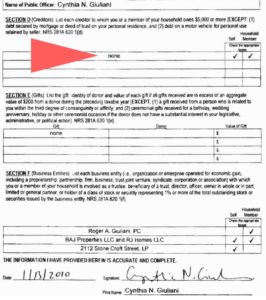
DID FAMILY COURT JUDGE COMMIT PERJURY BY FAILING TO DISCLOSE $2.5 MILLION OF LOANS IN DEFAULT?

February 7, 2018

Clark County Family Court Judge Cynthia N. Giuliani was elected November 4, 2008, officially taking the bench on January 5, 2009. Judge Giuliani was re-elected to the Eighth Judicial District Family Court in 2014. Her current term expires in January 2021.

Less than a year after taking the bench on January 5, 2009, Judge Giuliani and her husband, local Attorney Roger A. Giuliani, filed a Chapter 7 Bankruptcy petition on December 31, 2009, in Federal Court. According to their bankruptcy filing, the couple owed $2,579,954.65 on real estate holds worth $1,980,500.00. Their real estate holdings took a major hit when the market crashed in 2008. Most, if not all, of the properties, had loans which exceed the values by as much as 100% of the 2009 market values.

Clearly, the couple struggled in 2008 with more than eleven mortgage payments on properties underwater.

Every year Judges are required under Nevada law to submit a Financial Disclosure Statement, disclosing all their assets and liabilities including all creditors they owe money to. Judges must sign the FDS under penalty of perjury. Judge Giuliani’s FDS submitted on January 13, 2010, just 13 days after filing her Bankruptcy petition, failed to disclose the $2.5 million in debts she and her husband owed to over eleven different creditors. When a debtor files a Chapter 7 Bankruptcy petition, the debts are still valid for 90 days until the court discharges them. Many debts are not discharged automatically if the debtor has significant assets as did Judge Giuliani had.

As cited below on this page, Section D of the FDS requires “List each creditor to whom you or a member of your household owes $5,000 or more…”  Judge Giuliani wrote “None”. 

360Daily.net did reach out to Judge Giuliani for a statement but we never heard back.

Rob Lauer

Political Reporter

360Daily.net


Judge Giuliani’s BK Petition filed December 31, 2009 

giulianichapter7


Judge Giuliani’s Financial Disclosure Statement filed Jan 13, 2010 (thirteen days later)

0002010_Financial_Disclosure_Statement


January 13, 2010 Financial Disclosure Statement 

Comments from Ken Ditkowsky on article:
On 25 January 2018 4:15 PM, kenneth ditkowsky <kenditkowsky@yahoo.com> wrote:
Transparency is a word that is used solely to describe the attitude that others, other than the corrupt Political and Judicial elite are to exhibit.    You recalled that here in Illinois Jerome Larkin and the criminals he employees do not file the required FINANCIAL DISCLOSURE statements required of all public employees – ditto for some judges.  Our local law enforcement people even when confronted could care less — the criminal know exactly where their money may be and thus why should the public be kept in the dark as to DARK MONEY received by these public officials.
Would you expect anything different in Las Vegas.    Bankruptcy Fraud is a skill that a judge who is regularly on the edge (i.e. being caught for being ‘wired’) must learn and the advanced learning should be encouraged – not thwarted!
Frankly, under the ethical compact that is in force in Chicago, New York, Los Angeles, Vegas, etc EXPOSING JUDICIAL CORRUPTION is akin to “yelling fire in a crowded theater!”    Indeed, Lanre Amu received an interim suspension of his law license for comply with 18 USCA 4 and Rule 8.3  — The fact that his disclosure was echoed by CRAINS CHICAGO business publication may keep Mr. Amu from ever obtaining his law license.    He was caught practicing law while black!    According to the Illinois Lawyer Disciplinary Commission and the Supreme Court of Illinois exposing corruption is an ethically challenged activity and the 2nd oldest profession cannot and will not tolerate it.
Ms. Price is just following the law as dictated by the SWAMP!
I forwarded a copy of his e-mail to the certain law enforcement people and the White house.   obstruction of justice by public officials encompasses much more that aiding and abetting (18 USCA 371) the evasion of America’s immigration laws – it also encompasses local law enforcement people (and in particular judges and court personnel) giving special treatment to corrupt members of the Political and Judicial elite.    Maybe the DOJ can prosecute a few of these bureaucrats!

New book on Amazon about Probate/Disabled Abuse – A Breach of Trust-5 stars

You have a wonderful life. You’re running a business, have money in the bank and get to visit with all your friends and family whenever you like. Then one day you wake up to find someone shoving a pill down your throat in some lowdown nursing home situated in a dangerous part of the city. Without your permission, they’re liquidating your business and making all of your money disappear. You do whatever you can to try to get out of this nightmare, but discover the people who did this to you are simply too powerful. Think it can’t happen to you? Think again.

This is the true story of a newly licensed nursing facility administrator (LNFA) and the people she meets. The stories they tell her are both hard to believe and impossible to ignore. She begins investigating and the more layers she peels away, the worse it gets. Eventually, this leads to catastrophic consequences for three special people under her care. Can she repair the damage and stop the madness before it’s too late? Or are the forces against her too powerful?
A Breach of Trust exposes the weakest link in the freedoms we all hold dear. Cross the wrong line, say the wrong thing, and at any moment you too could be stripped naked and taken captive. It is for these three special friends and all the future victims that Susan Hodges offers this advice: whatever you do, don’t cross these people because soon, you might discover your life belongs to them now!

I have not read this book, but it has been rated 5 stars on 18 reviews.

Here is a dramatic trailer for the book.  The actress does a great job.

From EB: Michigan changes laws regarding predatory Realtors who prey on Estate homes, but how little, how late?

EB sent me this article on how Michigan is changing laws so that Realtors cannot open Decedents Estates quick and sell homes on the cheap causing heirs to take huge losses on the sale of homes owned by their deceased loved ones.

But note in the news stories, the Michigan officials admit they received a stream of stories over just how many years?

And how does giving notice and changing a waiting period to sell homes from 42 days to 63 days really help anyone when you know probate is a fixed game and a fixed sale and profits are only accessible to cronies of the wealthy and powerful.

I vote this a red herring, but watch for yourself.

7 Action News Investigation prompts probate law change, protects heirs


https://www.wxyz.com/news/local-news/investigations/7-action-news-investigation-prompts-probate-law-change-protects-heirs


A 7 Action News investigation has now changed the law in Michigan.  On Tuesday, Governor Rick Snyder signed the legislation that will increase protections in the law for heirs after a loved one dies.


Since November 2016, 7 Investigator Heather Catallo has been exposing several loopholes in the law that allowed real estate brokers and Attorney General-appointed lawyers called Public Administrators to open probate estates after a loved one dies. Catallo’s relentless reporting showed that Macomb County real estate broker Ralph Roberts and his company, Probate Asset Recovery, used that power from the courts to sell the homes and take thousands of dollars from the probate estates.


After the 7 Investigators exposed this, Attorney General Bill Schuette shut the practice down, and Schuette supported the changes to the law.

“Actions that came to light last year made it clear that now is the time to make changes to the public administration system,” said Schuette in a statement Tuesday. “What has happened in the system is unacceptable and these changes to an almost 40-year-old law will help ensure this never happens again. By creating a clear, current and direct path for public administrators to follow in the probate process we can better protect Michigan citizens and weed out any bad actors.”

Oakland County Sheriff’s detectives are also now conducting a criminal investigation into these practices.


In May 2017, Oakland County Treasurer Andy Meisner and Oakland County Clerk Lisa Brown brought together a bi-partisan group of lawmakers to close the loopholes.  Two bills sponsored by Rep. Jim Ellison (D-Royal Oak) and Rep. Jim Runestad (R-Highland Twp.) were signed into law Tuesday.


“We had the constant drum beat of stories that just got worse and worse that you chronicled, and I think that is major factor in why the legislature felt like ‘hey you know what, we need to deal with this one and we need to deal with it quickly,’” Meisner told Catallo.


Meisner is pleased the bills passed, especially since several probate judges and lawyers opposed the changes to the law.


“We reached out to the probate bench and to the bar, and solicited their input about it,” said Meisner. “Despite our reaching out, they didn’t connect with us, they didn’t provide any feedback – and then they submitted a letter before the committee hearing opposing the legislation… It reflects poorly on the probate bar and the judges that they came out against the legislation, and I hope in the future when they’re confronted with this sort of obvious wrong doing that they take the stand of the people.”


Here are more details from Public Act 13 of 2018:

-Heirs will now have 63 days instead of 42 days to open a probate estate, before a Public Administrator can open the estate;

-A formal hearing is now required for a Public Administrator to be appointed;

12CONTINUE READING

Copyright 2018 Scripps Media, Inc. All rights reserved. This material may not be published, broadcast, rewritten, or redistributed.

Print this article Back to Top

SHARE ARTICLE

From CT: Cook County’s first elected Filipina judge goes on trial on mortgage fraud charges

http://www.chicagotribune.com/news/local/breaking/ct-met-judge-mortgage-fraud-trial-20180205-story.html

What promises to be a mundane mortgage fraud trial filled with dry testimony from bankers about decade-old financial documents drew a standing room-only crowd to a federal courtroom in Chicago on Tuesday morning.

The reason? The defendant is a judge herself.

Cook County Associate Judge Jessica Arong O’Brien is the first sitting judge in years to face a jury on criminal charges at the Dirksen U.S. Courthouse.

O’Brien, 50, was accused of orchestrating a $1.4 million mortgage fraud scheme stemming from the purchase of two South Side properties when she was a lawyer and real estate agent a decade ago — long before she became the first Filipina elected to the county bench.

If convicted, O’Brien, who was reassigned to administrative duties following her indictment last year, would by law be forced to step down from her judgeship.

In opening statements Tuesday before U.S. District Judge Thomas Durkin, lawyers for both sides made no mention of O’Brien’s judicial position because it had nothing to do with the charges she’s facing.

Assistant U.S. Attorney Matthew Madden told jurors O’Brien lied at least four times on loan and refinancing applications for two investment properties she purchased in 2004 and 2005 when she was working as a lawyer for the Illinois Department of Revenue. She then made a profit by unloading the two homes in 2007 by paying kickbacks to a straw purchaser, Madden said.

In all, O’Brien pocketed at least $325,000 from the transactions, Madden said. She also caused losses to lenders after the straw purchaser defaulted on payments and the properties wound up in foreclosure, he said.

“She used lies to buy and sell these properties,” Madden said.

O’Brien’s attorney, Ricardo Meza, said in his opening remarks that O’Brien may have made some “mistakes” when reporting her income and financial affairs but that none of it was intentional.

“Mistakes are not fraud,” Meza said. “Whatever Jessica did, it was always done in good faith. If she made a mistake, she’s no different than anyone else.”

Meza also said prosecutors vastly overstated the amount of loss in the case.

“What happened here is the government got it wrong,” Meza said.

O’Brien was elected to the bench in 2012 as the first Filipina judge in Cook County and had most recently presided over a small-claims courtroom.

O’Brien, who is married to a judge, immigrated to the U.S. after high school and earned degrees in culinary arts and restaurant management, according to online biographies. She then made a career change and went to John Marshall Law School, graduating in 1998 and later serving on its board.

She was the first Asian elected president of the Women’s Bar Association of Illinois and also served on the board of governors for the Illinois State Bar Association. The judge also co-founded a foundation in 2008 that awards scholarships to law students from diverse backgrounds.

At the time of the alleged fraud, O’Brien was working as special assistant attorney general for the state Department of Revenue, where she also reportedly held the position of chief counsel to the Illinois Lottery. She also owned her own real estate company and worked part time as a loan originator for Amronbanc Mortgage Corp., records show.

Her co-defendant, Maria Bartko, was also working for Amronbanc and agreed to take part in the scheme, prosecutors said.

O’Brien allegedly used fraudulently obtained mortgage loan proceeds to buy an investment property in the 600 block of West 46th Street in Chicago and then lied on applications to refinance the mortgage on the property as well as on a second investment property in the 800 block of West 54th Street in Chicago.

Among the lies O’Brien told were listing her income as $81,000 in 2004 when in fact she was on maternity leave and made only $11,000 that year, Madden said.

The next year, O’Brien claimed in refinancing documents that her company, O’Brien Realty, took in at least $240,000 in profits in 2005, but tax returns showed only $21,000 in receipts, Madden said.

The indictment also alleges that O’Brien fraudulently obtained a $25,000 commercial line of credit to maintain the properties before selling them to Bartko and a straw buyer.

The deals closed on consecutive days in 2007, with O’Brien walking away “$100,000 richer” from the fraudulent transactions, Madden said.

Bartko, 50, of Streamwood, pleaded guilty last month to one count of mail fraud affecting a financial institution. She agreed to testify against O’Brien as part of her plea deal, but prosecutors have since said they do not intend to call her as a witness.

jmeisner@chicagotribune.com

Twitter @jmetr22b

RELATED:

Woman pleads guilty to mortgage fraud, agrees to testify against judge at trial »

Copyright © 2018, Chicago Tribune

From AP: Question: what can attorneys bill for or not bill for. How to dispute a legal bill

What attorneys can bill for (per billing rules at most large law firms):What attorneys can bill for (per billing rules at most large law firms):
Preparing pleadings 1 hour or $200 per page (attorneys should keep drafts day by day), depending on complexity.  Set a reasonable rate in advance with the attorney.
Put your attorney on a budget of expenditures per month or per task.
Legal Research:  Billing ok for:  Esoteric legal research .5 hrs to read a case, as long as cases are not unusually long .Attorneys should not bill for easy stuff they should already know like how to do an appeal brief, how to prepare a deed, how to prepare court forms, etc. Attorneys should save their list of cases they read if the client asks.
Reading or reviewing an email or pleading. Attorneys should only bill for actually writing a letter, motion or appeal brief and then it should only be 1/2 hour per page for routine motions (extension of time, motions to withdraw, etc.).  Disputing a will or trust will be more or for more complex pleadings.
Attorneys should not bill to write up an email and then call you to tell you the same stuff.  However, if you talk to an attorney, the attorney CAN bill you for confirming what was said during the conversation in a letter or email, and should make it clear in writing any important legal advice as to what to do or not to do.
No charges for secretarial time, organizing a file, making labels for a file, making a pleadings book, etc.  That should be built into overhead.  Overhead is not billable.
Travel time should not be charged, but waiting in court can be charged.  An attorney should try to have 2 or 3 motions calls per am or pm and then charge the client a proportionate share.  Say the attorney has 3 calls and starts at 9 am and leaves at 1 pm.  That’s 4 hours of work.  If s/he had 3 court calls, then each client can be billed 1.25.
Have an agreement on what, if anything, can be billed for travel time.  Argue that an attorney should not charge for travel time from a suburban building to a downtown court.
Duplicate bills.  Two bills for reviewing the same email, same correspondence by different attorneys or paralegals.
Reviewing correspondence that is not necessary to your case.  Reviewing case law not essential to your case or which is common to their field of law they should know updates on
Filing unnecessary pleadings to the case.  (Like updating a record on appeal over and over when documents are not clearly needed. These can be added as an exhibit)
If in doubt get a second opinion on your bills.
Late filed appearances should be a no no.  If your attorney takes a chunk of money (typically $3,000 to $10,000) to file an appearance, they should file their appearance right way.  If not, ask for the money back and hire another attorney.  Once you pay an attorney you should not have to dread opening up your mail to find another nasty, scathing letter from opposing counsel containing another bunch of ridiculous threats (such as taking your first born) that you don’t understand.  That’s your attorney’s job to take the stress off of you.
A pox on attorneys who take $5,000 and then don’t file an appearance for weeks on end and then at the last minute before a hearing.
A double pox on attorneys who take $5,000, don’t file an appearance for weeks, and then withdraw the day before a hearing and then you don’t even have money to hire another attorney for the hearing while they take their sweet time to return your money, or they dispute returning it with silly excuses.
A triple pox on attorneys at the disciplinary boards who you file complaints with, which are wholly ignored because they cover up for lying, cheating, scheming, dishonest attorneys that take your money and do nothing.
Other online articles on attorney billing
http://www.mylawcoach.com/my_weblog/2008/03/what-attorneys.html
https://www.timesolv.com/cant-attorneys-bill/

From KKD: Health care fraud needs more attention

On Sunday, February 4, 2018 9:49 PM, kenneth ditkowsky <kenditkowsky@yahoo.com> wrote:


A great number of problems exist and we have encouraged official corruption by making it very profitable.   The Health care industry has become the chosen profession of the corrupt political elite (and judicial elite) as there is so much money to steal.   The problem starts to dissipate if we start enforcing the laws as enacted by the sundry legislatures and start taxing the booty obtained by not only the miscreants, but those who cover up for them.
 
Let me give you an example.   Guardianship is a home grown industry.   Grab a elderly person and immediately you have two income sources – 1) the health care insurance – Federal and Insurance, and 2) the assets owned by the victim.   The guardian has a clear shot at the victim’s assets as the ‘wired’ court by rote approves all the accountings of the guardian, and by sharing (we call it kickback) health care providers are ready to jimmy bills and services to make then extremely profitable.   They add the 700% fraud penalty.   Everyone who matters profits.   The political machine in particular gets it share and work is provided for lawyers, judges, political hacks of all sizes and shapes etc.   The only losers do not complain – i.e. the victim (and her family) and the government (the government is used to being screwed).
 
The political people also profit by the fact that the 1 8 UsCA 371 co-conspirator (nursing home operator) makes certain that 100% of the residents VOTE for the dominant Political Party (usually the Democrats).   No one is embarrassed when 150 out of 150 residents VOTE for the same candidates – all of whom happen to be from the dominant political party election after election.     THIS IS A BIG DEAL!
 
This is the genesis of our problem.   A single patient housed in a nursing home can generate on the average a conservative profit of approximately $10,000 per month!   The profit can be enhanced by pharmaceutical charges — we have an opioid crisis — Medicare pays to get grandma addicted!   The IRS and the State Taxing organizations have not been bothering to collect the taxes interest and penalties due!    (Every co-conspirator has joint and several personal liability for the taxes!)  
 
The recent enforcement is encouraging – but it is still too slow!   The fraudsters are a major threat to America’s core values and as lethal as any other terrorists!      
  

From BL/FB; Protect this civil right attorney disbarred for protecting civil rights in divorce/custody cases

Sign the petition at:


This is the second petition that I have created for Civil Rights Attorney, Patricia Barry. Ms. Barry was unlawfully disbarred on June 30, 2017 and she is now suing the State Bar.  She has not engaged in any illegal or any kind of unethical misconduct. Ms. Barry was the attorney who successfully argued the first sexual harassment case in the United States Supreme Court in 1986. She is being discriminated against due to bias because she chooses to represent the protective parents which are mostly women/mothers who have been victims of domestic violence who are trying to protect their children from child abuse by the fathers. Ms. Barry has been under attack by the State Bar throughout her career (41 years) for “bucking the system” and taking action against the corruption and bias within our Family Law Courts and Child Protective Services (CPS). Let us ‘WE THE PEOPLE’ stand UNITED to fight the State Bar so that Pat Barry will have her license reinstated to practice law again. Thank you for your help and support in this very important and urgent matter. Pat has selected a few particular cases which explains the reasons for her disbarment.  Here are the following cases she has chosen to share:

WHEREAS, the California State Bar relied on three cases spanning a period of almost seventeen years to disbar Ms. Barry in all three of which she represented a domestic violence victim trying to regain custody of her children from their abuser, the father. The client did not complain to the Bar.

WHEREAS, FIRST OFFENSE, JULY 2000: CAROL MARDEUSZ sought ex parte order to regain custody of her daughter from the abuser LEO MAGERS. The mother was criminally prosecuted for doing so with Barry acting as co-counsel in Carol’s criminal case. Barry was held in contempt by Marin County Judge Verna Adams in July 2000. Judge Adams found Barry in contempt in part and put her in a jail cell because Barry stated in front of the jury that Mardeusz was a victim of domestic violence and for the prosecutor to stop badgering Mardeusz as she testified. The Bar waited five years and then in June 2005, the Bar ruled that the matter was not serious and issued only a private reproval. Then 16-1/2 years later, The Bar Review Court declared the matter serious and wanted Barry disbarred.

WHEREAS, The Bar indirectly and Judge Adams and prosecutor Vieira directly supported MAGERS, violent, alcoholic, drug addiction and his repeated DUI’s, along with arrests for felony child abuse, and possibly the murder of his wife. .

WHEREAS, OFFENSE NO. 2, 2002:  Barry represented DARLA ELWOOD in two federal civil rights law cases filed 2001 and 2002. Six years later the Bar prosecutor accused Barry of moral turpitude for filing frivolous lawsuits. Barry never knowingly filed a frivolous lawsuit in her 41 year career. The Prosecutor Tady knew this and did not dismiss for lack of probable cause in violation of his ethical duty.

WHEREAS, The Bar championed JOSEPH MORIN, father of two of Darla’s children. He is a child batterer (declarations of older children); a violent racist (Darryl Austin lawsuit) – called Darryl a “sand nigger” (he is Indian from Trinidad) while he beat him up, and Morin made a death threat against Darryl Austin and Morin paid a substantial settlement to Austin. Morin also made a death threat against a lesbian because of her sexual orientation and otherwise harassed her by stalking, carving threats on her door and other malicious acts. The woman obtained a two year restraining order against him. Barry signed a stipulation because she was trying to collect a judgment she had won in a jury trial for a black man who was impoverished, and she could not afford legal representation to fight the Bar case while she was trying to collect the $98,000 judgment for her client.
.
WHEREAS, OFFENSE NO. 3, 2009-present : Barry represents MICHELE FOTINOS and her two children RACHEL and AUSTIN in various lawsuits, both federal and state including a legal malpractice lawsuit against SAN MATEO ATTORNEY STEPHEN MONTALVO who had committed gross malpractice and fraud against Michele during her family law court proceeding in San Mateo County.

WHEREAS, The Bar and Supreme Court both want Barry disbarred because she did not pay discovery sanctions to Montalvo and judicial sanctions to San Mateo court. Barry did not have the money because Montalvo stole $70,000 from Michele and left her with no kids, no community property, and having to pay child support. Michele had no money to pay Barry.

WHEREAS, Montalvo has caused grave harm to Michele and her two children and to at least two other mothers and their children, including Susan Navratil and her daughter Sarah. The third mother has a Bar complaint pending against him. He has been sued for legal malpractice three times. The San Mateo judges and the Bar are protecting Montalvo who continues to live a wealthy lifestyle while disbarring Barry because she had no money to pay Montalvo discovery sanctions.

WHEREAS, The Bar also championed JOHN FOTINOS, Michele’s Ex husband; a violent, child battering felon with access to guns. The Bar forced Barry to defend the flier she used to get John Fotinos arrested and the 14 guns, 2 assault rifles, 10 high capacity magazines, and 10,000 rounds of live ammo in his possession confiscated. The San Mateo judges and District Attorney WAGSTAFFE who used to work for CURRENT BAR PRESIDENT JAMES FOX when he was the District Attorney let Fotinos off, and he walks free while Michele and Rachel are in hiding because San Mateo judges will not issue restraining order against Fotinos. He had threatened Rachel that her life would be over if she ever reported that he had guns which she did. Michele’s daughter showed the deputies where the guns were, and now Rachel is terrified that Fotinos will locate her and her mother and will kill them. Michele and her daughter Rachel remain in hiding.

THEREFORE, THE UNDERSIGNED respectfully request that the Supreme Court of California reinstate the license of PATRICIA BARRY so that she can continue to represent mothers and children who are victims of domestic violence and who have children that have suffered from abuse.

KRISTIN HANSON on behalf of Attorney, Patricia J. Barry

http://m.seattlepi.com/local/article/High-court-Abuse-victims-can-protect-their-kids-11256700.php?cmpid=fb-mobile – Article- High Court, Washington Supreme Court Rules that victims can protect their children from abuse, June 29, 2017.


From JP–More case law on Fraud on the Court and Void Judgments and how to attack them

http://www.abodia.com/t/law/files/Challenge-to-Jurisdiction.htm

Challenge to Jurisdiction

Federal Rules of Civil Procedure, Rule 60. Relief from Judgment or Order below


“Once jurisdiction is challenged, the court cannot proceed when it clearly appears that the court lacks jurisdiction, the court has no authority to reach merits, but, rather, should dismiss the action.” Melo v. US, 505 F2d 1026.

A judgment rendered by a court without personal jurisdiction over the defendant is void. It is a nullity. [A judgment shown to be void for lack of personal service on the defendant is a nullity.] Sramek v. Sramek, 17 Kan. App. 2d 573, 576-77, 840 P.2d 553 (1992), rev. denied 252 Kan. 1093 (1993).

“Court must prove on the record, all jurisdiction facts related to the jurisdiction asserted.” Latana v. Hopper, 102 F. 2d 188; Chicago v. New York, 37 F Supp. 150.

“The law provides that once State and Federal Jurisdiction has been challenged, it must be proven.” Main v. Thiboutot, 100 S. Ct. 2502 (1980).

“Jurisdiction can be challenged at any time.” and “Jurisdiction, once challenged, cannot be assumed and must be decided.” Basso v. Utah Power & Light Co., 495 F 2d 906, 910.

Defense of lack of jurisdiction over the subject matter may be raised at any time, even on appeal.” Hill Top Developers v. Holiday Pines Service Corp., 478 So. 2d. 368 (Fla 2nd DCA 1985)

“Once challenged, jurisdiction cannot be assumed, it must be proved to exist.” Stuck v. Medical Examiners, 94 Ca 2d 751. 211 P2d 389.

“There is no discretion to ignore that lack of jurisdiction.” Joyce v. US, 474 F2d 215.

“The burden shifts to the court to prove jurisdiction.” Rosemond v. Lambert, 469 F2d 416.

“A universal principle as old as the law is that a proceedings of a court without jurisdiction are a nullity and its judgment therein without effect either on person or property.” Norwood v. Renfield, 34 C 329; Ex parte Giambonini, 49 P. 732.

“Jurisdiction is fundamental and a judgment rendered by a court that does not have jurisdiction to hear is void ab initio.” In Re Application of Wyatt, 300 P. 132; Re Cavitt, 118 P2d 846.

“Thus, where a judicial tribunal has no jurisdiction of the subject matter on which it assumes to act, its proceedings are absolutely void in the fullest sense of the term.” Dillon v. Dillon, 187 P 27.

“A court has no jurisdiction to determine its own jurisdiction, for a basic issue in any case before a tribunal is its power to act, and a court must have the authority to decide that question in the first instance.” Rescue Army v. Municipal Court of Los Angeles, 171 P2d 8; 331 US 549, 91 L. ed. 1666, 67 S.Ct. 1409.

“A departure by a court from those recognized and established requirements of law, however close apparent adherence to mere form in method of procedure, which has the effect ofdepriving one of a constitutional right, is an excess of jurisdiction.” Wuest v. Wuest, 127 P2d 934, 937.

“Where a court failed to observe safeguards, it amounts to denial of due process of law, court is deprived of juris.” Merritt v. Hunter, C.A. Kansas 170 F2d 739.

“The fact that the petitioner was released on a promise to appear before a magistrate for an arraignment, that fact is circumstance to be considered in determining whether in first instance there was a probable cause for the arrest.” Monroe v. Papa, DC, Ill. 1963, 221 F Supp 685.

Read US v. Lopez and Hagans v. Levine both void because of lack of jurisdiction. In Lopez the circuit court called it right, and in Hagans it had to go to the Supreme court before it was called right, in both cases, void.

Challenge jurisdiction and motion to dismiss, right off the bat. If you read the Supreme Court cases you will find that jurisdiction can be challenged at any time and in the case of Lopez it was a jury trial which was declared void for want of jurisdiction. If it [jurisdiction] doesn’t exist, it can not justify conviction or judgment. …without which power (jurisdiction) the state CANNOT be said to be “sovereign.” At best, to proceed would be in “excess” of jurisdiction which is as well fatal to the State’s/ USA ‘s cause. Broom v. Douglas, 75 Ala 268, 57 So 860 the same being jurisdictional facts FATAL to the government’s cause ( e.g. see In re FNB, 152 F 64).


– – – –

       Federal Rules of Civil Procedure, Rule 60. Relief from Judgment or Order

>(b) Mistakes; Inadvertence; Excusable Neglect; Newly Discovered Evidence; Fraud, etc. On motion and upon such terms as are just, the court may relieve a party or a party’s legal representative from a final judgment, order, or proceeding for the following reasons: (1) mistake, inadvertence, surprise, or excusable neglect; (2) newly discovered evidence which by due diligence could not have been discovered in time to move for a new trial under Rule 59(b); (3) fraud (whether heretofore denominated intrinsic or extrinsic), misrepresentation, or other misconduct of an adverse party; (4) the judgment is void; (5) the judgment has been satisfied, released, or discharged, or a prior judgment upon which it is based has been reversed or otherwise vacated, or it is no longer equitable that the judgment should have prospective application; or (6) any other reason justifying relief from the operation of the judgment. The motion shall be made within a reasonable time, and for reasons (1), (2), and (3) not more than one year after the judgment, order, or proceeding was entered or taken. A motion under this subdivision (b) does not affect the finality of a judgment or suspend its operation. This rule does not limit the power of a court to entertain an independent action to relieve a party from a judgment, order, or proceeding, or to grant relief to a defendant not actually personally notified as provided in Title 28, U.S.C., Sec. 1655, or to set aside a judgment for fraud upon the court.

Writs of coram nobis, coram vobis, audita querela, and bills of review and bills in the nature of a bill or review, are abolished, and the procedure for obtaining any relief from a judgment shall be by motion as prescribed in these rules or by an independent action.

– – – – –

This rule does not limit the power of a court to entertain an independent action to relieve a party from a judgment, order, or proceeding, or to grant relief to a defendant not actually personally notified as provided in Title 28, U.S.C., § 1655or to set aside a judgment for fraud upon the court. Writs of coram nobis, coram vobis, audita querela, and bills of review and bills in the nature of a bill of review, are abolished, and the procedure for obtaining any relief from a judgment shall be by motion as prescribed in these rules or by an independent action. Where necessary parties in government have actual notice of suit, suffer no prejudice from technical defect in service, and there is justifiable excuse for failure to serve properly, courts should not construe rule 4 of these rules governing service so rigidly, or construe this rule governing relief from orders so narrowly, as to prevent relief from dismissal, especially where dismissal signals demise of all or some of plaintiff’s claims. Jordan v. U.S., C.A.D.C. 1982, 694 F.2d 833, 224 U.S.App.D.C. 267.   A liberal construction of this rule is particularly appropriate where equitable considerations are involved. Johnson Waste Materials v. Marshall, C.A.5 (Tex) 1980, 611 F.2d 593. This rule authorizing a court on motion to relieve a party or a legal representative from a final judgment or order for any reason justifying relief is to be liberally applied in a proper case, that is, in a case involving extraordinary circumstances or extreme hardship. U.S.S. v. Cirami, C.A.2 (N.Y) 1977, 563 F.2d 26, on remand 92 F.R.D. 483.   See, also, Marquette Corp. v. Priester, D.C.S.C.1964, 234 F.Supp. 799;U.S. v. $3,216.59 in U.S. Currency, D.C.S.C.1967, 41 F.R.D. 433. Subd. (b)(4) to (6) of this rule that court may relieve party from final judgment if it is void, if it is no longer equitable that judgment should have prospective application or for any other reason justifying relief from operation of judgment, is to be liberally construed to carry out purpose of avoiding enforcement of erroneous judgment. Blanchard v. St. Paul Fire & Marine Ins. Co., C.A.5 (Fla.) 1965, 341 F.2d 351, certiorari denied 86 S.Ct. 66, 382 U.S. 829, 15 L.Ed.2d 73.  This rule should be liberally construed for purpose of doing substantial justice. In re Hankins, N.D.Miss.1973, 367 F.Supp. 1370. See, also, Fackelman v. Bell, C.A.Ga.1977, 564 F.2d 734; Radack v. Norwegian America Line Agency, Inc., C.A.N.Y.1963, 318 F.2d 538; Triplett v. Azordegan, D.C.Iowa 1977, 478 F.Supp. 872; Tann v. Service Distributors, Inc., D.C.Pa.1972, 56 F.R.D. 593, affirmed 481 F.2d 1399. This rule establishing requirement for granting relief from a final judgment or order is to be given a liberal construction. U. S. v. One 1966 Chevrolet Pickup Truck, E.D.Tex.1972, 56 F.R.D. 4597. —- Void judgment clause: Although this rule providing for relief from judgment is not substitute for appeal and finality of judgments ought not be disturbed except on very narrow grounds, liberal construction should be given this rule to the end that judgments which are void or are vehicles of injustice not be left standing. Brennan v. Midwestern United Life Ins. Co., C.A.7 (Ind.) 1971, 450 F.2d 999, certiorari denied 92 S.Ct. 957, 405 U.S. 921, 30 L.Ed.2d 792.

A claim for relief from judgment on basis of “any other reason justifying relief from operation of the judgment” is cognizable where there is evidence of extraordinary circumstances or where there is evidence of extreme hardship or injustice, and, once extraordinary circumstances or hardship is found, this rule is to be liberally applied to accomplish justice. U. S. v. McDonald, N.D.Ill.1980, 86 F.R.D. 204.

Attorney’s motion for reconsideration on ground that court lacked jurisdiction to order him to pay court reporter could be entertained under rule governing relief from judgment and was not subject to time constraints of rule governing motion to amend judgment. U.S. v. 789 Cases of Latex Surgeon Gloves, C.A.1 (Puerto Rico) 1993, 13 F.3d 12

Void judgments are those rendered by a court which lacked jurisdiction, either of the subject matter or the partiesWahl v. Round Valley Bank 38 Ariz. 411, 300 P. 955 (1931); Tube City Mining & Milling Co. v. Otterson, 16 Ariz. 305, 146 P. 203 (1914); and Milliken v. Meyer, 311 U.S. 457, 61 S.Ct. 339, 85 L.Ed. 2d 278 (1940).

A void judgment which includes judgment entered by a court which lacks jurisdiction over the parties or the subject matter, or lacks inherent power to enter the particular judgment, or an order procured by fraud, can be attacked at any time, in any court, either directly or collaterally, provided that the party is properly before the courtLong v. Shorebank Development Corp., 182 F.3d 548 ( C.A. 7 Ill. 1999).

A void judgment is one which from the beginning was complete nullity and without any legal effect, Hobbs v. U.S. Office of Personnel Management,  485 F.Supp. 456 (M.D. Fla. 1980). Void judgment is one that, from its inception, is complete nullity and without legal effect, Holstein v. City of Chicago, 803 F.Supp. 205, reconsideration denied 149 F.R.D. 147, affirmed 29 F.3d 1145 (N.D. Ill 1992).

Void judgment is one where court lacked personal or subject matter jurisdiction or entry of order violated due process,  U.S.C.A. Const. Amend. 5 – Triad Energy Corp. v. McNell  110 F.R.D. 382 (S.D.N.Y. 1986).

Judgment is a void judgment if court that rendered judgment lacked jurisdiction of the subject matter, or of the parties, or acted in a manner inconsistent with due process, Fed. Rules Civ. Proc., Rule 60(b)(4), 28 U.S.C.A.; U.S.C.A. Const. Amend. 5 – Klugh v. U.S., 620 F.Supp. 892 (D.S.C. 1985).

A void judgment is one which, from its inception, was, was a complete nullity and without legal effect, Rubin v. Johns, 109 F.R.D. 174 (D. Virgin Islands 1985).

A void judgment is one which, from its inception, was a complete nullity and without legal effectLubben v. Selevtive Service System Local Bd. No. 27,  453 F.2d 645, 14 A.L.R. Fed. 298 (C.A. 1 Mass. 1972).

A void judgment is one which, from its inception, is and forever continues to be absolutely null, without legal efficacy, ineffectual to bind the parties or to support a right, of no legal force and effect whatever, and incapable of enforcement in any manner or to any degree – Loyd v. Director, Dept. of Public Safety, 480 So. 2d 577 (Ala. Civ. App. 1985).

A judgment shown by evidence to be invalid for want of jurisdiction is a void judgment or at all events has all attributes of a void judgmentCity of Los Angeles v. Morgan,  234 P.2d 319 (Cal.App. 2 Dist. 1951). Void judgment which is subject to collateral attack, is simulated judgment devoid of any potency because of jurisdictional defects Ward v. Terriere,  386 P.2d 352 (Colo. 1963).

A void judgment is a simulated judgment devoid of any potency because of jurisdictional defects only, in the court rendering it and defect of jurisdiction may relate to a party or parties, the subject matter, the cause of action, the question to be determined, or relief to be granted, Davidson Chevrolet, Inc. v. City and County of Denver, 330 P.2d 1116, certiorari denied 79 S.Ct. 609, 359 U.S. 926, 3 L.Ed. 2d 629 (Colo. 1958).

Void judgment is one entered by court without jurisdiction of parties or subject matter or that lacks inherent power to make or enter particular order involved and such a judgment may be attacked at any time, either directly or collaterally,  

People v. Wade,  506 N.W.2d 954 (Ill. 1987). Void judgment may be defined as one in which rendering court lacked subject matter jurisdiction, lacked personal jurisdiction or acted in manner inconsistent with due process of law Eckel v. MacNeal,  628 N.E. 2d 741 (Ill. App. Dist. 1993).

Void judgment is one entered by court without jurisdiction of parties or subject matter or that lacks inherent power to make or enter particular order involved; such judgment may be attacked at any time, either directly or collaterally

People v. Sales, 551 N.E.2d 1359 (Ill.App. 2 Dist. 1990). Res judicata consequences will not be applied to a void judgment which is one which, from its inception, is a complete nullity and without legal effect, Allcock v. Allcock 437 N.E. 2d 392 (Ill. App. 3 Dist. 1982).

Void judgment is one which, from its inception is complete nullity and without legal effect In re Marriage of Parks,  630 N.E. 2d 509 (Ill.App. 5 Dist. 1994). Void judgment is one entered by court that lacks the inherent power to make or enter the particular order involved, and it may be attacked at any time, either directly or collaterally; such a judgment would be a nullity People v. Rolland 581 N.E.2d 907, (Ill.App. 4 Dist. 1991).

Void judgment under federal law is one in which rendering court lacked subject matter jurisdiction over dispute or jurisdiction over parties, or acted in manner inconsistent with due process of law or otherwise acted unconstitutionally in entering judgment, U.S.C.A. Const. Amed. 5, Hays v. Louisiana Dock Co.,  452 n.e.2D 1383 (Ill. App. 5 Dist. 1983).

A void judgment has no effect whatsoever and is incapable of confirmation or ratificationLucas v. Estate of Stavos,  609 N. E. 2d 1114, rehearing denied, and transfer denied (Ind. App. 1 dist. 1993).

Void judgment is one that from its inception is a complete nullity and without legal effect Stidham V. Whelchel,  698 N.E.2d 1152 (Ind. 1998).

Relief form void judgment is available when trial court lacked either personal or subject matter jurisdiction,  Dusenberry v. Dusenberry,  625 N.E. 2d 458 (Ind.App. 1 Dist. 1993).

Void judgment is one rendered by court which lacked personal or subject matter jurisdiction or acted in manner inconsistent with due process, U.S.C.A. Const. Amends. 5, 14 Matter of Marriage of Hampshire,  869 P.2d 58 ( Kan. 1997).

Judgment is void if court that rendered it lacked personal or subject matter jurisdiction; void judgment is nullity and may be vacated at any time, Matter of Marriage of Welliver, 869 P.2d 653 (Kan. 1994).

A void judgment is one rendered by a court which lacked personal or subject matter jurisdiction or acted in a manner inconsistent with due process In re Estate of Wells, 983 P.2d 279, (Kan. App. 1999).

Void judgment is one rendered in absence of jurisdiction over subject matter or parties 310 N.W. 2d 502, (Minn. 1981). A void judgment is one rendered in absence of jurisdiction over subject matter or parties, Lange v. Johnson, 204 N.W.2d 205 (Minn. 1973).

A void judgment is one which has merely semblance, without some essential element, as when court purporting to render is has no jurisdictionMills v. Richardson, 81 S.E. 2d 409, (N.C. 1954).

A void judgment is one which has a mere semblance, but is lacking in some of the essential elements which would authorize the court to proceed to judgment,  Henderson v. Henderson, 59 S.E. 2d 227, (N.C. 1950).

Void judgment is one entered by court without jurisdiction to enter such judgment,  State v. Blankenship  675 N.E. 2d 1303, (Ohio App. 9 Dist. 1996).

Void judgment, such as may be vacated at any time is one whose invalidity appears on face of judgment roll, Graff v. Kelly, 814 P.2d 489 (Okl. 1991). A void judgment is one that is void on face of judgment roll, Capital Federal Savings Bank v. Bewley, 795 P.2d 1051 (Okl. 1990).

Where condition of bail bond was that defendant would appear at present term of court, judgment forfeiting bond for defendant’s bail to appear at subsequent term was a void judgment within rule that laches does not run against a void judgment  Com. V. Miller,  150 A.2d 585 (Pa. Super. 1959).

A void judgment is one which shows upon face of record a want of jurisdiction in court assuming to render the judgment,  Underwood v. Brown,  244 S.W. 2d 168 (Tenn. 1951).

A Void judgment is one which shows upon face of record want of jurisdiction in court assuming to render judgment, and want of jurisdiction may be either of person, subject matter generally, particular question to be decided or relief assumed to be given,  State ex rel. Dawson v. Bomar,  354 S.W. 2d 763, certiorari denied, (Tenn. 1962).

A void judgment is one in which the judgment is facially invalid because the court lacked jurisdiction or authority to render the judgment, State v. Richie,  20 S.W.3d 624 (Tenn. 2000).

A void judgment is one which shows on face of record the want of jurisdiction in court assuming to render judgment, which want of jurisdiction may be either of the person, or of the subject matter generally, or of the particular question attempted to decided or relief assumed to be given,  Richardson v. Mitchell, 237 S.W. 2d 577, (Tenn.Ct. App. 1950).

Void judgment is one which has no legal force or effect whatever, it is an absolute nullity, its invalidity may be asserted by any person whose rights are affected at any time and at any place and it need not be attacked directly but may be attacked collaterally whenever and wherever it is interposed City of Lufkin v. McVicker,  510 S.W. 2d 141 (Tex. Civ. App. – Beaumont 1973).

A void judgment, insofar as it purports to be pronouncement of  court, is an absolute nullity, Thompson v. Thompson,  238 S.W.2d 218 (Tex.Civ.App. – Waco 1951).

void judgment is one that has been procured by extrinsic or collateral fraud or entered by a court that did not have jurisdiction over the subject matter or the parties.” Rook v. Rook, 233 Va. 92, 95, 353 S.E.2d 756, 758 (1987)

A void judgment is a judgment, decree, or order entered by a court which lacks jurisdiction  of the parties or of the subject matter, or which lacks the inherent power to make or enter the particular order involved State ex rel. Turner v. Briggs, 971 P.2d 581 (Wash. App. Div. 1999).

A void judgment or order is one that is entered by a court lacking jurisdiction over the parties or the subject matter, or lacking the inherent power to enter the particular order or judgment, or where the order was procured by fraudIn re Adoption of E.L.,  733 N.E.2d 846, (Ill.App. 1 Dist. 2000). Void judgments are those rendered by court which lacked jurisdiction, either of subject matter or parties,  Cockerham v. Zikratch,  619 P.2d 739 (Ariz. 1980).

Void judgments generally fall into two classifications, that is, judgments where there is want of jurisdiction of person or subject matter, and judgments procured through fraud, and such judgments may be attacked directly or collaterally,  Irving v. Rodriquez,  169 N.E.2d 145, (Ill.app. 2 Dist. 1960). Invalidity need to appear on face of judgment alone that judgment or order may be said to be intrinsically void or void on its face, if lack of jurisdiction appears from the record Crockett Oil Co. v. Effie,  374 S.W.2d 154 ( Mo.App. 1964).

Decision is void on the face of the judgment roll when from four corners of that roll, it may be determined that at least one of three elements of jurisdiction was absent: (1) jurisdiction over parties, (2) jurisdiction over subject matter, or (3) jurisdictional power to pronounce particular judgment hat was rendered, B & C Investments, Inc. v. F & M Nat. Bank & Trust, 903 P.2d 339 (Okla. App. Div. 3, 1995). Void order may be attacked, either directly or collaterally, at any time In re Estate of Steinfield, 630 N.E.2d 801, certiorari denied, See also Steinfeld v. Hoddick, 513 U.S. 809, (Ill. 1994).

Void order which is one entered by court which lacks jurisdiction over parties or subject matter, or lacks inherent power to enter judgment, or order procured by fraud, can be attacked at any time, in any court, either directly or collaterally, provided that party is properly before court,  People ex rel. Brzica v. Village of Lake Barrington, 644 N.E.2d 66 (Ill.App. 2 Dist. 1994).

While voidable orders are readily appealable and must be attacked directly, void order may be circumvented by collateral attack or remedied by mandamus,  Sanchez v. Hester,  911 S.W.2d 173, (Tex.App. – Corpus Christi 1995). Arizona courts give great weight to federal courts’ interpretations of Federal Rule of Civil Procedure governing motion for relief from judgment in interpreting identical text of Arizona Rule of Civil Procedure,  Estate of Page v. Litzenburg, 852 P.2d 128, review denied (Ariz.App. Div. 1, 1998).

When rule providing for relief from void judgments is applicable, relief is not discretionary matter, but is mandatory, Orner v. Shalala,  30 F.3d 1307, (Colo. 1994).

Judgments entered where court lacked either subject matter or personal jurisdiction, or that were otherwise entered in violation of due process of law, must be set aside Jaffe and Asher v. Van Brunt, S.D.N.Y.1994. 158 F.R.D. 278.

A  “void” judgment as we all know, grounds no rights, forms no defense to actions taken thereunder, and is vulnerable to any manner of collateral attack (thus here, by ).

No statute of limitations or repose runs on its holdings, the matters thought to be settled thereby are not res judicata, and years later, when the memories may have grown dim and rights long been regarded as vested, any disgruntled litigant may reopen the old wound and once more probe its depths. And it is then as though trial and adjudication had never been. 10/13/58 FRITTS v. KRUGH. SUPREME COURT OF MICHIGAN, 92 N.W.2d 604, 354 Mich. 97.

On certiorari this Court may not review questions of fact. Brown v. Blanchard, 39 Mich 790. It is not at liberty to determine disputed facts (Hyde v. Nelson, 11 Mich 353), nor to review the weight of the evidence. Linn v. Roberts, 15 Mich 443; Lynch v. People, 16 Mich 472. Certiorari is an appropriate remedy to get rid of [({a  void judgment one which there is no evidence to sustain.})] Lake Shore & Michigan Southern Railway Co. v. Hunt, 39 Mich 469. 

In Stoesel v. American Home,  362 Sel. 350, and 199 N.E. 798 (1935), the court ruled and determined that, “Under Illinois Law and Federal Law, when any officer of the Court has committed “fraud on the Court”, the order and judgment of that court are void and of no legal force and effect.” In Sparks v. Duval County Ranch, 604 F.2d 976 (1979), the court ruled and determined that, “No immunity exists for co-conspirators of judge. There is no derivative immunity for extra-judicial actions of fraud, deceit and collusion.”  In Edwards v. Wiley,  374 P.2d 284, the court ruled and determined that, “Judicial officers are not liable for erroneous exercise of judicial powers vested in them, but they are not immune from liability when they act wholly in excess of jurisdiction.” See also,  Vickery v. Dunnivan,  279 P.2d 853, (1955). In Beall v. Reidy,  457 P.2d 376, the court ruled and determined, “Except by consent of all parties a judge is disqualified to sit in trial of a case if he comes within any of the grounds of disqualification named in the Constitution. In Taylor v. O’Grady,  888 F.2d 1189, 7th Cir. (1989), the circuit ruled, “Further, the judge has a legal duty to disqualify, even if there is no motion asking for his disqualification.”  Also, when a lower court has no jurisdiction to enter judgment, the question of jurisdiction may be raised for the first time on appeal. See DeBaca v. Wilcox,  68 P. 922.  The right to a tribunal free from bias and prejudice is based on the Due Process Clause. Should a judge issue any order after he has been disqualified by law, and if the party has been denied of any of his/her property, then the judge has engaged in the crime of interference with interstate commerce; the judge has acted in his/her personal capacity and not in the judge’s judicial capacity. See U.S. v. Scinto,  521 F.2d 842 at page 845, 7th circuit, 1996. Party can attack subject matter jurisdiction at anytime in the proceeding, even raising jurisdiction for the first time on appeal, State v. Begay,  734 P.2d 278.  “A prejudiced, biased judge who tries a case deprives a party adversely affected of due process.” See Nelson v. Cox,  66 N.M. 397.

There is no time limit when a judgment is void:

       Precision Eng. V. LPG, C.A. 1st (1992) 953 F.2d 21 at page 22, Meadows v. Dominican Republic CA 9th (1987) 817 F.2d at page 521, In re: Center Wholesale, Inc. C.A. 10th (1985) 759 F.2d 1440 at page 1448, Misco Leasing v. Vaughn CA 10th  (1971) 450 F.2d 257, Taft v. Donellen C.A. 7th (1969) 407 F.2d 807, and Bookout v. Beck CA 9th (1965) 354 F.2d 823. See also, Hawkeye Security Ins. V. Porter, D.C. Ind. 1982, 95 F.R.D. 417, at page 419, Saggers v. Yellow Freight D.C. Ga. (1975) 68 F.R.D. 686 at page 690, J.S. v. Melichar D.C. Wis. (1972) 56 F.R.D. 49, Ruddies v. Auburn Spark Plug. 261 F. Supp. 648, Garcia v. Garcia, Utah 1986 712 P.2d 288 at page 290, and Calasa v. Greenwell, (1981) 633 P.2d 555 at page 585, 2 Hawaii395.   “Judgment was vacated as void after 30 years in entry,” Crosby. V. Bradstreet, CA 2nd (1963)  312 F.2d 483 cert. denied 83 S.Ct. 1300, 373 US 911, 10 L. Ed. 2.d 412.  “Delay of 22 years did not bar relief,” U.S. v. Williams, D.C. Ark. (1952) 109 F.Supp. 456.

– – – – –

>A motion to set aside a judgment as void for lack of jurisdiction is not subject to the time limitations of Rule 60(b). See Garcia v. Garcia, 712 P.2d 288 (Utah 1986).

>A judgment is void, and therefore subject to relief under Rule 60(b)(4), only if the court that rendered judgment lacked jurisdiction or in circumstances in which the court’s action amounts to a plain usurpation of power constituting a violation of due process. United States v. Boch Oldsmobile, Inc., 909 F.2d 657, 661 (1st Cir. 1990)

>Where Rule 60(b)(4) is properly invoked on the basis that the underlying judgment is void, “‘relief is not a discretionary matter; it is mandatory.'” Orner v. Shalala, 30 F.3d 1307, 1310 (10th Cir. 1994) (quoting V.T.A., Inc. v. Airco, Inc., 597 F.2d 220, 224 n.8 (10th Cir. 1979)).

>In order for a judgment to be void, there must be some jurisdictional defect in the court’s authority to enter the judgment, either because the court lacks personal jurisdiction or because it lacks jurisdiction over the subject matter of the suit. Puphal v. Puphal, 105 Idaho 302, 306, 669 P.2d 191, 195 (1983); Dragotoiu, 133 Idaho at 647, 991 P.2d at 379.

>A court may not render a judgment which transcends the limits of its authority, and a judgment is void if it is beyond the powers granted to the court by the law of its organization, even where the court has jurisdiction over the parties and the subject matter. Thus, if a court is authorized by statute to entertain jurisdiction in a particular case only, and undertakes to exercise the jurisdiction conferred in a case to which the statute has no application, the judgment rendered is void. The lack of statutory authority to make particular order or a judgment is akin to lack of subject matter jurisdiction and is subject to collateral attack. 46 Am. Jur. 2d, Judgments § 25, pp. 388-89.

>”A court cannot confer jurisdiction where none existed and cannot make a void proceeding valid. It is clear and well established law that a void order can be challenged in any court”, OLD WAYNE MUT. L. ASSOC. v. McDONOUGH, 204 U. S. 8, 27 S. Ct. 236 (1907).

>”Jurisdiction, once challenged, cannot be assumed and must be decided.” Maine v Thiboutot 100 S. Ct. 250.

>”The law requires proof of jurisdiction to appear on the record of the administrative agency and all administrative proceedings.” Hagans v Lavine 415 U. S. 533.

Though not specifically alleged, defendant’s challenge to subject matter jurisdiction implicitly raised claim that default judgment against him was void and relief should be granted under Rule 60(b)(4). Honneus v. Donovan, 93 F.R.D. 433, 436-37 (1982), aff’d, 691 F.2d 1 (1st Cir. 1982).

>”A judgment is void if the court acted in a manner inconsistent with due process. A void judgment is a nullity and may be vacated at any time.” 261 Kan. at 862.

>A judgment obtained without jurisdiction over the defendant is void. Overby v. Overby , 457 S.W.2d 851 (Tenn. 1970).

>Although Rule 60(b)(4) is ostensibly subject to the “reasonable” time limit of Rule 60(b), at least one court has held that no time limit applies to a motion under the Rule 60(b)(4) because a void judgment can never acquire validity through laches. See Crosby v. Bradstreet Co., 312 F.2d 483 (2nd Cir.) cert. denied, 373 U.S. 911, 83 S.Ct. 1300, 10 L.Ed.2d 412 (1963) where the court vacated a judgment as void 30 years after entry. See also Marquette Corp. v. Priester, 234 F.Supp. 799 (E.D.S.C.1964) where the court expressly held that clause Rule 60(b)(4) carries no real time limit.

Challenge to Jurisdiction

Challenging jurisdiction is one of the best defenses you can make, because if you use the right argument it is almost impossible for you to loose!

If they attempt to tell you that you can’t question their jurisdiction you can easily shut them up with these court rulings!

Are we on the record? I don’t say anything further until we are.

Where is the competent fact witness? Where is the damaged party?

Who brings the claimWho is underwriting this action?

As a man, as an accused by law, I come with the presumption of innocent and I can go with that.

Hey, as keeper of the records for the thing, I’m willing to plead the defendant guilty upon validated proof of claim.

Where is the Form 1099OID?

Who are you people and why do you deem yourselves better than me?

Equality under the Law is paramount and mandatory by law.

I am unrepresented, I don’t “do Attorneys” as I have found them to be injurious to my freedom, life, liberty and pursuit of happiness.

Am I under arrest or am I free to go?

I am a man, not a corporation or a legal “person” nor am I a surety for one.

I am a man. I am competent. I am here under duress. I do not consent to this matter.

I reserve all rights at all times in all places and I waive no rights at any time or in any place. I do waive benefit privilege.

If I am here at all, I am here in special appearance to challenge jurisdiction and to have this matter dismissed.

I see a yellow fringe around your flag which clearly advertises “admiralty matters settled here” – so again I say, where is the contract?

Where is the contract wherein I knowingly and willingly, with full disclosure, consented or otherwise agreed to be treated this way?

I believe this court lacks a jurisdiction. I want to see the supposed jurisdiction that was duly placed into evidence.

Can this court move on facts not in evidence ?

I do not understand the nature and cause of the accusation with regard to the elements of personal jurisdiction, venue, underwriting and the nature of the action until the prosecution properly alleges them.

I cannot rebut an unstated presumption.

I am therefore unable to plea to the charges until I have had an opportunity to raise a meaningful defense against the elements.


From the NLJ: More diversity demanded in SCOTUS law clerk positions

https://www.law.com/nationallawjournal/sites/nationallawjournal/2018/02/01/minority-attorneys-take-a-closer-look-at-the-scotus-diversity-dearth/?kw=Minority%20Attorneys%20Take%20a%20Closer%20Look%20at%20the%20SCOTUS%20Clerk%20Diversity%20Dearth&et=editorial&bu=National%20Law%20Journal&cn=20180202&src=EMC-Email&pt=Afternoon%20Update

I’m sure this comes a no shock to anyone, but law clerks for the US Supreme Court are demanding more diversity.  Few persons of color have that job.  Too few women are selected still when law schools are 50% male.

Read on for an interesting article on the issue:

Justices of the U.S. Supreme Court pose for a formal group photograph in the East Conference Room of the Supreme Court in Washington, D.C., U.S., on Thursday, June 1, 2017.

U.S. Supreme Court justices should step up and state publicly that they want greater diversity among their law clerks, said Howard University School of Law Dean Danielle Holley-Walker.

“The first step,” Holley-Walker, a Harvard Law alum, said, “is always to say, ‘This is something that is important to us. We want to see a change happen and we are committed to taking steps to make a difference in terms of the makeup of our clerks.’ That is not something that I’ve heard expressed by many of the justices.”

Holley-Walker made the statement in response to The National Law Journal’s research, first released in December, on the persistent dearth of minority law clerks at the nation’s highest court.

NLJ research found that since 2005—when the Roberts court began—85 percent of all law clerks have been white. Only 20 of the 487 clerks hired by justices were African-American, and nine were Hispanic. Twice as many men as women gain entry, even though as of last year, more than half of all law students are female.

Former clerks have their pick of top-tier job offers and can command $350,000 law firm hiring bonuses. Four current justices were formerly clerks at the court—a record number, as are the general counsel of Apple Inc. and Facebook Inc. For aspiring appellate litigators and academics, a Supreme Court clerkship opens the creakiest doors.

But this term, of the 36 clerks hired by sitting justices this term, only one is African-American, two are Hispanic and three are Asian-Americans, based on the NLJ research.

Some prominent minority lawyers have commented on why the numbers are so low, and what the court and others involved in clerkship recruiting should do about it.

“It’s an uncomfortable topic for all of us in the bar, in the courts, law professors and the like because we all bear some of that responsibility for what these numbers are,” said Neal Katyal, a partner at Hogan Lovells. “I don’t think this conversation should be about blaming nine justices. Katyal, a Yale Law School graduate, clerked for Justice Stephen Breyer. A former acting solicitor general, Katyal, who is Asian-American, shared his thoughts in a December podcast about law clerk diversity hosted by The National Law Journal.

Crystal Nix-Hines, a partner at Quinn EmanuelUrquhart & Sullivan, Harvard Law School alum and a former clerk for Justice Thurgood Marshall, agreed.

“I think there’s a broader systemic problem. It starts in law school or perhaps even earlier,” said Nix-Hines, who is African-American. “If you’re not at a great law school, and you’re not on the law review, or at the top of your class, or known to a feeder professor or judge, the chances of getting a Supreme Court clerkship are pretty slim.”

The low numbers span the court’s ideological spectrum. Since Chief Justice John Roberts Jr. joined the court in 2005, just 8 percent of the law clerks he’s hired have been racial or ethnic minorities. Only 12 percent of the clerks hired by Justice Ruth Bader Ginsburg and Justice Clarence Thomas since 2005 were minorities. Ginsburg has hired only one African-American clerk since she joined the high court in 1993, and the same goes for Justice Samuel Alito Jr., who became a justice in 2006.

By contrast, more than 30 percent of Justice Sonia Sotomayor’s clerks have been nonwhite, making her chambers the most diverse among those justices who have been on the court for more than a year. (Justice Neil Gorsuch has hired seven clerks so far over two terms, three of whom are nonwhite, for a total of 43 percent.)

Holley-Walker, who is African-American, said justices and feeder judges need to cast their net wider to achieve a diverse class of clerks. “If you only hire from one or two law schools or at the most, five law schools, and those schools only have a certain number of diverse graduates every year, then you’re really cutting down on the number of potentially diverse clerks that you could hire,” said Holley-Walker, who noted that only one student from Howard Law, a historically black institution, has ever served as a Supreme Court clerk. James McCollum Jr., a Howard graduate, clerked for now-retired Justice John Paul Stevens in 1984 and 1985.

Since 2005, Breyer, Ginsburg, Elena Kagan and Anthony Kennedy have hired 10 percent or fewer of their clerks from law schools outside the U.S. News & World Report Top 10. The late Justice Antonin Scalia hired just a single graduate from a school outside the top 10 during that period.

Harvard and Yale law schools have tightened their grip on the clerk “market,” providing half of the court’s law clerks since 2005, compared to 40 percent in 1998.

As one possible resource to diversify clerk ranks, Holley-Walker pointed to Just the Beginning Foundation, formed by African-American federal judges to connect minority and other students with the law and judges.

Holley-Walker said she was surprised to learn from the NLJ stories that liberal Justice Ginsburg has hired only one African-American law clerk since she joined the high court in 1993.

“It was surprising because we know that she has a deep commitment to diversity and inclusion in terms of women and also people of color,” Holley-Walker said. “I don’t doubt her commitment at all.”

In terms of gender diversity, Ginsburg and Breyer have hired men and women in equal numbers. In contrast, other chambers continue to be male-dominated. For instance, Kennedy, has hired six times as many men as women law clerks since 2005. And Gorsuch, in his second term, has hired just one female law clerk.

“The justices, and the legal profession as a whole, should aspire to be as intentional as Justice Stephen Breyer, who has hired more black clerks than any other justice and as many women as men. This doesn’t just happen,” said Yolanda Young, a Georgetown University Law Center alum who heads Lawyers of Color, a nonprofit devoted to promoting diversity in the legal profession. Young is African-American.

For Katyal, knowledge also makes a difference. He said he was among minority law students who arrived at law school not knowing the shortcuts to clerkships—such as becoming a research assistant to a well-connected professor. Students need that information early in their time at law school.

Another factor is financial, Katyal said. Students of all backgrounds with student loan debt may find law firm salaries more attractive than the $79,720 salary of U.S. Supreme Court law clerks.

“As I talk to minority student groups across the country, I get that question a lot which is ‘How can I afford [clerkships]?’” Katyal said. “The last thing we should do is be having people pull their punches just because of money.”

Lisa Helem contributed to this story.

From LockHimUpNow: Interesting history of term “Boycott”

From an email I received today:

Where did the term boycott originate? One of the first examples (although there were boycotts earlier; they just weren’t called boycotts yet) involved Charles Cunningham Boycott (March 12, 1832 – June 19, 1897). Boycott was an English land agent who was ignored and ostracized by his Mayo Irish community in Ireland after treating them badly. In fact, he was so bad that they named the action after him.
(A message from our sponsor:)
After Boycott retired from the British Army, he worked as a land agent for Lord Erne, a major landowner in the Lough Mask area of County Mayo who lived off the exorbitant rents he charged tenants. Evictions by Boycott were many, and bloody. In 1880, Boycott’s opponents Charles Stewart Parnell and the Land League campaigned for the Three Fs (fair rent, fixity of tenure, and free sale) and in opposition to evictions. When Boycott set about evicting 11 tenants, the Mayo branch of the Irish Land League urged Boycott’s employees to withdraw their labor, and began a campaign of isolation against Boycott in the local community. The nearby shops in Ballinrobe refused to serve him, people quit working for him, and Boycott found himself a marked man. Boycott was furious and made a crucial mistake: he complained to the London media. If he had kept his mouth shut he might have been fine, but now it was a story, and the boycott campaign became a YUGE issue. Here is his complaint:
“Sir, The following detail may be interesting to your readers as exemplifying the power of the Land League. On the 22nd September a process-server, escorted by a police force of seventeen men, retreated to my house for protection, followed by a howling mob of people, who yelled and hooted at the members of my family.
“On the ensuing day, September 23rd, the people collected in crowds upon my farm, and some hundred or so came up to my house and ordered off, under threats of ulterior consequences, all my farm labourers, workmen, and stablemen, commanding them never to work for me again.
“My blacksmith has received a letter threatening him with murder if he does any more work for me, and my laundress has also been ordered to give up my washing…The shopkeepers have been warned to stop all supplies to my house, and I have just received a message from the postmistress to say that the telegraph messenger was stopped and threatened on the road when bringing out a message to me and that she does not think it safe to send any telegrams…I can get no workmen to do anything, and my ruin is openly avowed as the object of the Land League unless I throw up everything and leave the country. I say nothing about the danger to my own life, which is apparent to anybody who knows the country.”
The story exploded in the media. About 50 Ulster Loyalists volunteered to come to Boycott’s aid and bring in his crops. Then it went international. The Brooklyn Eagle reported on November 9, 1880:
“Four troops of Hussars were dispatched hence for Ballinrobe by special trains at 2 o’clock this morning. Four hundred infantry have just arrived at Ballinrobe and will encamp near Lough Mask.
“These precautions are taken in view of the intention of the Northern Orangemen to send laborers to harvest the crops of Mr. Boycott, Lord Erne’s agent, for whom the local peasantry, at the instigation of the Land League, refuse to work. The Government will protect a moderate force of laborers, but refuse to furnish anything approaching armed demonstrations, which would certainly provoke a collision.”
All of this led to a ridiculous scene. Dozens of reporters rushed to the West of Ireland to report on 50 men harvesting crops surrounded by a regiment of the 19th Royal Hussars and more than 1,000 men of the Royal Irish Constabulary.
Cost to guard harvesters: £10,000
Profit from harvest: £500
The fact that an armed thug for a greedy landowner is ostracized to the point that the “boycott” is named after him: Priceless
Charles Boycott got out of town, clearly an unwelcome member of the community. He left Ireland on December 1, 1880, in disgrace, his name forever attached to a campaign to bring down tyrants. In 1886, Boycott became a land agent for Hugh Adair’s Flixton estate in Suffolk. He died at the age of 65 on June 19, 1897, in his home in Flixton, after an illness earlier that year. His name lives on, in infamy, forever.
The practice of boycotting spread and gave the peasants bargaining power. By the end of 1880, Irish peasants were boycotting all over Ireland, as the Land League implemented one of the most successful non-violent actions against unfair conditions and oppressive landowners in the world’s history.
Boycotting is effective. It is easy to feel powerless when we are under the rule of tyrants, but we will not be subjugated. As Resisters, it is our duty to use every tool at our disposal so that when the history is written we will have shown that we fought back, we would not lay down, we would not capitulate.

From KKD: How is it that Justice Connors completely ignores jurisdiction in the Sykes case, but can write up a full decision in support of the 5th Amendment for another case. Unbelievable.

Amazingly, Justice Maureen Connors writes up a decision dismissing a case based upon lack of jurisdiction, but ignored service upon Mary Sykes in 09 P 4585

Johnson v. Platas, 2016 IL App (1st) 143468-U (Ill. App., 2016)  see http://www.illinoiscourts.gov/r23_orders/AppellateCourt/2016/1stDistrict/1143468_R23.pdf


And how is this a “rule 23” decision that is not supposed to be cited.  Now attorneys in Illinois cannot cite cases that fully support the 5th Amendment?  I believe that violates the First Amendment.  Rule 23 is clearly unconstitutional under the First Amendment.

This Johnson case that Attorney Denison refers is particularly galling as Justice Connors openly and notoriously ignored the jurisdictional requirements in the Mary Sykes case 09 P 4585 and Jerome Larkin, using the power of his office as administrator of the Illinois Attorney Registration and Disciplinary Commission attempted to silence protest.   
 
ELDER CLEANSING/HUMAN TRAFFICKING is today a major business in the UNITED STATES.   The Political and Judicial elite use organizations such as the attorney disciplinary commissions to silence lawyers (Rule 8.3 and 18 USCA 4 notwithstanding).   The media is dead silence, and law enforcement impotent as they can ferret out the criminals who commit these dastardly crimes by judges (some corrupt and easily influenced by a share of wealth) are required to prosecute them.    Using opioids and other chemicals to turn healthy vibrant senior citizens into zombies thousand upon thousands of VOTES are delivered to political fiefdoms by “nursing home operators” and whole elections are turned.  
 
 Corruption is un-American!    


From DH: A letter to the Illinois ATG on corruption in the Illinois courts and a quote from Judge Brandeis

“The government is the potent omnipresent teacher. For good or ill it teaches the whole people by its example. Crime is contagious. If the government becomes a lawbreaker, it breeds contempt for law; it invites every man to become a law unto himself; it invites anarchy. To declare that the end justifies the means — to declare that the government may commit crimes — would bring terrible retribution.”  Judge Louis Brandeis, Olmstead v. US 277 US 438.

From DTH, regarding the estate of his father in Cook County Illinois, DH:

This is a letter in response to an assistant states attorney from the offices of Lisa Madigan advising me that my complaints against the Probate Court and its staff would not be investigated or prosecuted because they don’t do that.

If not the Attorney General of Illinois, then who will stop these crimes against me and other innocent Illinois citizens?

Dear Mr. Matulis;

This is in response to your assertion that the Attorney General of Illinois (Lisa Madigan) has no jurisdiction to investigate or prosecute public corruption or crimes committed by court staff, the clerk of court’s offices and judges and Cook County Sheriff’s department employees.

I vehemently and assiduously beg to differ with this assertion of yours.

You told me my only relief lies with the Illinois JIB. (Judicial Inquiry Board)

However, the Illinois JIB rarely prosecutes cases. Thousands of grievances against judges are filed each year in Illinois but only less than .5 percent result in any discipline.

In this case, Judge O’Malley changed a docket date to deny me my hearing. She did it in a conspiracy with her clerk and Attorney David Blocher. All of these persons have committed the crimes of docket tampering, file tampering, destruction or spoliation of evidence and each is a felony.

The JIB has no jurisdiction over criminal activities.

I note that Judge Jessica Arong O’Brien’s assistant just pled guilty in federal court to loan or bank fraud so she can testify against Judge O’Brien next month and get a lighter sentence.

The FBI is doing it.

Also, it is incorrect that “there are no problems” in probate.

I would like to direct your attention to the following blogs which have tons and tons of stories about theft of estates by judges and attorneys and GALs: http://www.marygsykes.com, NASGA or National Association to Stop Guardian Abuse, http://www.probatesharks.com, http://Www.aaapg.com, and many others.

In addition, I am attaching a PDF file of numerous cases in Illinois and from the US relating numerous tales of probate court corruption.

Finally, I would like to direct your attention to two instances where the Cook County Sheriff’s offices were complicit in corruption at the Daley Center.

During a first court date, I was told by Deputy Coughlin “this is my floor, I do what I want on my floor, and if you don’t leave the building immediately I will have you arrested.” This was after I was try to open my mother’s estate and the judge wouldn’t let me because I didn’t have an attorney. I told the judge there is no law and nothing in the Illinois Probate Act that requires me to have an attorney. That’s when the Judge (Malone) told the clerk to get the sheriffs on me. After Deputy Coughlin escorted me out of the Daley Center, she told me that if I came back (to court) for any reason, she would have me arrested.

During another court date, on my father’s estate, Sheriff Sanchez told me “if you don’t play the game the way the judges want, then you get to see ‘Big Bubba’”–implying a threat I would be beaten, arrested or abused. And she took me to see “Big Bubba” who held me up for a few hours telling me I did something wrong in court, when I did not. The judge was letting my sister steal about $300k from my father’s estate with impunity. The judge was mad that I told him that.

I would appreciate your investigating these crimes and keeping our courts safe, open and transparent.

DTH


From GG: Judge O’Brien associate to cut deal and testify against crooked judge

Woman pleads guilty to mortgage fraud, agrees to testify against judge at trial

A former associate of Cook County Judge Jessica Arong O’Brien pleaded guilty Friday to her role in a $1.4 million mortgage fraud scheme and is expected to testify at O’Brien’s criminal trial next month.

Maria Bartko, 50, of Streamwood, pleaded guilty to one count of mail fraud affecting a financial institution.

U.S. District Judge Thomas Durkin put off setting a sentencing date until after Bartko’s anticipated testimony against O’Brien, who is scheduled to go to trial Feb. 5 on mail and bank fraud charges stemming from the same alleged scheme. O’Brien has pleaded not guilty.

Federal sentencing guidelines call for up to about three years in prison for Bartko, but prosecutors said they will recommend a reduced sentence of about a year and a half if she testifies truthfully, according to her plea agreement.

An indictment last year charged O’Brien with lying to lenders to obtain more than $1.4 million in mortgages on two South Side investment properties that she bought and sold between 2004 and 2007 when she owned a real estate company and worked part time as a loan originator for a Lincolnwood real estate company. She was then also working as a special assistant attorney general for the Illinois Department of Revenue.

O’Brien was elected to the bench in 2012 as the first Filipina judge in Cook County and had most recently presided over a small-claims courtroom. She’s since been reassigned to administrative duties pending the outcome of the criminal case.

At the time of the alleged scheme, Bartko was a loan originator at Amronbanc Mortgage Corp., where O’Brien was working part time, according to the indictment.

O’Brien allegedly used fraudulently obtained mortgage loan proceeds to buy an investment property in the 600 block of West 46th Street in Chicago and then lied on applications to refinance the mortgage on the property as well as on a second investment property in the 800 block of West 54th Street in Chicago.

The indictment also alleges that O’Brien fraudulently obtained a commercial line of credit to maintain the properties before selling them to Bartko and a straw buyer.

Asked by Durkin on Friday to put succinctly in her own words what she did, Bartko launched instead into a lengthy explanation about how she was simply following the direction of her superiors at the bank.

As a single mom, she said, she was looking to make extra money.

As Bartko continued, her attorney, Thomas Brandstrader, cut her off and asked the judge for time to confer with her in private. When they returned to the lectern, Bartko said simply, “I know what I said was false information.”

O’Brien, who is married to a judge, immigrated to the U.S. after high school, earning degrees in culinary arts and restaurant management, according to online biographies. She then made a career change and attended John Marshall Law School, graduating in 1998 and later serving on its board.

She was the first Asian elected president of the Women’s Bar Association of Illinois and also served on the board of governors for the Illinois State Bar Association. The judge also co-founded a foundation in 2008 that awards scholarships to law students from diverse backgrounds.

jmeisner@chicagotribune.com

Twitter @jmetr22b

Judge Jessica OBrien has been indicted, why is Timothy Evans keeping her on the payroll and burdening taxpayers?

Also, when is the FBI going to investigate all the funky property records of attorneys Jerome Larkin, Melissa Smart and other Judges who are making clearly biased rulings and I have a ton of information on those problems?

Who is looking into that?

Today I got a call from a client who sent off grievances to the FBI, the DOJ, the states attorneys, the OIG, the OIEG and other places.  An attorney from Lisa Madigan’s offices called him up and says that Lisa Madigan will not prosecute a judge who helped an attorney and his client break a trust and steal $300,000+ from an estate and who changed a court date (docket tampering and file tampering, both felonies), he says he never heard of any probate corruption before.  The client gave him this blog and NASGA blog and probatesharks.com so he will get an earful.  How do these people get hired for $50k plus per year and they deny knowing anything about court corruption and deny it as if it does not exist?  Un freaking believable.  I will publish the name of the attorney soon as I get it.

From FB: Oldest man in Canada is 108

Ohttp://www.cbc.ca/news/canada/saskatchewan/oldest-man-in-canada-1.4507942

oldest man in Canada says the trick to a long life is to pick a good wife

Esmond Allcock celebrated his 108th birthday on January 26

By Alex Johnson, CBC News Posted: Jan 28, 2018 4:55 PM CT Last Updated: Jan 28, 2018 5:16 PM CT

Esmond Allcock celebrated his 108th birthday on January 26 in his hometown of Kerrobert, Sask.

Esmond Allcock celebrated his 108th birthday on January 26 in his hometown of Kerrobert, Sask. (Submitted by Jaime Frydenlund)

​Esmond Allcock says the secret to living 108 years is to select the proper spouse.

Allcock, from Kerrobert, Sask., located about 200 kilometres southwest of Saskatoon, celebrated his 108th birthday on Friday and is the oldest man in Canada.

“I didn’t behave myself for a few years there, but then I got a really good wife,” he said, when asked how he managed to live a long and happy life.

“Oh they nearly drove me nuts. They probably took 100 pictures of me.”– Esmond Allcock, oldest man in Canada

His wife Helen passed away seven years ago after 72 years of marriage. He lived alone in the family home for a short time and then decided to move into the Kerrobert Health Centre.

On Friday employees at the centre threw the 108-year-old a birthday party.

“Oh they nearly drove me nuts. They probably took 100 pictures of me,” he said laughing.

The town’s Mayor, Wayne Mock, also attended the party. He honoured the self-proclaimed Blue Jays baseball super-fan by declaring January 26 as Esmond Allcock Day.

Esmond Allcock

The Mayor of Kerrobert stopped by the Kerrobert Health Centre to announce he declared January 26 as Esmond Allcock Day. (Submitted by Jaime Frydenlund)

Long-distance celebrations

Although his son Dale Allcock, 78, couldn’t make it to the party from Port Coquitlam, B.C., the two Facetimed beforehand.

‘He really is a gift. That’s about all we can call that.’– Dale Allcock, son

“We Facetime every day on his iPad and you can really tell how happy he is, and they treat him like gold in there,” he said.

Staff wrapped up the party with his favourite meal: steak, carrots and fruit.

Home sweet home

According to his son, Allcock has lived in Kerrobert for 100 years and worked as a farmer before retiring in 1965.

He has 67 living relatives which includes 38 great grandchildren.

“He really is a gift. That’s about all we can call that,” said Dale.

for the oldest living persons in canada, see https://en.wikipedia.org/wiki/List_of_Canadian_supercentenarians

for the oldest living persons in the US

https://en.wikipedia.org/wiki/List_of_supercentenarians_from_the_United_States

From the OIG: Reponse to my request for an investigation of the horrific case of Lawyer Barbara Stone protecting her abused mother in probate

From: “HQW.IG.Complaints” <IG.Complaints@myflfamilies…

To: “JOANNE@JUSTICE4EVERY1.COM” <JOANNE@JUSTICE4EVERY1.COM>

Subject: RE: From Office of Inspector General – 2018010278

Date: Jan 22, 2018 3:33 PM

Dear Ms. Denison:


On January 18, 2018, the Office of Attorney General forwarded your complaint to the Department of Children and Families Office of Inspector General concerning the handling of a case.


Your allegations fall within the jurisdiction of the Justice Qualification Commission.  Therefore, you may contact that office directly at:

Address:               Michael L. Schneider, Executive Director

Judicial Qualifications Commission

1110 Thomasville Road

Tallahassee, FL 32303-6224

Phone:                 (850) 488-1581


No further action will be taken by this office.


Sincerely,


Anissa F. Southall

Operations & Management Consultant Manager

Office of Inspector General


From: attorney.general@myfloridalegal.com [mailto:attorney.general@myfloridalegal.com]
Sent: Wednesday, January 17, 2018 6:09 PM
To: JOANNE@JUSTICE4EVERY1.COM
Subject: From Florida Attorney General Pam Bondi


The Florida Attorney General’s Office received your correspondence regarding your concerns with attorney Roy Lustig and Judge Michael Genden in relation to a guardianship and criminal case involving Helen Stone and Barbara Stone.

We appreciate that you consider this office as a source of assistance; however,  in Florida the state attorney in each judicial circuit prosecutes alleged violations of the criminal laws. The elected state attorneys operate independently and are not part of the Attorney General’s Office. Further, while our office is not generally involved in the prosecution of cases at the circuit level, by law the Attorney General’s Office represents the State of Florida in criminal cases on appeal. It would be, therefore, inappropriate to comment on a particular criminal case. You may find information about the role and function of the Attorney General on our website at http://myfloridalegal.com/pages.nsf/Main/F06F66DA272F37C885256CCB0051916F. Regarding this case, you may wish to contact the state attorney in the 11th Judicial Circuit to express your concerns:

The Honorable Katherine Fernandez Rundle
State Attorney for the Eleventh Judicial Circuit
1350 Northwest 12 Avenue
Miami, Florida  33136
Telephone:  (305) 547-0100
Website: http://www.miamisao.com

If there are safety concerns for the welfare of a senior citizen or vulnerable adult in Florida, please contact the local law enforcement authorities and the Florida Department of Children and Families (DCF) Abuse Hotline. The DCF operates the state’s Abuse Hotline which receives reports about abuse, neglect or exploitation of children, senior citizens and vulnerable adults (https://reportabuse.dcf.state.fl.us/). You may contact the Abuse Hotline at:

Florida Department of Children and Families
Abuse Hotline: 1-800-962-2873 DCF
Website: http://www.myflfamilies.com/service-programs/abuse-hotline
How To Report Abuse (tips): http://www.myflfamilies.com/service-programs/abuse-hotline/howtoreport
Online Abuse Form: https://reportabuse.dcf.state.fl.us/

You may also wish to contact the Office of Public and Professional Guardians at:

Office of Public & Professional Guardians
Florida Department of Elder Affairs
Toll-free Complaint Line:  (855) 305-3030
Website: http://elderaffairs.state.fl.us/doea/spgo.php
FAQs: http://elderaffairs.state.fl.us/doea/SPGO/OPPG_Facts_Sheet.pdf
Online Complaint Form:   http://elderaffairs.state.fl.us/doea/oppg_complaint.html

In regard to your concerns about Mr. Lustig, the Florida Supreme Court has designated The Florida Bar as the agency responsible for reviewing grievances against attorneys licensed to practice in this state. For more information on attorney regulation and the grievance process, please visit https://www.floridabar.org/public/acap/ and https://www.floridabar.org/public/acap/assistance/ . The Florida Bar’s contact information is:

The Florida Bar
Telephone: (850) 561-5600
ACAP Hotline: 1-866-352-0707
Lawyer Referral Service: (800) 342-8060
Website: www.floridabar.org
Complaint: webprod.floridabar.org/wp-content/uploads/2017/04/inquiry-complaint-form.pdf

In regard to the judge’s decisions, as part of the executive branch of government, our office cannot supersede or circumvent the actions of the judicial branch. If you have a complaint about a judge’s conduct, please contact the Judicial Qualifications Commission (JQC), the independent agency created by the Florida Constitution to review certain kinds of complaints involving judicial conduct. The contact information is:

Judicial Qualifications Commission
1110 Thomasville Road
Tallahassee, Florida 32303-6224
Telephone: 850-488-1581
Websites: http://www.floridasupremecourt.org/pub_info/jqc.shtml#Information
http://www.floridajqc.com/

Finally, because our office is not at liberty to give legal opinions to individuals, if you need legal guidance, again please consult a private attorney, The Florida Bar offers a Lawyer Referral Service toll-free at (800) 342-8011 or online at https://www.floridabar.org/public/lrs/.

Thank you for contacting Attorney General Bondi’s office. Please understand the Attorney General’s duties are prescribed by law.

Sincerely,

Yuliya Boiko
Office of Citizen Services
Florida Attorney General’s Office
The Capitol, PL-01
Tallahassee, Florida  32399-1050
Telephone:  (850) 414-3990
Toll-free in Florida:  (866) 966-7226
Website:  http://www.myfloridalegal.com

PLEASE DO NOT REPLY TO THIS E-MAIL. THIS ADDRESS IS FOR PROCESSING ONLY.

To contact this office please visit the Attorney General’s website at http://www.myfloridalegal.com and complete the on-line contact form.  Again, thank you for contacting the Office of the Florida Attorney General.
________________________________________________________________________

INTERNET MESSAGE RECEIVED BY THE ATTORNEY GENERAL’S OFFICE ON 01/12/2018

joanne denison
5330 W DEVON AVE STE 6
Chicago, IL 60646
Phone: (773) 255-7608
Email: joanne@justice4every1.com

RE: Justice 4 Every 1, NFP
5330 W DEVON AVE STE 6
Niles 60714
Website: http://www.marygsykes.com

Subject: Activist Alert–Lawyer Barbara Stone jailed for fighting corruption in MIami Dade

I am writing to you to demand the immediate release of Lawyer Barbara Stone.
Her mother was taken from her in an abusive guardianship.  During this
proceeding, where Judge Michael Genden and Attorney Roy Lustig tried to murder
both Helen Stone and Barbara Stone, Mother Helen Stone actually spent 3 weeks
in the ICU for malnutrition, dehydrations, numerous infecions, lacerations and
contusions.  After she was released she we returned to her abusers by both
Lustig and Genden.  I and the readers of my blog are demanding the immediate
release of Barbara Stone and that Genden be removed as Judge and Roy Lustig be
disbarred for his crimes against Helen Stone, violations of her civil and human
rights and those of Lawyer Barbara Stone.  Lawyer Barbara Stone is an attorney
activist and heroine of every probate victim across the nation. Thank you. see
my court corruption blog at http://www.marygsykes.com

From FB: An excellent Post on the Issue of Domestic Violence

From Courtney Lynn Blasiol, published with permission:

I fell asleep and woke up having a nightmare about the speech I am giving Tuesday going horribly wrong. Since it is a topic that I am passionate about I was just going to wing it but decided to jump up and prepare a speech.

Please tell me how it sounds. I don’t want it to sound formal or scripted, I want it to sound authentic and down to earth. I intend to add some unscripted conversation into it but overall I would like to follow this format. If there are typos or misspellings it is not because I am stupid or careless, it is because I am exhausted and I wrote this with a migraine so I can’t even hardly see what I am writing due to my visual aura disturbing my vision.

Please don’t be harsh. I wrote this in like 5 minutes. I have written anything important since I was in college, my writing skills are rusty to say the least, my public speaking skills are nonexistent. 😉

**********************************************************************
Hi, thank you for allowing me to speak to you for a few minutes about domestic violence from a survivior’s perspective. All of you are on the frontlines of this battle. You have the very challenging task of responding to these calls and responding in a manner that keeps women and children safe. I do understand that men can be abused as well but since 95% of interpersonal violence is perpetrated against women I am going to speak about that.

My brother used to be a deputy in Caroline County so I have been able to hear about the challenges of these calls. Not only are they difficult to evaluate but they are some of the most dangerous calls you can go on. I do not envy your position at all, and as a survivor I am grateful for the job you do. I am going to give you a little information that you may find helpful, you may not but as a survivor they are things we want you to know.

I think perhaps one of the most important issues is bias. We all have biases, we don’t even realize it sometimes, these biases frequently lay just below the surface of our concious thought and we do not intend any harm with them but they can be dangerous when trying to make a determination if dv did occur or not. When it comes to DV there are a few dangerous biases that can happen.

The first one is that false accusations of abuse are rampant. They aren’t. Women make false accusations less than 2% of the time, I believe the actual number is 1.8%. So if a woman is saying abuse occurred it is most likely true. On that same note many abusers will play the victim and accuse the real victim of being the abuser. This is a common tactic of DV abusers to silence their victims. To complicate the situation further, the victim may have harmed the abuser, there may be marks, but it was very likely self defense. To illustrate this, back in October of 2011 my husband at the time took my 4 children hostage when I was out of the house taking a breather. It had been a long rough day parenting my little 9 month old who had been extremely clingy and I had needed about an hour of time to restore myself. My husband did not like this, he wasn’t an active participant in parenting and he took offense to me getting some time to myself and leaving him to care for the children. As a punishment he locked them all inside our master bathroom and told them all that “mommy was coming back to kill them”. They knew the truth but they were fearful of him and kept quiet. When I returned home my house was quiet. WIth four kids it was usually loud and lively. I could not find the children. I searched everywhere calling their names. Finally I approached the master bedroom and the door was locked. My husband wouldn’t open the door and he wouldn’t answer me, I started to cry and beg. He finally came out and told me that I was “(insert expletive) insane and that I was a harm to myself and others”…remember this was all because I took an hour to drive to Starbucks and come back. For 45 minutes I called for my children to answer me. They didn’t. I finally gave my husband a warning that I would have to call the police if he didn’t show me that the children were okay. He knew that I was panicked. As I was dialing 911, he walked up behind me and hit me hard across the back of my head and took the phone out of my hand and threw it to the ground, shattering it. Our baby was in his arms and she kept reaching out to me crying “mama, mama, mama!” and he wouldn’t let me touch her, every time I attempted to he would slap my hands away. As he towered over me (he is 6’4) screaming at me and poking his finger into my forehead, he eventually had me cornered in our kitchen…within reach of our knives. I saw his eyes darting back and forth between me and the knives and at one point his arms reached towards the knives…I slapped him. I was NOT abusing him, this was self defense and I knew that it would startle him momentarily allowing me to push past him to run upstairs to my other children. I didn’t make it far, he set our daughter on the floor and pushed me to the hardwood floor and then turned my body around, slammed my head to the ground, restrained my wrist, spit on me, and told me he was calling the police. When the older children came out of the room crying he left me alone, I gathered up the children and left for a week. While I was gone he would send me harassing texts that the sheriff’s department was looking for me. During that week he told people we knew and posted on my facebook profile that I had “punched him in the face with our baby in our arms, just missing the baby’s head.” Had the sheriff’s office been called that night and a deputy responded it would have been a very confusing situation to walk in on. I am certain my husband would have told them the story he told his friends and posted on my facebook wall, but it would not have been true. Yes, I did slap him, with an open hand, but it was in self defense, not out of anger and/or aggression. These things are very, very different. Always be mindful of the potential of this happening when you respond to a call.

Another bias I have run into since leaving is the bias of socioeconoimic status. I never actually called the sheriff’s dept on my husband so I can’t say that the deputies responded with this bias but the court system has. I have been told multiple times by officials in the court system that affluent and educated men don’t abuse their wives or children. I am here to tell you that they do and it is easier for them to get away with it because most people think of an abuser as a guy in a “wife beater shirt” sitting in a lazy boy chair sipping beer after beer. This is a dangerous misconception! Just because there is a BMW parked in the driveway of the large fancy house of the call you are responding to does not mean that the well dressed and well spoken man who opens the door is not abusing his partner. Abuse cuts across all social classes! But because of this bias, women in higher socioeconomic classes actually have a harder time escaping from their abuser.

And the last misconception/bias is the one that the victim/abuser dad gives off themselves by their emotional states. I can only speak from my own experience and the experience of many other victims that have shared their stories with me but let’s just say…not everything is as it seems. Odds are that when you make contact with the couple, the female is likely to be upset, crying, maybe even screaming in hysterics. She may be hostile as well. The other party is likely to be calm, charismatic, charming, maybe even using humor to laugh off his partner’s current emotional state insinuating that she is a “few cards short of a full deck” and prone to dramatics to get her way. He will have excuses for whatever she may have told you. He will seem believable, she may not. You will perhaps think that she is just one of those crazy women calling the police to manipulate or punish her partner. Tread cautiously. I urge you to please try to convince her to reach out to a domestic violence center, give her the number, you can even give her my number, she can text me, I will do everything in my power to get her help. She will probably not present well and will not be very likable but please don’t judge her credibility based on this. Victims live in a primal survival mode, in this mode we are operating off of our ancient reptilian brain, we don’t have higher thought, we are not very likable in this mode. But this is how we operate when we are in fear. This should actually be a red flag that something did occur.

While I have your attention I would like to talk to you about one more thing…strangulation/choking. If a woman tells you that she has been choked/strangled…PAY ATTENTION! Strangulation is the biggest predictor of future homicide. According to Casey Gwinn at the strangulation training institute “If a man strangles a woman once with his hands, he is 800 percent more likely to later kill her than a man who assaults a woman but does not strangle her.” There are other lethality risks (presence of stepchildren, presence of guns, suicidal threats, presence of substance abuse, presence of mental illness, etc) but strangulation is the primary one and something you all need to pay close attention to. I don’t know how it is here in Hanover but I was told in Caroline that they can only arrest for strangulation if there are marks…in 50% of strangulation cases there will NOT be marks but you can look for other indicators. One is a raspy/hoarse voice. Often victims may use the bathroom on themselves involuntarily. Also petechiae (little red pinprick marks) around the eyes or under her eyelids may be present. A victim strangled to unconsciousness suffers internal brain damage and often long-term health consequences but may have no external marks at all. Any observations you document will be key in prosecution if he is charged and goes to trial. Not only is it important for the victim for these men to be identified it is important for you, it is a matter of life or death for you as it has been found that 50 percent of all police officers killed in the line of duty are killed by men who have previously strangled women. please learn all you can about strangulation and its lesser known indicators, try to focus less on the presence or absence of bruises around the neck and on other indicators that may be present. Make sure to add any signs you see to your reports, the more the better. Make sure the victim receives medical help immediately, before you leave the call,
She may have survived but she can die hours or even weeks later from swelling of the tissue inside her throat or fluid build up in the lungs caused by the strangulation. It is important to let her know what grave risk she is at by staying with a partner who strangles her. To quote Casey Gwinn again: “Men who strangle women are the most dangerous men on the planet.” and to quote his colleague Gael Strack: “Strangulation is the last warning shot.” You can save many lives by being diligent in a case where a victim says she was choked/strangled.

Thank you for the work you do, it is important work, it is brave work. Thank you for risking your own lives to protect ours.

From FB: a great news story and article on how the states must step up oversight on elder abuse and guardianship abuse

https://www.ktnv.com/news/contact-13/state-adds-more-oversight-to-protect-vulnerable-citizens

Las Vegas, NV (KTNV) – Thanks in part to a Contact 13 Investigation, the state is stepping up to help protect our most vulnerable residents.

Contact 13 Chief Investigator Darcy Spears has new information in her ongoing expose of a system that many say fails to protect those who need help the most.

Our series of reports prompted the Nevada Supreme Court to take a serious look at how the guardianship system was failing. One of the key recommendations – create a permanent Guardianship Compliance Office to support and protect the rights of people under guardianship.

Today the Nevada Supreme Court announced Kathleen McCloskey will run the new office. McCloskey previously worked for Nevada Aging and Disability Services.

Her first task will be hiring an investigator and forensic financial specialist to help courts overseeing guardianship cases.

Our investigation revealed heart-wrenching stories where loved ones were isolated from family. Houses were sold without court approval and entire life savings were drained away.

The Guardianship Compliance Office will also set up a toll-free hotline where anyone who suspects abuse or exploitation in a guardianship case can report those concerns.

Print this article Back to Top

From FB: I am pleased to announce Guardianship abuse is finally making the mega media.

Excellent new documentary on Guardianship has been released by award-winning filmmaker Billie Mintz (Jesus Town USA, National Geographic) Coming soon to a theater near you, and in real-life, guardianship is coming to you too, if you don’t protect yourself and your loved ones.

https://vimeo.com/166043022/ <– Click on this link to view trailer