Matt.5:10: “Blessed are they which are persecuted for righteousness, sake for theirs is the kingdom of heaven.
I want to thank Sunny Williams for sending me these.
thanks
JoAnne


Matt.5:10: “Blessed are they which are persecuted for righteousness, sake for theirs is the kingdom of heaven.
I want to thank Sunny Williams for sending me these.
thanks
JoAnne
Ken Ditkowsky asks: Is Florida in the business of murdering its citizens?
PALM BEACH COUNTY, Florida — For the first responders who found her lifeless body one October morning, 24-year-old Alison Flory was yet another casualty of addiction here on the front line of Florida’s opioid crisis.
To her family, she was a daughter, a beloved sister, a goofy bookworm who made them laugh and a young woman they desperately hoped would get help. She had arrived in South Florida from Illinois just more than a year before she died, seeking treatment for her addiction. Her parents believe it is that treatment, paid for by her family’s excellent insurance, that ultimately got her killed.

Play
“It haunts me,” said Scott Weber, Alison’s stepfather. “She trusted in people that she shouldn’t have trusted in.”
“And we told her to trust those people,” said her mother, Jennifer Flory.
Palm Beach County can feel like paradise. The ocean laps on soft-sand beaches and the wind rustles through tall palms. Maseratis cruise the roads and mansions rise behind gilded gates. On the wealthiest stretch of waterfront sits Mar-a-Lago, President Trump’s winter White House. In its backyard is one of the rehab capitals of America.

Related: How to Find a Good Drug Treatment Program and Avoid the Bad Ones
Thousands of addicts arrive here each year from Ohio and West Virginia, New Jersey and Pennsylvania, hoping that at one of South Florida’s many drug treatment centers, they’ll find recovery. And some do.
But an investigation by NBC News has found that many of these vulnerable patients have become grist in an insurance fraud mill. Crooked treatment centers partner with “body brokers” and operators of so-called “sober homes” to find patients with good health insurance. Brokers and sober home owners offer those trying to get clean free rent and grocery store gift cards, cigarettes and manicures in exchange for going to a specific treatment center, which pays kickbacks for every client.
Related: Death Race: Florida’s First Responders Race To Save A Steady Stream of Overdose Victims
Once they’ve reeled patients in, these treatment centers bill their insurance tens of thousands of dollars for often questionable counseling, costly and potentially unnecessary drug screens, and exotic laboratory tests. Some treatment centers not only overlook drug use — they encourage it. To Florida’s worst operators, relapse doesn’t mean failure. It means profit.

“This is an entire industry that’s been corrupted by easy money,” said Palm Beach County’s top prosecutor, State Attorney Dave Aronberg. “Unscrupulous actors have taken advantage of well-intended federal law, and a lack of any good law at the state level, to profit off people at the lowest stages of their lives.”
That law is the Affordable Care Act, which along with the federal Mental Health Parity Act passed in 2008, was meant to ensure people suffering from addiction could get the care they needed. Together they required insurers to cover substance abuse treatment, barred companies from rejecting those with preexisting conditions, and allowed young people to stay on their parents’ insurance until age 26. But this broader coverage met with little oversight.
Those looking to make cash found the country’s opioid epidemic had provided them with a trove of desperate people, many young and hooked on pills or heroin, and access to a deep pool of insurance dollars. Everyone got in on the business. Substance abuse treatment in Palm Beach County used to consist largely of a scrappy network of treatment centers and sober homes that just scraped by. In the past few years it’s become a $1 billion business, according to the Palm Beach Post’s calculations.

“It’s a total scam,” said Aronberg. “Not only are taxpayers footing the bill, but people are dying unnecessarily because of this.”
The scammers have made it difficult for the ethical, and sorely needed, treatment centers and sober homes to survive, said John Lehman, the director of the Florida Association of Recovery Residences, an industry group that oversees sober homes.
“The broad brush of bad actions and illegal activity is painting across everybody,” said Lehman. “So the good guys are having trouble keeping their beds full. And the bad guys are saying you want to shoot dope in the bathroom, go ahead.”
Alison Flory was a teenager who loved to be in love. She loved trips to the bookstore in Sugar Grove, a Chicago suburb, Star Wars, ice cream, and when she was 17, she fell for a boy. He was artsy, and moody, and loved her back, so much that when she said she wanted to break up, he threatened to kill himself. Her mother thought it was teenage stuff. “I said, ‘That’s ridiculous,'” Jennifer Flory said.

He called Alison one night after they split. She didn’t answer. On the voicemail, she could hear as he jumped in front of a train. Alison was beside him at the hospital when he died.
“She felt like it was her fault,” said Flory. “I felt like it was my fault. We all felt like it was our fault.”
Alison started with prescription pills to dull the pain. Her parents read the signs — moodiness, languishing in bed — as grief. And they were. But she was also sinking into substance abuse. Flory’s smart, ambitious daughter made it less than a year through college, dropped out, and sank deeper. She did a month of rehab in Illinois, and Flory thought she’d get her smiling daughter back. But when Alison got out, her parents said a boy Alison met in rehab introduced her to heroin. Jennifer didn’t know exactly what was wrong with her daughter. In 2015, when Alison was 23, Flory knew she needed help.
Related: Moms Unleash Anger on Corrupt Rehab Owner
That was the same year that Michelle Curran decided that rehab was going to be the difference between life and death for her daughter, Mikaya Feucht. Mikaya first used pills after a surgery while she was still in high school outside of Columbus, Ohio, a state that routinely leads the nation in deadly overdoses. By the time Feucht was 23, she had two little boys she loved fiercely, but the pull of heroin threatened to tear them apart.

Across the state in Troy, Sandra Hinkle was at work as a 911 dispatcher the day in April 2015 when the call came in that her 22-year-old daughter Kaitlyn Cruea had overdosed on heroin. Cruea had a little boy, too. Hinkle wanted Cruea to live to see her son Karter grow up. To get her well, Hinkle felt she had to get her daughter out of town.
These mothers discovered that Florida was happy to help. They found the state’s flourishing recovery industry through an internet search, word of mouth, and the help of an Illinois man working as a marketer for a Florida treatment center. Their daughters each started at a different treatment center, but the pattern is the same.
Someone checked their insurance, asked a few questions, bought their daughters a plane ticket to South Florida — a potentially illegal marketing practice. The mothers were told their insurance would cover the care and that everything was going to be okay.
“I felt hopeful, more than I had ever felt,” said Jennifer Flory. “I didn’t know. I thought going to this treatment program was going somewhere special.”
Within a few months, each mother began to suspect something was wrong. Their daughters would call every few weeks to tell them they had moved to a new sober home. And when they did, the names of the treatment centers on the bills that kept arriving changed too.
Envelopes from their insurance company arrived almost daily, detailing thousands of dollars in treatment and thousands more in laboratory tests. There were bills from chiropractors and bills from counselors and bills for DNA testing.

Dizzied, the mothers tried to track from afar where their daughters were and who was helping them get sober. Sometimes, when they called, a counselor on the other end of the line would offer updates, or explain charges. Others never even picked up.
As their girls hopped from house to house, the envelopes from the insurance companies mounted. But the mothers didn’t realize the scope of the problem, because no one ever came to collect. Treatment centers routinely, and illegally, waive co-pays and deductibles, according to prosecutors, telling patients and parents insurance covers everything.
Treatment centers and labs rack up sky-high bills, sometimes collecting only a fraction of the money charged for a $5,000 urine test or a $1,800 counseling session. What they don’t get paid, they write off, said Aronberg. Flory, Curran and Hinkle said they never got calls from debt collectors, so it took time to realize what was unfolding.
Curran’s insurance would be charged more than $600,000 by the seven treatment centers Mikaya attended between January and June of 2016. Flory’s was charged about $1.2 million during the 15 months Alison bounced between nine different facilities in South Florida. At least three of the facilities the girls attended have been raided by law enforcement and shuttered. All of the facilities declined requests for comment by NBC News.

Hinkle hasn’t tallied up everything yet, but she keeps coming back to that one month when she said she got billed for more than 172 different charges.
“How did I not see this? I should have known,” said Hinkle. “You just want to believe they’re in the right place, that they’re getting the help that you sent them for.”
In 2015, the year these mothers first sought help, nearly 52,500 people lost their lives to an overdose in the U.S, up nearly 40 percent from 2010. About 33,000 of those deaths were due to opioids, more than any year on record. Overdoses now kill more people than car accidents, more than guns.
Treatment is not always within reach. Waitlists for beds at state-run facilities across the country can run weeks or months. Many private rehabs don’t take insurance, and their fees can run $10,000 or more a month.
For these problems, the Sunshine State had an answer.
The “Florida model” was born with good intentions. In a traditional, 28-day inpatient program, patients are cloistered, then return to the community.

In many South Florida programs, clients first attend inpatient detox, then do more intensive rehab and outpatient treatment while living in the community. The idea was that this would better develop their ability to live on their own. It also kept costs lower, so some insurance companies would cover treatment longer.
“Sober homes” became key to this model. Patients would pay rent to live in the group homes, sleeping and eating there, then report to nearby drug treatment centers staffed with counselors and doctors. At their best, these homes provide structure, rules and a community to lean on in the early stages of recovery. But unscrupulous operators began to realize these homes could be a way to reel in vulnerable addicts.
Some sober homes offered addicts free or discounted rent, cash, and other perks in exchange for attending a specific treatment center, which law enforcement officials said violates Florida laws barring kickbacks and insurance fraud. Those in the shuffle are more blunt.
“It’s like hustling humans,” said Drew, a 21-year-old from West Virginia who was living in a sober home in Delray Beach last February. “They’ll take extra insurance money and pay you to live there and just let you get high because the owner’s making bank.”

Delray Beach Mayor Cary Glickstein estimates that his city of 66,000 has about 700 sober homes that house up to 7,000 people in recovery. Nearby Lake Worth, Boynton Beach and West Palm Beach likely hold hundreds more. Exactly how many is hard to know, because sober homes operate without any kind of oversight — and the bad homes, he said, are crowding out the good.
“These kids are just cycled through different houses,” said Glickstein. “There’s no supervision. Many times they’re supervised by convicted felons, people that are trafficking drugs while they’re supposed to be supervising kids in recovery.”
This is an unintended consequence of federal disability and housing laws that bar municipalities from discriminating against those with physical or mental disabilities, including addiction. Cities that have tried to limit sober homes have been successfully sued for discrimination. But because the treatment isn’t technically being provided within the homes, they can’t regulate them as they would drug treatment centers either.
Within these homes, people are dying. Palm Beach County’s overdose deaths have quadrupled in the past four years, hitting almost 600 in 2016, as the number of treatment centers and sober homes has grown. The rise of the synthetic opioid fentanyl is exacerbating the problem, making batches of heroin stronger, and more deadly.
“It’s a tragedy on so many levels,” said Glickstein. “The desperate parents in Ohio and Kentucky and Michigan that are being lured through deceptive websites with palm trees have no idea what their kids are getting into when they get down here.”

Palm Beach County has started to crack down. Last year it launched a task force, headed up by State Attorney Aronberg, which has made 30 arrests for so-called “patient brokering” since last July.
In May, Gov. Rick Scott officially declared Florida’s opioid crisis a state of emergency. Legislators recently passed a bill that would increase penalties for brokering. It will give prosecutors sharper tools to crack down on what a grand jury last December found was rampant brokering and fraud across the industry.
“The legitimate players, the good guys, are far outweighed by the corrupt,” said Aronberg. “This is not a case where a few bad apples spoil the whole bunch. This is a case where most of the apples are spoiled.”
Among those to see gold in addiction was a man who became one of South Florida’s most notorious treatment center owners. All three of the girls from the Midwest, Alison, Mikaya and Kaitlyn, would get wrapped up in his network. His name was Kenneth Chatman.
Rehab was not the first way Chatman tried to make a buck in Florida. In 2008, Chatman, a transplant from New York, pleaded guilty to federal charges for running a credit card fraud scheme. After that, he founded a car dealership that didn’t go far. Then he had a gym, where, according to an account he posted online, he got interested in the journey to recovery.
In 2012, while he was still on federal probation, he became what’s known in South Florida as a “body broker.” He rented houses in the area and began to operate them as sober homes under the name Stay’n Alive. He stepped into a game already hot throughout South Florida. He partnered with local drug treatment centers, offering to send them his residents in exchange for kickbacks.

More than 100 pages of police reports obtained by NBC News through an open records request show that his homes were chaotic from their earliest days. One address was visited by the police 15 times in a year.
Sometimes Chatman called the cops to deal with an unruly resident. Sometimes the residents called to complain about Chatman — for kicking them out, refusing to give them back a phone, or in one woman’s case, trying to block her from leaving.
There were also rumors of Chatman trafficking his female clients. In 2013, a woman reported that her god-daughter was living in one of Chatman’s houses. She told police he had called her to demand money, and that she had heard Chatman was prostituting women under his care.
In 2017, he would plead guilty to a multi-million dollar conspiracy to commit healthcare fraud, and to sex trafficking, for prostituting his female clients.
But at the time, those rumors didn’t hinder him. In fact, Chatman worked his way up from brokering patients out of his sober homes to running the drug treatment centers themselves.
In Florida, nearly anyone can open a treatment center, as long as they have a little cash, find a doctor to write prescriptions, and a clinical director to oversee treatment. The exceptions are those, like Chatman, with felony convictions. To dodge that, his wife, Laura, became the official owner. Reflections Treatment Center launched in late 2013.
The empire rose quickly. One arm of it oversaw the sober homes, some of which Chatman continued to run himself. He also recruited a network of other homes to funnel bodies to his treatment center. He has since admitted to giving $500-a-week kickbacks to sober home operators who brought him insured clients. All told, court papers show Chatman paid out at least $640,000 to three sober home operators who sent people his way.

In exchange for free rent, addicts boarded vans — “druggie buggies” as locals call them — three to six mornings a week, bound for Reflections. Chatman, fit and nattily dressed, put up a good front. He posted videos of success stories, and made a brand of t-shirts his clients wore that read DOPELESS HOPE FIEND.
But behind the blackened windows of the treatment center in a Margate, Florida strip mall, former clients and employees said treatment wasn’t the priority.
“I walked right into the group room and I could easily spot that at least 90 percent were getting high,” said Jack, who attended Reflections in 2015. He said Chatman made it clear clients could use as long as he could bill their insurance. “When he looks at a client, he doesn’t see a human being,” said Jack. “He sees a dollar sign.”
But the real dollars didn’t come from sitting kids down for treatment. It was in getting them to pee in a cup.
In the spring of 2016, the incessant bills Michelle Curran received in the mail began to make her wonder. She called her insurance company, Cigna, but she said no one ever called her back. (Cigna said it could not comment directly on Curran’s case for privacy reasons, but said it has since contacted Curran and is addressing fraud issues in Florida).
One day on the phone with her daughter Mikaya Feucht, Curran started to try to get to the bottom of things.

“I’m like, ‘I didn’t know you saw your therapist every single day,'” Curran remembered. Feucht said she most certainly did not. “So I said, ‘Are they doing drug tests every day too? I have a bill here for $10,600.” And she goes, ‘Mom, I’ve’ — and these were her words — ‘I’ve peed in a cup twice this week.'”
Random drug screens have long been a key piece of recovery. Treatment centers and sober homes used to depend on dipstick tests, the kind anyone can do, which can run as low as $5 apiece. If staffers got what they thought was a false result, they’d send it over to a lab for “confirmatory” tests to make sure the results were right.
Chatman was among a group of treatment center operators who realized laboratories could become the financial fuel of the rehab industry.
They made deals with labs, or started up their own, so they could take a slice of every test billed. Particularly lucrative were young people from out of state like Feucht, Flory and Cruea, because their insurance could be charged at sky-high out-of-network rates. One tally by an industry group found 75 percent of the young people in treatment in Florida are from out of state.
Doctors at treatment centers would put in “standing orders” for near-daily drug screens, along with genetic and allergy tests that could run thousands of dollars.

To maximize profits, some treatment centers retest samples or double-test patients. When Chatman didn’t have enough clients in treatment to hit his lab numbers, he had employees submit their own saliva and urine to keep the money flowing, according to court documents.
Chatman teamed up with at least five different labs, according to the federal indictment filed against him in 2016. Kickbacks were so common that he allegedly complained to one laboratory rep when he wasn’t offered money or wined and dined.
One unnamed lab wrote Chatman at least $160,000 in kickback checks between December 2014 and May 2015, court papers show. Another allegedly had a driver go to the Florida Keys to cash checks and deliver thousands of dollars to Chatman each week.
Chatman went to great lengths to keep a hold on people. Former clients and court documents describe how he nailed the windows of houses shut, and locked them in from the outside. He confiscated and never returned their cell phones. He took their money and then plied them with drugs so they would relapse, trigging another round of insurance-funded treatment.
Curran said that in May 2016, she learned a man named Kenny had allegedly provided her daughter drugs so she would relapse. When Feucht overdosed, he allegedly left her on a sober home lawn for the first responders to find.
When some parents called Reflections to ask about stories they were hearing from their kids, Chatman convinced the parents their kids were lying, according to one former employee, because that’s what addicts do. But his most effective tool may have been that he always provided a home of last resort.
“Even though he mistreated a lot of them, he had this hold over them,” said a woman who worked at Reflections in 2014. “A lot of people had been cut off by their parents. He always took you back in.”

Former employees said they tried to raise flags. Three said they asked the state’s Department of Children and Families, which regulates treatment centers, to do a surprise inspection. In an email sent to DCF in February 2015 and provided to NBC News, one person who had worked there told the agency that despite the fact that Chatman’s wife Laura was on the paperwork, Chatman was actually in charge. The email also said patient applications had been forged, and that there were rumors Chatman was prostituting his clients.
DCF told NBC News that the agency did not have authority to screen personnel or spouses not listed in certain leadership roles on licensure applications. The agency did not respond specifically to NBC News’ questions about warnings employees said they submitted about Chatman.
Two months later, in April 2015, a woman contacted the Palm Beach County Sheriff’s Office. She told police that Chatman ran flophouses, using one as a “staging home for women who are addicts,” according to her account in a police report obtained by NBC News. She charged that he kept her and other women “in a state of impairment in order to pimp them out,” placing ads for them on a local escort site.
Local police turned the investigation over to the FBI. Police reports show the agency already had an active investigation going on Chatman.
But that didn’t hinder Chatman from growing his business. In September 2015, DCF gave Reflections a permanent license to run both intensive rehab and outpatient treatment. A year later, Laura Chatman applied to open a second treatment center, Journey to Recovery. The application, obtained by NBC News, shows that while the center was opened under Laura’s name, Kenny Chatman is listed as a signatory to its bank account. It was approved.

The same month, he and Laura bought a $1.1 million home in Reflections’ name. Chatman posed for photos at charity events, where he gave away large checks to support kids’ football games and unwed mothers.
Chatman relied on this image as a pillar of the community in December, when the Palm Beach Post published a scathing expose, which included details from the report of the woman who said she had been prostituted. Chatman denied everything, telling the paper in a statement, “I would never, knowingly put any of the clients of Reflections Treatment Center or any other vulnerable young person in harm’s way.”
In the wake of Chatman’s arrest, DCF said it has accepted the surrender of both licenses for his treatment centers. The agency said it refers complaints that are beyond its authority to law enforcement, and coordinates with those groups to hold individuals accountable. It has also supported recent legislation to beef up standards for substance abuse in the state.
“The alleged practices of those who have been accused of taking advantage of vulnerable individuals are shameful and sickening and DCF has no tolerance for this type of behavior,” the agency said in a statement.
Chatman’s attorney Saam Zanganeh said that his client was a small fish in an industry where fraud and kickbacks run rampant. “Everybody’s looking for a scapegoat,” Zanganeh said in May, when a judge sentenced Chatman to spend the next 27 years in federal prison. Zanganeh said his client had fully cooperated with federal authorities, and criticized the judge for overruling the “miraculous” plea deal of 14 years Zanganeh had negotiated.
Laura Chatman pleaded guilty to two felony counts for letting her husband use her name on the paperwork for the treatment centers they opened. Her attorney, Christopher Lyons of the Miami-based firm Mase Tinelli, said that she had been kept in the dark about her husband’s business. “She is sincerely remorseful for her role in the offense and causing so much pain to the victims and their families,” he said.
Two sober home operators, a mental health counselor and a doctor have also pleaded to fraud charges. A third doctor has pleaded not guilty, and is taking his case to trial.
Katie Cruea was the first of the three Midwestern girls to move into Chatman’s houses, and she was the first to die.
She’d been living in sober homes linked to Chatman for about two months when her mother, Sandra Hinkle, bought her a ticket to come back to Ohio for the holidays. She arrived at noon on Christmas Day 2015, and left a few days before New Year’s. At the airport, Cruea begged Hinkle not to make her go back. Hinkle thought her daughter was just getting cold feet, doing that addict thing.
“She said, ‘Mom please don’t make me go, I’m afraid I’m never going to see you again,'” Hinkle remembered. “I gave her a hug, and said ‘You will absolutely see me again, I’ll never let anything happen to you. I’m your mom.'”
But Hinkle never did see her daughter again. Cruea overdosed on February 24, 2016. She was found in a local motel, dead of an overdose of cocaine mixed with the synthetic opioid carfentanil. “It was almost like she was giving me a warning, like she knew,” Hinkle said.

Five months later, Mikaya Feucht, who had been shuffling through the same network of Chatman-linked houses since March, got kicked out of her sober home after her boyfriend got in a fight with the manager. In the middle of the night, Feucht, her boyfriend and bags holding all of their belongings were dumped at a motel in Boynton Beach.
Curran was in touch with Feucht that night and most of the following two days, trying to figure out a plan to get her daughter stabilized. Then the phone went quiet. At 3:07 on the morning of July 31, two sheriff’s officers knocked at the door of Curran’s house in Ohio, where Feucht’s two boys slept tight.
Curran sat on the couch, tired and confused. It wasn’t until an officer knelt on the floor next to her that it clicked. Curran said he told her, “‘We had a detective from Florida get ahold of us.’ And I knew. I said, ‘What happened to my daughter?’ They told me she was found in that hotel.”
Local police have responded to 17 overdoses at that motel since 2010, at least five of them deadly. For many addicts caught in the South Florida shuffle, motels are the last stop.
Alison Flory was still living in her sober home the day she died. Things seemed to be going well. Alison would call back to Illinois to talk to her younger siblings for long stretches, chatting about movies or counseling her brother on how to navigate the bullies at school. “She was their idol, just the fact that she was in Florida was breaking their heart,” Flory said. “She was really feeling a bond with family, she was trying to make things right.”

October 13, the last day of Alison’s life, was like many before it. She got up, she went to treatment at Reflections, she sat in group therapy, she peed in a cup. Then she went back to her sober home, a yellow bungalow where she and her boyfriend were living with at least three other couples. Shamar Brooks, the 24-year-old “manager” who rented and operated the home, lived in the green house next door.
The 911 call came from Brooks at 8:35 the next morning. When he entered the house to wake everyone up to go to Reflections, he told responders, he found Alison wasn’t breathing. He couldn’t feel a pulse. She was declared dead at 9:09 a.m.
Flory said she never got a call from Brooks, or from Chatman at Reflections. “No condolences,” said Flory. “There was nothing.” It was a roommate of Alison’s who called to tell Flory her daughter had died. Brooks told NBC News he considered Alison a friend, and declined further comment.
On May 17, Hinkle, Curran and Flory traveled to Florida for Chatman’s sentencing. Each took a turn, along with nine other people, standing before a federal judge in Palm Beach County to tell him what Chatman and the South Florida shuffle had done to their families.
“He had such influence — why didn’t he use that influence to help people?” Flory told the judge as Chatman sat, shackled at the waist and nearly motionless at the table behind her.
Like the other mothers, Flory wanted justice. But above all, she wanted Alison’s death to bring change, to save someone else’s life.
“There’s no sentence that will bring my daughter back,” Flory added. “She didn’t deserve to die.”
 Thank you Jakkie.
Published with permission
Affidavit of Corruption, fraud of Beaufort county Family court system
of Jacqueline Pidanick
To Who it May Concern;
This is a account and record of violations of the judicial system that has fogged my case and hurt my children. In my affidavit, Listed will be the event and laws broken by a string of characters that have hurt and fraudulent acted against the South Carolina Code.
In January 2014,I lived with Chris Maddaloni and we have a little girl Olivia Grace Maddaloni. I have another child with Roman Udvornocky, Jacob Udvornocky who is now 5 but at the time was 2 and Olivia a few weeks old.
In January 2014 Chris became mad at me for leaving the house to go to a yoga class. when I returned he throw a recycle bin filled with glass at his sister because he was so mad he was watching Olivia for a hour.
Next day, Chris was mad at me for something else and throw the baby on the sofa. I grabbed her and my son and locked us in the bedroom once he cooled down I ran out of the house and called the police and reported it. I have numerous reports against Christopher Maddaloni.
In January 2014, 29th if i remember correctly was the night from hell. I had a migraine and put Olivia down and I went up stairs to lay down. I was awoke by my daughter’s heart wrenching scream . I ran to the entry way of the stairs as Chris was coming up them . He throw the baby at me and said “take your fucking child” . I placed her head on my chest to calm her down . It was dark and I followed him down the stairs as he is screaming and punching walls . As I passed Jacob’s door, I checked to see if he was asleep and he was . I then thought I could run out and knock on a neighbor door for help but my son I couldn’t leave him . Chris was so out of control. I knew I was going to die that night, I thought it was over .. I asked Chris ” did you feed her or change her?” He yelled no! I stated well that is probably why she is crying . I placed her on the bed as Chris entered the bathroom. He turned on the light and I noticed her whole left side of her face was black and blue. I said you hit her!!!!! He ran out and I saw not remorse not sadness I saw oh crap I’m caught on his face. Then to get away, I hit Chris and ran up stairs with the baby in arms to grab my cell phone . Right before I could grab it, Chris pushed me on the bed and tried to suffocate us as he stated ” you won’t ruin me”. I kept as much pressure as I could off of Olivia. He grabbed my cell and placed it in his pocket. I followed him down the stairs stating I loved him to calm him down and it will be ok.
I placed Olivia who was now asleep in her swing as my mind kept thinking of ways to escape. My phone went off and I stated to Chris a client needs a response. He throw my phone at me and I knew if I placed my phone to my ear I would be dead. I quickly texted Catherine Delong for help and get your husband call 911. Then switched on my voice recorder, I knew this would be the only way my family would know what happened to me. As Chris walked back and forth in rage out of control. He looked at me and said what are you doing and grabbed cell twisting it out of my hand placing it in his pocket again (this is kidnapping that Chris was not charged with nor child abuse due to corruption by Sargent Adams) . He then called his parents and they refused to come out to get Olivia to take her to the hospital and Chris would not let me get her help. His parents are very into themselves Chris even states something along those lines because now he is coming down from his anger.
I beg him let me call the police… He states “I can get help, I have violent rages and I can’t control myself… I can..” As he shakes his head ( prosecutor states this wasn’t a admission of guilt my law professor said it was!) . I said ” I know Chris I love you it will be ok.” He throw my cell phone at me and walked into the kitchen to clean up his mess. I called 911 and stated there was a accident. As Chris got farther away I stated, “ Help my boyfriend hurt our baby I have a 2 year old too, I think he’s going to hurt us help!“ ( God as I write this I cry … I truly thought this night was it … I thought my kids and I were going to die and I couldn’t save them). The police came and Chris fled the scene. They chased Chris down and arrested him for Domestic violence. I asked the Sargent later that night if Chris wasn’t guilty why would he flee? They refused to answer me. As I got my son up and ready and Olivia went to Er. I remained calm so that my 2 year old would remain calm. As I got to the Er. The first words out of the detective’s mouth (Sargent Adams) was you don’t look like a de-shoveled mom. I stated “I have to remain calm for Jacob my son”. The detective laughed. If you read my statement it is doesn’t make sense because I was in shock. I held Olivia and followed the nurse to the ct scan when she went limp. The nurse ran me to the doctor and removed me from the room. Have you ever held your child limp in your arms and you can’t hold her hand because you can’t go in the room!
My two year old hung to my leg as I watched. Then she moved and I realized I wasn’t breathing. I passed Olivia to a friend that night Chris knew nothing of her to hide her not knowing if Chris was coming back. I could barely stand. I then called Roman Udvornocky which is Jacob’s dad to take him and told him the story.
As I returned home, the police were searching the house at 26 victory pt drive. As I was allowed to go back in the detective kept asking me if you thought you were in danger why were you here (Sargent Adams). I stated, ” I was trying to leave, I wasn’t working and I had no family . February when Chris was to be out of town I was going to run.” The detective then told me your going to go back right they all go back. I said ” not me ” He said “sure” as he laughed. The Beaufort county Sheriff’s department should be deeply disturbed by how the Sargent treated a victim, deeply.
Later as I played my tape I was told it was nothing and they were not charging Christoper Maddaloni with kidnapping and child abuse. ( they were covering it up). I cried … I sat in my condo without furniture. I played picnic with the kids each night and slept with them in my bed to ensure they were safe. I worked 14 hours a day to pay a lawyer and to be torn apart by the court for being the victim. I was told it was my fault by those that were sworn to protect us. As the state v. MADDALONI trial began, Marshall Horton ( Chris’s lawyer) shook the prosecution’s Mr. Hall’s, hand and said ” we are playing golf this weekend right?” I was floored. Then the prosecution said there was a shuffle and that was how the baby got hurt. Judge Elizabeth Prince, Stated I take this very seriously after she stated he can’t by gun or leave country as his only punishment ( I later found out that wasn’t true, no governing body means Chris can buy gun local and can leave country because no one wrote down his so called sentence, Scary , trust me I even called the FDA and talked to a federal agent who thought it was messed up too and called it a cover up, July 2016).
Our temporary hearing with judge Peter Fuge , he didn’t allow me to speak. He opened my divorce fills to gain evidence against me when I was asking to protect my child. Fuge reduced my support and called me a whining girl just after money and gave Chris MADDALONI now convicted on Criminal Domestic Violence due to my cd I threatened to play at the State trial, the ability to see Olivia without protection. This was with Christopher Maddaloni having a 15 year record of Domestic Violence and hurting his son Micheal Maddaloni for years. Chris immediately admitted guilt at the state trial. Mr. Fuge gave Chris at temporary trial visitation without supervision and called him hitting the child a mistake. Chris Denys hitting the child but I have emails where Chris said he elbowed her or throw a bottle at her. The police said he had hit her.(Judge Fuge thought nothing of this) in the police report the officer stated in the police report from Jan 29th 2014, he saw four knuckle marks on the side of Olivia’s face placed there by her father. Yes if Chris hit her she would be dead but a quick jab the doctor claims would leave marks with low injuries and the police wrote it as such.
The following crimes have occurred:
PETER L. FUGE CORRUPTION ( Contains Regina Strickland GAL)
Peter L Fuge
Judge’s Oath
All Members of the Unified Judicial System in this state shall take the following oath of office: I
do solemnly swear that: I am duly qualified, according to the Constitution of this state, to
exercise the duties of the office to which I have been appointed, and that I will, to the best of
my ability, discharge those duties and will preserve, protect and defend the constitution of this
State and of the United States. I pledge to uphold the integrity and independence of the
judiciary. I pledge, in the discharge of my duties, to treat all persons who enter the courtroom
with civility, fairness and respect. I pledge to listen courteously, sit impartially, act promptly,
and rule careful and considerate deliberation. I pledge to seek justice, and justice alone.
Mr. Fuge violated the following rights to due process:
During my temporary hearing in 2014, April 17th, at 11 am, Mr FUGE allowed the plaintiff to talk and give more then the allotted so called evidence. I asked to speak and was told I could not. During this court case, Mr. FUGE went into my divorce files which is out of Mr. Fuge’s jurisdiction, to use against me instead of focusing on Christopher Maddaloni’s 15 years of Domestic violence charges. During the Temporary hearing Mr. FUGE would not allow the Domestic Violence laws in and Title 63 of South Carolina law states: Domestic violence must be considered during deciding custody and visitation .Mr. FUGE waved his hand to dismiss it. Violation of my Due Process Rights Amendment 14.
REGINA STRICKLAND G.A.L
Was the guardian ad litem for the FINAL ORDER of the court hearing for Maddaloni v. Pidanick.
Section 63-3-830 Responsibility of a G.A.L
MUST represent the best interest of the child
Which violates Section 63-3-830
G.A.L MUST do a report on parties and provide to parties 10 days before hearing.
During a Rule To Show Cause hearing , March 30th 2016
Again Mr. FUGE would not let the Domestic Violence Laws in the courtroom. When I was testifying he was what looked to be a grocery list Mr. FUGE was writing. At the end of the hearing, Mr. FUGE claimed to be quoting my words only I never said the words he claimed he was stating. He then claimed if I continued to go after my abuser, Mr. FUGE would take my child away. This is a crime and against my Constitutional rights, amendment 1 and 14.
I proceed with a suite against Mr. FUGE but due to undue stress from court and abuse from court I was forced to drop suite filed 2016 ( please see in exhibit). Mr. FUGE, I was told he had removed himself from my hearings and if I pressed he would take Olivia my little girl leaving her in the hands of a abuser of 15 years (documented).
Mr. FUGE violated my 5 th Amendment rights to due process and a legal obligation to fair procedures. In 2014, Mr. FUGE denied me the ability to speak at my own hearing. Mr. FUGE acted outside his jurisdiction by going into my divorce files from 2013 to obtain evidence to use against me in a different hearing. He then made up evidence or reason to rule against me and rule for the abuser, Christopher Maddaloni.(convicted of CDV in criminal court)
Mr. FUGE denied my 1st amendment rights by attacking my use of media to gain help from abuse. Use of Media is my protected right. The 1st amendment states freedom of speech to express and use of media. The facts I posted and story I expressed were of true as I know them statements in which I reached out to officials for help. Mr. FUGE held me in contempt of exercising my 1st amendment right. Very disrespectful of Mr. FUGE for the United States Constitution to deny a citizen their rights. Mr. FUGE let the abuse from Chris Maddaloni continue due to Chris Maddaloni being a wealthy man.
Mr. FUGE would not let the following sections of South Carolina law into the court room:
Section 63-15-40 (a) States Criminal Domestic Violence must hold weight when discussing and considering visitation of the convicted parent.
Section 63-15-40 was denied by Mr. FUGE in both hearings 2014 and 2016, March 30 th.
Section 63-15-50 (2) states order of visitation to be supervised by another person or agency. Judge FUGE dismissed and chose freely to ignore South Carolina code, and has been known to do so by other attorneys.
Christopher Maddaloni was charged with Criminal Domestic Violence in 2014. Mr. FUGE stated Christopher Maddaloni with a 15 year history, drug abuse, alcohol abuse, called Mr. Maddaloni ‘s abuse to be just a simple mistake.
Transcript Violations for Mr. FUGE Hearing 2016, March 30th
Transcripts of that day were Changed by a Dana Hartley. Audio of that day was requested and I was denied November 2016 (please see in exhibit).
Transcript of July 25th ,28th 2016 by a Missy Brown was changed. Audio of that day was requested and denied November 2016 ( please see in exhibit).
FUGE in VIOLATION OF THE FOLLOWING:
Canon 1: A judge shall uphold the integrity and independence of the Judiciary. A judge should participate in establishing, maintaining and enforcing high standards of conduct.
Deference to the judgements and ruling of courts depends upon public confidence in the integrity and independence of judges. The integrity and independence of
judges depends in turn upon their acting without fear of favor. Although judges should be
independent, they must comply with the law including the provisions of the code.
Canon 2: Judge Shall Avoid Impropriety and the Appearance of Impropriety in all of the Judge’s Activities.
manner that promotes public confidence in the integrity and impartiality of
the judiciary. Public confidence in the judiciary is eroded by irresponsible or improper conduct by judges.
influence the judge’s judicial conduct or judgement. Nor shall a judge convey or permit to convey the impression that they are in a special position to influence the judge.
Cannon 3: A judge shall Perform the Duties of Judicial Office Impartially and Diligently
A Judge shall NOT, while a proceeding is pending or impending in any
court, make any public comment that might reasonably be expected to affect its outcome or impair the fairness of the trial (Fuge was said to have recusal). Administrative Responsibilities A judge shall diligently discharge the judge’s administrative responsibilities without bias, prejudice and cooperate other judges (Mr. FUGE stated he would remove my daughter if I proceeded to try to get help against my abuser). I, Ms. Pidanick has never had a issue with the law or any problems with alcohol or cocaine unlike the opposing counsel, Christopher Maddaloni which as been arrested for Domestic Violence and harassment for 15 years, drug abuse and alcohol abuse. Mr. Horton has had issues with harassing a opposing counsel and was sued for such. Mr. Kiker has had numerous legal malpractice law suites over the years. Again I, Ms. Pidanick have nothing but is declared by Mr. FUGE the problem. Christopher Maddaloni is a wealthy man, I think it is pretty clear the fraud on the court that is transcending. Deeply saddened by the lack of respect for the law from these cast of characters and how they hurt child after child for the sake of money. They should know children have no price.
A judge who receives information indicating a substantial likelihood that another judge has committed a violation of this code should take appropriate action. (Cely Brigmann, the other judge who followed Fuge’s corrupt ruling. Mrs. Brigmann was a new Judge and like most feared the presiding Judge for fear of career).
A judge shall disqualify himself or herself in a proceeding in which the
Judge’s impartiality might reasonably be questioned, including but not limited to instances where: Impartiality might reasonably be questioned. Or the judge has a personal bias or prejudice concerning a party.
Marshall Horton Corruption
Fraud upon the court is fraud which is directed to the judicial machinery itself and is not found between parties or fraudulent documents, false statements and perjury. Which I have expressed in the affidavit by all parties involved. Usually and sadly once targeted any lawyer hired will participate which is seen when my former lawyer try’s to cover up his legal malpractice. These lawyers practiced malicious prosecution, which held myself in false litigation actions. It seemed to be the more fear for this Judge the more the fraud which I turn creates a fog of false orders which is seen in my situation. Next as in both Mr. FUGE and Mr. Horton evidence now becomes fabricated. Which means all parties in fear or gain of funds work together to deny your evidence. This was seen in my hearing on July 25 th. I am in school for law and my evidence was deemed fit. Some hoe my evidence was denied or barely allowed to admit. Bent Kiker still with holds my evidence from me. Over a course of time my evidence with fraud upon the court begins to get hidden by the Judge and opposing counsel with help from your own attorney. Another fact is material is not fabricated til trial where as you can see from the hearing of July 25 th 2016, Mr. Horton fabricated evidence and material misrepresentation to focus efforts away from the truth. Mr. Horton and Brent Kiker with held evidence from me which is extrinsic fraud, with holding and is associated with Fraud upon the court. The main point is to steer away from discovery which makes sense because when I asked Brent to do discovery he never answered and when I asked Brent Kiker to extend restraining order, Brent also created a fog to deter me from following up with the extension. I know this to be true since now in school for law. The clouded cover up is the biggest characteristic of the fraud which again is seen in my case. Mr. Kiker relied on attorney client privilege, excusable neglect and plausible Deniability. The easiest way to see in my case of fraud upon the court is any claim I brought was turned against me to create confusion which is what Mr. Horton relays upon. Attached are the transcripts and orders where the confusion created by Mr. Horton is apparent. Since Mr. Maddaloni is wealthy, this type of fraud is on the lower income of the two I had learned in school for the ease to cover up.
In the same affidavit of fees Mr. Horton added fees for the trial against Mr. Maddaloni for a protection order. Nikki Haley 2015 Domestic Violence laws clearly states one can not retaliate for a hearing to obtain a protection order. This of course means you can no obtain fees lost. Again Mr. Horton place cost of this trial into yet again a different trial fee affidavit. Mr. Horton should be embarrassed that he calls himself highly ethical. Yes of course all the proof is attached in exhibit.
Mr. Horton as a lawyer is in violation of the following
Rule 1.11 Special conflicts of interest
(1) Since Marshall Horton is a magistrate judge in Beaufort S.C as I understand it, He should have been disqualified to represent a client within this jurisdiction without proper approval. Rule 1.15 safekeeping.
(A)(b) A lawyer must keep your funds separate from others and my only place their own money in account for fees. Mr. Horton held in escrow my fees corruptly stolen from me but when ask for documents obtaining those funds there is backed out funds not related to my funds.
Rule 3.3 candor towards judge
This type of crime, using statements of truth against me, found in a place not given access to is call CYBERSTALKING. This “ is the use of the internet to stalk or harass an individual. It includes FALSE accusations, defamation and slander. Also include threaten or bully to harass monitored person.” This is a desire to control , intimidate or influence a victim which is all characteristics of a person in which commits Domestic Violence( I studied Domestic Violence social-pathetic behavior for 6 months under a therapist). Christopher Maddaloni would attempt to use information or money even hurting the children in attempt to control me. The internet is used the same way. Cyberstalking is a criminal offense (another violation to add to Mr. Hortons list, and yet another contempt Mr. Maddaloni remains shielded from due to the “legal mafia”. This is punished by jail). Cyberstalking is a strategic offense since Christopher Maddaloni pays Mr. Horton to find things on the internet to use and twist against me, the opposing counsel fits the mold. Main point is to instill fear through legal actions of bad faith. This is obviously the current situation. This information is all found on the national department of justice website which encourages one to file a FBI report against all involved. That is how horrific this crime is that Mr. Horton freely participates in. My favorite statement from the department of justice states “ false victimization, the cyberstalker will claim that the victim is harassing him or her , this being Christopher Maddaloni. If you look at the hearing of July 25th 2016 and March 30th 2016, Mr. Maddaloni and Mr. Horton clearly demonstrates such claims. This is a great example of cybercrimes. This is addressed in the Violence Against Women Act, 2000. Again Mr. Horton is breaking the law and admits getting paid for it. He is also in violation of Federal law 47 U.S.C. Which was brought to Mr. Hortons attention during hearing July 25th 2016 by myself. Did Mr. Horton stop? No, he proceeded to break the law. A fourth degree charge is a sentence of 10 years and yet Mr. Horton disregards the law. The internet is protected by the 1st amendment which was just backed by the U.S Supreme Court.
(4) legal arguments: lied to judge about Facebook post and past evidence that was found to
be ungrounded. Also Cely Brigmann stated Judge Fuge was recused when he was supposedly not. This is grounds for a mis trial since fact was not retracted at time of hearing. Again this is a due process right the Beaufort county court violated.
(5) offering evidence, can prove the evidence in Cely Brigmann case was of past-dismissed
claims and is double jeopardy in which Horton built his whole case around faulty evidence
and the evidence was before the court order in question leaving it inadmissible evidence.
(8) lawyer must know evidence is false, yes Mr. Horton (Christopher Maddaloni’s) lawyer was providing evidence that was know to him to be false to him. Mr. Horton again is in violation.
(12) lawyer must report fraud. Mr. Horton was part of the fraud with Peter Fuge. Rule 4.4 respect the rights of 3rd party. Mr. Horton failed to report such violation which is a professional misconduct violation on Horton also.
Mr. Robertson was on my property to help keep me safe from Chris MADDALONI during
exchanges. Mr. Horton harassed Mr Robertson by stating he followed Chris Maddaloni when they both Mr. Maddaloni and Mr. Horton had no proof and wrote letters to Mr. Robertson lawyer trying to file a restraining order against Mr. Robertson without cause. Horton was in violation of final order dated May 1st 2015, Harassing a 3rd party being Mr. Robertson.
Rich Ulrich Private Detective
Title 40 Professions and Occupation
Section 40-18-20
Trustworthy, honesty business.
Rich, when he found out Mr. Horton was the opposing attorney, Rich stopped
charging me claiming he wanted to help but in actuality, Rich was not charging so
he can use what he learned to sell and or give to opposing counsel . Mr. Horton knew more than I ever told him when I realized it was Rich to my knowledge I stopped all communication. This put Olivia’s Life in jeopardy.
Mr. Hall Prosecutor in State v Maddaloni
Rule 3.8 special responsibility of a prosecutor. The prosecutor must administer justice. Mr.
Hall shook Mr. Horton’s hand and Mr. Horton asked if they were going golfing just before hearing. Then told the Judge (Beth Prince) lied to by Mr. Hall covered for Chris Maddaloni stating there was a shuffle that hurt the baby. The police reports that baby had knuckle marks on side of face (see exhibit). Chris had 3 different stories given to police in police report.
(5) prejudice statements… Mr. Hall told me I was changing my story when I protested his account of actions. He tried to intimidate me from speaking the truth and aiding the cover up
Sgt. Adams
Refused to listen to my cd which caught Mr. Maddaloni in a confession that he had Violent rages and could not control them. He then states he needs help. I told Sgt. Adams that I have this recording. Sgt Adams states that he as in Chris is not being charged for child abuse or kidnapping when Mr. MADDALONI took my phone leaving me stuck and helpless also delaying medical attention to our daughter after Mr. Maddaloni hit her.I brought up recording to a number of police until Sgt Adams was forced to listen and Christopher Maddaloni then feared a trial and Recording to be heard. Mr. Maddaloni pleaded guilty. Sgt. Adams tried to cover up.
Brent Kiker Violations ( former lawyer )
Rule 1.1 Competence: Brent was not prepared on the laws of Domestic Violence or he participated in fraud to deceive. He did not ask the court to follow the laws for Domestic Violence one removed by the Judge, I believed he was scared of Mr. FUGE and lack of use of visitation laws, Brent, He chose to ignore me when my G.A.L training I took was in favor of pushing title 63 Domestic Violence laws. FUGE throw those laws out of court room, Brent needed to object. He didn’t even try. Horrible. I truly feel Brent was afraid to protest the corrupt Judge due to fraud.
Rule 1.1 (5),Brent Kiker would tell me that we would sit down and meet to discuss case and he never allowed me to because I feel it didn’t matter since Brent Kiker was only going easy on Mr. Maddaloni for a preplanned out verdict. Again Mr. FUGE didn’t listen to my testimony and was writing a grocery list at the time. It felt as if they were only going through the motions. Brent always called last minute to prepare and never followed through with his course of actions he was hired for. (filing my motion RTSC which he agreed with and took money for)
Rule 1.1 (6) was violated because Brent was not aware of the Domestic violence laws of 2008 and he never tried to make himself aware therefore was not doing justice for his client.
Rule 1.2 (5) scope: Brent refused to file suit against Maddaloni and report FUGE even though he agreed FUGE was acting out of jurisdiction and was falsifying statements.
Rule 1.2 (10) Brent knew the order against me was fraud and the opposing lawyer was fraudulent but never addressed it or stopped it out of unlawfulness or fear.
Rule 1.3 Diligence: was not worried about working on my behalf, never followed
through with motions and was always last minute with prep, we were hindered and I the client had to prepare the trial on more then one occasion.
Rule 1.4 Communication
(1) Area of promptly informing client. I had asked Brent to appeal not do a
motion 59. Then Brent with held evidence consisting of transcript from State v Maddaloni and recordings along with paperwork. To this day Brent Kiker still with holds my evidence from me.
(2) Reasonable consult with client. Would never sit down with me and talk about decisions or outcomes, nothing. He failed to explain situations and options as if he was pushing a outcome. I question if he received a threat or pay off from opposing counsel. Mr. Horton would then be considered aiding a convicted criminal.
(3) Promptly reply for information. Still has not returned all evidence I have been asking for over the 6 months. Made an appeal process impossible, please see exhibit.
(B) No real explanation only his paralegal and I had to scream at her to get him
on the phone when the law states the lawyer must explain to an extent to
ensure the client understands. This was denied for me. Motion 59 was not
something I wanted to do. I wanted a supersedes but Brent was fraudulently working to help Mr. Horton because Mr. Hortons client was a millionaire and wanted the corrupt order not to be stopped.
The whole law, Rule 1.4 was denied. I at one point have proof I thought my
lawyer Mr. Kiker had dropped me has a client and I reached out to other lawyers. Mr. Kiker, would not return calls nor emails or show up at office for lengths of time. Mr. Kiker with held information at all times. One being, Mr. Horton named Brent Kiker the tier of fact and I stated that’s the judge not a lawyer but either lawyer would address what that meant.
Rule 1.5 FEES
(F) written agreement: Brent Kiker and I never had a written agreement and I have proof that I repeatedly asked for one and / or an invoice in which I never got but you better believe I was harassed for the money and when I was quoted a price for the filing of the RTSC motion (he never filed), Brent Kiker charged me 2,500 more then quoted and never filed my motion. I literally was running cash everyday to his door or checks so he would file it. I wrote and filled self.
Rule 1.6 Confidentiality
Brent allows Mr. Horton to know about my side of the case and repeatedly made it look like he, Brent was working when he would never ask certain questions to the opposing counsel that were
contempts against Mr. Hortons client during the trial but Mr. Horton some how knew
everything about me. In my hearing with Judge Brigmann, Horton admits to Brent telling all.
Rule 1.7 Identifying Conflicts of interest: Material Limitations
A conflict of interest exists when something holds back the lawyer from doing his job. Brent Kiker would not follow through with certain issues, like domestic violence laws or filling my suite or report Horton for acting unlawful or Judge Fuge, due to Brent’s career and probably some sort of kickback since what I personally learned fraud upon the court is driven from.
Rule 1.9 Duties to former clients to allow evidence and the clients paperwork to be returned was denied to me by Brent Kiker. See exhibit for text messages.
Rule 1.10 imputation of conflicts of interest
(3) When loyalty to the client is in question. Due to Mr. Kiker not addressing me when
contempts were sent to Kiker law firm, when Brent was not retained and then these letters were sent to me when it was to late, even though the letters were not valid contempts. Mr Horton was violating my rights by not sending these letters to me directly and Mr. Kiker violated my rights by not forwarding letters since he was not retained. Both parties failed to give timely notice by not allowing me access or knowledge of these letters in a timely fashion. This is also a characteristic of fraud.
(4) Brent Would not use the Domestic violence 2008 laws nor 2015 laws in later court dates. In fact steered around certain questions so laws were not addressed in some cases. I feel this was done by Brent Kiker to avoid making Mr. FUGE upset since he would not allow Domestic Violence laws in the court room.
Rule 1.16 declining or terminating representation
Brent failed to give me motions, letters from Fuge and letters sent from Marshall Horton stating contempt. This directly impacted my case by getting my appeal dismissed and being lead to believe a recusal had occurred. Also fired Mr. Kiker and he failed to remove himself as counsel for months.
(9) Brent was fired numerous times and refused to remove himself .
Rule 3.3 candor laws
(2) refused to push laws of domestic violence 2008. Law states the lawyer must fight for the client.
Rule 3.4 fairness to opposing counsel, a lawyer must not block clients right to evidence.
Brent Kiker would not give me the motion 59. I asked all evidence be given back and I have yet to receive the 2014 transcripts of state v. Maddaloni and the cd of Chris admitted violence. I had to over and over call, text, beg, stop by and was met with no response.
To ensure violations were understood, I felt it was in the best interest of my case to attach all laws broken. I have yet to correctly appeal each corrupt order due to the lack of cooperation in the Beaufort county clerks office who for months failed to send me the record on appeal. I have witness and tape recorded their denial which led me to make my own record. This is against the constitution and all due process laws. They are protecting the Judge due to a kick back system I know to be true.
Thank you
Jacqueline Pidanick
1.1.2017
|
The fight for Justice and in particular the fight against ELDER CLEANSING/HUMAN TRAFFICKING rages on and no quarter is being given the victims, their families, etc. So much money is available to steal from MEDICARE (and other Federal Health care programs) and from the elderly themselves that the incentive to continue the felonies and the assault on America’s core values is no where near ending.
Any investigator with any competence at all would upon examination of the Cook County, Illinois Probate case of Mary G Sykes 09 P 4585 would be impressed by:
Like it or not this is a major crime! The fact that the ‘cover up’ promulated by Administrator Jerome Larkin and the corruption in the Courts is broad based does not mitigate the problem, it makes the problem much more serious. The fact that this crime involved not only A GARDEN VARIETY fraud on government health care programs and focused instead on the theft of approximately three million dollars of Mary Sykes’ assets (and Gloria Sykes’ assets) does not sweep this criminal conduct under the bed – it makes it much worse.
Of course Larkin’s crimes could not be complete until he took away the bar licenses of TWO attorneys for reveal all the corruption and perfidy and arranging fixed trials for these attorneys–myself and Joanne Denison.
To accomplish this fait accompli he used additional attorney miscreants:
Sharon Opryszek, Lea Black, Robert Verrando, Melissa Smart (mortgage paid in full), Johnny Fairman II, Robert Henderson, Gordon B. Nash, Sang Yul Lee, Ziad Alnaquib, Jeffrey Torosian, Donald Hilliker, Fran Williams, Keith Roberts Jr, Debra Braselton, Andrea Rice, Donald Torisky, Anne Loftus (awarded Judgeship out of nowhere) and of court James Grogan, general counsel. Jerome Larkin has over $1 million in mortgage payments paid on his home for him, by whom? Why won’t he tell us.
The actions (or non-actions) of Administrator Larkin, who knew or should have know that his disciplinary prosecution of both JoAnne Denison and myself was wrongful is such a serious violation as to require not only the disbarment of Larkin, but of every ARDC attorney in any way involved in this sordid affair. As Federal health care funds were involved 18 USCA 371 is violated and all are culpable. Gloria Sykes is still being abused by this criminal activity – Larkin and his co-conspirators have done nothing to mitigate this situation even though they accept public funds to protect the public – and in particular Gloria Sykes and others similarly situated.
I mention all of the foregoing because I received an e-mail from Gloria Sykes. Gloria was Mary Sykes’ younger daughter and a journalist. She has done some quite memorable work and has been recognized for it; however, like the rest of us as her own advocate she has not only done poorly but alienated people who should be her friends and allies.
The foregoing fact is common place and SOP for most victims and their families. We the great unwashed have little patience with our own faults when we see them in others. Nevertheless, our failure to aid and assist the victims and their families who are in the ‘sights’ of the predators forfeits the battle to the miscreant human traffickers who tomorrow will be on your and my doorstep.
Gloria Sykes has put out a call for help. I received by e-mail and am forwarding it to you for kind assistance her cry for help . Gloria unfortunately, whether you or I like it or not is our respective proxy. To wit:
Gloria’s plight could be mine or yours! Gloria is not the only victim of this insidious criminal enterprise (and cover up!) This morning at the Northshore Senior center I called attention to the October 9, 2017 New Yorker magazine article on Guardianship abuse. If you have not read it, please do so – it is quite strikingly similar to the Mary Sykes case 09 P 4585.
Indeed, there are differences between the facts related in the New Yorker article and the Sykes. For instance, Judge Maureen Connors on page 95 of her evidence deposition take by the ARDC (Attorney disciplinary commission) admitted that she was “wired!” (fixed!). We can assume that the Clark County judges presiding in the New Yorker expose were fixed, but – none were so bold, arrogant, or so confident that the ‘fix’ was in all the way up to the top so as to admit it.
The travesty that Gloria finds herself in as a vicious assault on the Core values of America! The threat to our sovereignty and democracy created by the co-conspiring criminals acting together and in concert to deny Sykes of her Constitutional Rights cannot be over stressed! The official cover-up and attempts to intimidate Gloria Sykes and the attorneys who have stood up for the RULE OF LAW and have demanded an HONEST INVESTIGATION is a 9/11 attack equivalent. NO MR. LARKIN = exposing corruption in the Courts is NOT A FUNCTIONAL EQUIVALENT OF “YELLING FIRE IN A CROWDED THEATER!”
Ken Ditkowsky On Monday, April 2, 2018, 12:16:51 PM CDT, kenneth ditkowsky <kenditkowsky@yahoo.com> wrote:
In the October 9 New Yorker article it says that 273 billion dollars are being administered by guardians in the the United States.
If the Mary Sykes case is any example this is a gross miscalculation. The inventory filed by the guardian did not include the million dollar gold coin collection that the guardian stole from Mary and Gloria’s safety deposit box. It also did not disclose the cash that Mary had hidden in the house, the valuable personal property etc. It also did not include the real value of Mary’s house.
Let me explain. Mary had her home appraised prior to the guardianship was even contemplated by the miscreants. It had a value of approximately $800,000.00 as a potential sales price . (The appraisal varied apparently with the Appraiser – the high was a million dollars and the low $800,000.) Obviously the guardian was not going to allow a fair market sale, so a parochial appraiser was engaged. It was rumored that Cynthia Farenga’s husband was in the real estate business and had contacts with professionals. I trust you are aware that appraisals are important in Cook County, Illinois. For instance Real Estate taxes are based upon appraisals. The lower the appraisal the lower the taxes. One governor candidate who spent 70 million dollars to obtain the Democratic nomination is reported in the Tribune to have purchased a mansion adjacent to his home. He has maneuvered the appraisal to suggest that the house itself has zero value. The county assessor has accepted the appraisal.
Thus, the guardian petitioned the ‘wired’ judge for leave to sell the house. A price was suggested based upon a appraisal obtained by the guardian. This was allegedly a low ball appraisal but as an appraisal is merely opinion – who can really say! The house was thus placed on the market for a sum in excess of the appraisal. The expert realtor engaged to sell the house following the scenario does not get a offer! A conference is had with the judge and it is agreed to lower the selling price – it is so ordered. The scenario is repeated until the offering price has a stench. Finally, an offer comes in!
Hallelujah! A savior has arrived! The guardian reluctantly seeks Court approval of the sale price respectfully pointing out that BUT FOR the necessity this offer would be totally unacceptable. The ‘wired’ judge reluctantly enters an order approving the sale. (What is not mentioned is the fact that a respected member of the corrupt Political elite has a strong hand in this transaction – in the Sykes case it was the father=in-law of the last Illinois Governor to go to jail. (His real estate firm found the purchaser).
In reality the purchaser is a nominee. The purchase is completed and the nominee goes into title. Shortly thereafter the nominee engages a ‘related broker’ and the dwelling is sold for a price consistent with the purchase price from the disabled person (Mary Sykes) A small loss on the sales price adds a nice touch.
In the event that JoAnne Denison and others are still watching a series of mesne sales are promulgated and completed until step by step the record is spiked to indicate that the true and correct appraisals were at best inaccurate. Finally the property is sold to the ultimate purchaser — usually a developer. The million dollar value is now the purchase price. This sale now is a ‘capital gain’ for the miscreants and they will report it as such on their Federal and State Tax return not withstanding the fact that they have literally stolen hundreds of thousands of dollars from their ward. The theft by a fiduciary is not a capital gain – IT IS ORDINARY INCOME.
I am absolutely certain that the approximately $600,000 is not part of the estimate of money under guardianship. I am equally certain that the jewelry and gold coin collection were also not calculated as part of the money under guardianship. If the Sykes miscreants retained a benefit in the final project related to the real estate that money is not included in the value of property under guardianship either! It is also not taxed.
(NB. As the State of Illinois is on the verge of Bankruptcy I do not understand why the Illinois Department of Revenue is so lax at looking in this tax fraud against the State of Illinois. As Jerome larkin – the administrator of the IARDC = attorney disciplinary commission – has orchestrated the cover -up of the Mary Skes frauds he is a co-conspirator and has joint and several liability. As he owes a public trust his salary is easily garnishable! In a civil collection proceeding he has the burden of proof as well as the duty to disclose exactly how much was actually stolen from Mary Sykes).
I wonder if the director of the Internal Revenue Service would discuss this perfidy with you. He certainly knows much more about this tax scam that yours truly and especially around tax time find it advantageous to discuss tax evasion and fraud by public officials with the press.
Ken Ditkowsky |
NOW IS THE TIME TO ACT!!!
HB4113 has been assigned to the Judiciary Committee. The Judiciary Committee is comprised of 10 lawyers and 1 law student (our only Co-Sponsor in the Judiciary Committee). They are controlled by the ISBA (IL State Bar Association.
The Committee hearing on HB4113 is Tuesday, April 10, 2018 at 8:00AM. What you can do (And request everyone you know to do the same):
NOTE
| Representative | Local Office Phone | Springfield Phone | HB4113 Sponsor | Judiciary Committee Member | |
| Emanuel Chris Welch | (708) 450-1000 | (217) 782-8120 | repwelch@emanuelchriswelch.com | X | |
| Ann M. Williams | (773) 880-9082 | (217) 782-2458 | ann@repannwilliams.com | X | |
| Thaddeus Jones | (708) 933-6018 | (217) 782-8087 | repjones.jones@gmail.com | X | X |
| Andre Thapedi | (773) 581-9250 | (217) 782-1702 | illinois32district@gmail.com | X | |
| Peter Breen | (630) 403-8135 | (217) 782-8037 | Breen@ilhousegop.org | X | |
| Scott Drury | (847) 681-8580 | (217) 782-0902 | repdrury@gmail.com | X | |
| Steven A. Andersson | (630) 457-5460 | (217) 782-5457 | steve@staterep65.com | X | |
| Michael Halpin | (309) 558-3612 | (217) 782-5970 | RepHalpin@gmail.com | X | |
| Lindsay Parkhurst | (815) 523-7779 | (217) 782-5981 | Lindsay@LindsayParkhurst.com | X | |
| Avery Bourne | (217) 324-5200 | (217) 782-8071 | bourne@ilhousegop.org | X | |
| Jay Hoffman | (618) 416-7407 | (217) 782-0104 | repjayhoffman@gmail.com | X |
More to come as we get more information and strategize.
From MG
You know, I am always advocating for the testing of attorneys and judges for psychopathy and banning them from the bar. This can be doe with a PET brain scan. Of course if they did this, it would empty most of the disciplinary agencies that let this stuff happen and are mostly psychopaths themselves.
see
 Suffolk County District Court Judge Robert Cicale. Photo: Suffolk County Police Department via AP
The New York Court of Appeals has suspended a Suffolk County District Court judge who was arrested last week and charged with burglary after he was caught with women’s underwear that he allegedly stole from a private residence.
The state’s high court suspended Suffolk County District Judge Robert Cicale, 49, with pay, but gave the judge an April 12 deadline to submit papers to state his position as to whether or not his suspension should be continued and, if so, if he should be paid during that time.
Cicale was arrested on March 29 after allegedly breaking into a neighbor’s house in East Islip. A 23-year-old woman was home alone at the time and identified Cicale as the intruder, according to media reports.
Cicale was allegedly in possession of soiled women’s underwear when police arrived at the scene and told police that he had stolen the garments during previous break-ins.
Cicale has pleaded not guilty to a charge of second-degree burglary, a class C felony.
The day after Cicale’s arrest, Chief Administrative Judge Lawrence Marks issued an order to prohibit Cicale from taking on new cases and to reassign pending matters before Cicale to other judges.
Suffolk County solo attorney William Wexler is representing Cicale in the criminal matter. Cicale, a graduate of St. John’s University School of Law, was elected to the bench in 2016. He previously served as town attorney for the Town of Islip.
From Joanne:
Now if the New York Law Journal publishes corrupt psychopathic judge stories, that’s okay. No one gets hurt.
But if I do it, the Illinois ARDC goes right after me and other attorneys such as Ken Ditkowsky and Lanre Amu for telling the truth publicly.
They never investigate anything, and I mean anything (look at the Seth Gillman case and I have a list of others) and they never force tests for psychopaths on lawyers or judges (they would all be gone), further the JIB and ARDC and Ill. Sup. Ct refuses to do so, and they won’t pull the deposit records on judges and ARDC staff (Larkin) who clearly have mightily suspicious property records that look like for sure money laundering of bribes.
Which I think is funny, because when I think of money laundering, I think of washing my husband’s pants and finding $25 or $50 pulled out of the washer because he does not empty his pocket. I leave it out for a day or two to dry out on top of the dryer, but if it’s not picked up by then (he never goes in the laundry room), it’s then donated to the food fund for the house. Too funny. Ladies, I’m sure you know. They watch sports and we do cookig, clening and laundry.
So I hope you enjoy the article.
Women’s dirty panties, are you kidding?
Hall of shame, sir.
Joanne
This article says yes.
https://blog.iodine.com/tramadol-the-most-dangerous-drug-in-the-world-5500450d6cc6

Imagine a prescription medication that relieves pain just as well as narcotics like Oxycontin, but isn’t addictive. Too good to be true?
Turns out, yes.
For years, that was the case with Tramadol, a synthetic opioid drug that was released in 1995 under the brand name Ultram to great expectations. This new drug seemed to offer all the benefits of more powerful, more addictive drugs, but with fewer of the downsides of dependency — at least in clinical trials. This was apparently in part because trials examined tramadol use by injection, but it is manufactured — and far more potent — in pill form.
And if the drug was unlikely to make people dependent, it was not likely to be abused, unlike other opioid alternatives like Vicodin (also known as Norco), Percocet — let alone be as dangerous as high potency opioid medications like morphine, Dilaudid, or Fentanyl.
So for many years, Tramadol was widely prescribed by doctors as a “safer” alternative to narcotics for pain. The difference between narcotics and opioids is subtle, but opioids are natural or synthetically made drugs that function metabolically in the body like opium derivatives derived from poppy plant, while narcotics is more often used as a legal term, classifying drugs that blur the senses and produce euphoria, including cocaine and other non-opiates.
Indeed, unlike other opioid drugs, the Drug Enforcement Agency didn’t classify Tramadol as a controlled substance, because the FDA believed it had a low potential for abuse.

Though there were concerns about tramadol abuse in the years after release, the FDA repeatedly determined that the drug was not being widely abused, and so left it as an unscheduled drug.
This made Tramadol a particularly dangerous drug — because it was, in fact, highly addictive and prone to abuse. But because it was easier to obtain and had less concerns from physicians, it was more widely prescribed. Over the years, as often happens, a difference between clinical trials and the real world started to emerge. Emergency rooms began to report a growing number of overdoses related to Tramadol, even as the number of prescriptions soared, especially after the drug went off patent and cheaper generic versions became available in 2009. In 2013, nearly 45 million prescriptions for tramadol were written for patients in the U.S., nearly doubling in just five years.
In fact, one of the reason people like taking Tramadol is because for some people it works as an antidepressant, producing euphoria or energy, unlike other opioids which tend to make people drowsy. This has led it being used recreationally, while people still go to work or live their daily lives.
The problem didn’t just emerge in the U.S. Tramadol has become a widely available and widely abused drug across the world, as a recent report in the Wall Street Journal spelled out, pointing out horrible abuse in African nations of Cameroon and Nigeria. Ireland has seen overdoses from Tramadol soar. Egypt has been another victim of the misleading perceptions of the drug, as cheap pills have spread as daily-helpers among the poor and working class.
Finally, in 2014, the DEA finally changed Tramadol to a Schedule IV designation as a controlled substance. But the World Health Organization continues to classify the drug without restriction, under the belief that it would become much more difficult to obtain by people who need legitimate pain relief, according to the Wall Street Journal report.
When you actually consider the real world experience of people taking the drug, however, it quickly becomes evident that Tramadol, like other opioids prescribed for pain relief, also carries the trade off of dependency and withdrawal. Among the 50 or so first-person reports on Iodine.com, many Tramadol users cite these effects.
“I wish I knew this was an addictive narcotic. My doc told me it was non narcotic,” offered one user, who identified herself as a 36 year old woman.

This is exactly what makes Tramadol so dangerous. Despite it’s reputation as being a “safe” opioid, it is still an opioid. These drugs have been massively over-prescribed over the past 20 years, causing an opioid crisis in the U.S. with thousands of people suffering the consequences of addiction, ruined lives, and death. In 2014 alone, more than 28,000 people died from opioid overdose — at least half of them prescription drugs, compared to street drugs like heroin (which are often the cheaper drug of choice among people who started with a prescription opioid).

On every page for an opioid drug at Iodine.com, we have placed a clear and emphatic warning about the risks of these drugs in a big orange box. For many people, these drugs serve a purpose, and are a necessary part of coping with pain. But people need to be careful before they begin using them, and they need to be aware that the drugs carry a significant risk of dependency that can squander lives. These are dangerous drugs that must be taken seriously.
From Joanne:
If your loved one needs pain relief, stop turning to aspirin, acetaminophen (Tylenol) and Ibuprofen. Those are also very dangerous drugs and hard on your liver which has to process that poison.
Safe, highly effective all natural pain relief is as follows:
good luck and namaste. You know the ALs and nursing homes feed a crap diet. Ever see one advertise yoga, meditation, all organic diets, all vegetarian diets? Ever see one advertise no psych drugs, all natural healing? Sprituality, yoga and meditation? Heck no. If they did that all their residents would be gone in 2 to 6 months. And, more important, nearly zero people in guardianship. You want to stop guardianship, get educated on living to 100 to 120 and walking out of your body. Get a clue. We need to make these opiate drugs illegal, take down the false and fraudulent drug companies that prescribe poison and their minion MD’s that get massive bennies from being their patrons and stop all this nonsense.
There is a new energy. And it is unstoppable. The shutters have been taken down. We have peace and light and love.
joanne
From Alan Greyson, Congressional Rep:
When do women face attacks on equal access to health care? Now.
When have women been denied equal pay? Now.
When have conservatives organized nationally to block the Equal Rights Amendment? Now. Here and now.
And if you’re looking for history (or herstory), look how slowly change has come: The 19th Amendment, giving women the vote, was ratified “only” 129 years after the Bill of Rights, and “only” 50 years after the 15th Amendment gave male ex-slaves the vote. Contraceptives weren’t covered under the Public Health Service Act until 1970, 26 years after the PHSA itself became law. “Female hysteria” was a recognized (albeit fictive) mental illness until 1952. (One of the baneful symptoms of female hysteria was “sexual desire.”) The states have passed more than a thousand anti-abortion laws to try to counter Roe v. Wade since 1973. And, of course, women are paid only 80 cents for every dollar paid to men.
Last question in today’s quiz. Who said this:
“I’m willing to fight for Social Security, Medicare, student loans, U.S. jobs, equal pay, progressive taxation and full employment.”

Sealed guardianship cases
In June 2013, Nassau County Judge Angela Iannacci sealed a legal action brought by Dean Hart, now a candidate for State Assembly, to have a guardian appointed for his 79-year-old mother, whose mental faculties were in decline.
Iannacci’s order failed to provide any substantive justification for sealing the records, as required by the state mental health law. In such cases, concern for the privacy of the vulnerable party typically serves as the basis for sealing.
An examination of partial case records obtained by Newsday, however, raises the question of who actually benefited from the sealing order. It appears to have done little for the welfare of Beatrice Hart, who suffers from dementia, while shielding attorneys, the courts and a current candidate for public office from outside scrutiny.
The disturbing accusations leveled in the case include elder abuse, cronyism in the court system, and Dean Hart fleecing his mother of $4.5 million with help from the firm of attorney Steven Schlesinger, a powerful Democrat whose court-appointed stewardship of a wealthy charity is now under state and federal investigation.
The Hart case is one of 207 guardianship proceedings identified by Newsday that Long Island judges hid from the public during a roughly 10-year period.
These cases involve the appointment of legal caretakers for people who require help managing their personal affairs. They comprise two-thirds of the court actions Newsday found in its investigation of case sealing by Long Island judges.
After obtaining confidential records, Newsday two weeks ago reported state Sen. Tom Croci’s involvement in one of those cases. In 2013, Newsday reported, a court-appointed evaluator found that Croci had “taken advantage” of his elderly aunt, philanthropist Adele Smithers, for his own financial benefit and recommended that a judge reject his request to control her assets as guardian. Croci told Newsday that he always acted in his aunt’s interest and that he could not answer questions about the case because of the sealing order.
Read Part 1The order in the Smithers case, as in the Hart proceeding, fell short of the state mental health law’s requirements for sealing guardianships.
Documents in the Hart case, which is marked by an intense family schism, reveal the severity of the alleged misconduct that can be hidden when judges seal guardianship files. The records show that in 2012, Dean Hart’s wife pleaded guilty to disorderly conduct after a violent physical altercation with her mother-in-law.
And early in the case, Beatrice Hart’s lawyer, David A. Smith, wrote an impassioned letter to Iannacci, saying that he had witnessed Dean Hart confront his mother days earlier in a manner so disturbing that he’d summoned the police.
“In Beatrice Hart’s home,” Smith wrote, “Dean Hart repeatedly screamed at his mother, while positioning himself within inches of her face, that ‘I will get even with you for turning on me’; repeatedly cursed at her; told her that he did not consider her to be his mother anymore; and got so close to her while screaming at her that the independent agency nurse had to keep moving Beatrice from room to room of her home in order to seek, unsuccessfully, to get Dean to stop.”
In a recent interview, Hart — a Democrat vying to represent parts of Hempstead, North Hempstead and Oyster Bay through a self-financed campaign — said Smith’s letter is rife with “false accusations” and that the attorney had worked in concert with his estranged sister, Penny Hart, to smear him. Hart and his sister have disagreed vehemently over Beatrice Hart’s care, and while defending their own actions have accused each other of impairing their mother’s health and attempting to control her $5 million estate.
Schlesinger declined to be interviewed. In email responses, he disputed any suggestion of impropriety in his representation of Dean Hart or the $4.5 million trust transaction.
Privacy concerns serve as the ostensible basis for sealing guardianship cases, which can be lurid and messy. Clashes over what’s in the best interest of an enfeebled relative are often what leads a judge to appoint a family member or outside attorney guardian. When money is at stake and there is entrenched family conflict, proceedings can turn especially vitriolic.
All this may seem to argue for confidentiality. However, elder advocate Jack Halpern, an observer of the state guardianship system for over 40 years, said the privacy concerns that judges and family members cite as justification to seal cases are often overblown and even disingenuous.
“In too many instances,” said Halpern, who is CEO of My Elder Advocate, a private senior advisory firm, “the sealing is not serving the interests of the elderly person, but those individuals or entities that are supposed to be caring for them.”
Dean Hart, who has gained notice with political stunts such as giving out plastic handcuffs while on the campaign trail to highlight public corruption, supported Iannacci’s sealing order in 2013. He said he did so, in part, out of a desire to protect his mother’s privacy.
Contacted for this story in August, however, Hart said that he’d like the case files made public, even if some voters took their contents “out of context” and turned against him. He said the sealing had allowed the court system to get “away with murder” in its treatment of his mother.
In one of the few areas of agreement between Hart and his sister, Penny Hart said she too would like to see the guardianship case involving her mother unsealed, saying the secrecy had masked her brother’s outrageous conduct.
“I have nothing that I need to hide in this,” said Penny Hart. “The only person who has something to hide is Dean. Let the world see.”
A month ago, Newsday asked state court leaders to vacate the sealing order in the Hart case and scores of others that were improperly concealed from the public. They have not responded to the request.
The guardianship law is sensitive to privacy concerns. Judges must inform those who may be assigned a guardian of their right to request a sealing order. Issuing a sealing order simply when asked, however, is forbidden. Judges are supposed to balance any claim of the need for confidentiality against other factors, including the benefit of open court proceedings to the health of the justice system.
That balancing is required for good reason.
When outsiders have gotten a look inside this area of the courts, appalling conduct has sometimes been revealed. Government agencies and media reports have repeatedly identified abuses such as court-appointed lawyers or family members draining the estates of their vulnerable wards. In part, the sealing law is meant to encourage a degree of transparency and act as a check on abuses.
Newsday found that when applying the law, Long Island judges repeatedly relied on generic, stock phrases to overcome the presumptively public nature of the proceedings. This was most often true in Suffolk County, where 174 sealed guardianship cases were identified compared with 33 in Nassau.
In nearly all the Suffolk sealing orders, judges simply quoted verbatim a passage from the state mental health law that lists elements that must be weighed when deciding whether “good cause” exists to conceal a case. Suffolk Judge Sandra Sgroi, who now sits on a state appellate court, signed 108 orders of this kind in a five-year period. Sgroi declined to be interviewed for this story.
In Nassau, judges employed a blanket statement about case files containing privileged and confidential information to achieve the same end.
In the Hart case and four others, the orders lacked even this boilerplate language.
Dozens of sealed guardianship files Newsday identified involved efforts by hospitals and nursing homes to have residents declared incapacitated and in need of a guardian. That can happen when a hospital wants to discharge a patient who’s unwilling to leave or when a resident can’t pay nursing home bills.
One sealed guardianship proceeding was brought by the controversial Judge Rotenberg Center. The Canton, Massachusetts-based home for disabled youth has drawn criticism for its use of restraints and electroshocks to control residents.
The case appears to have stemmed from a dispute between the center and public agencies in New York State over the care of a resident from Long Island who’d been born addicted to cocaine and whose mother had killed another of her children. In one available record, the center alleged that the state had failed in its obligation to find a placement for the resident when she turned 21 and that it was owed nearly $180,000 in taxpayer dollars for providing the woman nine months of care.
Judge H. Patrick Leis, who sealed the case in 2009, declined to be interviewed.
Rotenberg attorney Jocelyne Kristal said the center brought the case in the hope that a guardian could provide the young woman appropriate care, which she contended public agencies had failed to arrange. She said the guardianship matter was secondary to related federal litigation that was of legitimate public interest, but that sealing the guardianship was appropriate to protect the woman’s privacy.
Significant documents in the Hart case obtained by Newsday provide an unusual look at one guardianship battle that was placed behind a wall of official secrecy.
In November 2012, as Beatrice Hart’s faculties began to diminish, she signed over $4.5 million from her personal trust to her son, Dean. The stated reason for the move was to minimize the tax obligation of Beatrice Hart’s estate. Penny Hart said her mother was gravely ill and being spoon-fed by a caretaker when she signed over the money. Lawyers in the firm led by Schlesinger, Dean Hart’s attorney, served as witnesses and prepared the paperwork.
Records show that during this time, Beatrice Hart expressed fear of Dean Hart and his wife, going so far as to obtain orders of protection against them based on allegations of physical abuse. Dean Hart was never criminally charged with being violent toward his mother, but in December 2012, Hart’s wife pleaded guilty to disorderly conduct following a violent episode with Beatrice Hart.
In an email to a reporter, Dean Hart wrote, “Every family has squabbles and in this case an isolated incident took place that my wife still deeply regrets. My wife still respects and cares deeply for my mother, as do I.”
In early 2013, Beatrice telephoned her daughter Penny Hart, who had long been estranged from the family. The women started to re-establish a relationship, something Penny Hart had been reluctant to do. Around this period, Beatrice began to voice suspicions about the trust transaction. Ultimately, her lawyer asserted, she came to believe that her son had “stolen” the money from her.
Dean Hart denies ever having swindled or abused his mother, saying his sister manipulated a senile Beatrice Hart into making the ugly charges.
“I’ve never done a thing that I am embarrassed about,” Dean Hart said.
It was during this period of high tension, in May 2013, that Hart petitioned the court to have his mother declared in need of a guardian. Schlesinger and multiple attorneys from his firm handled the legal action.
The case landed in Judge Iannacci’s court. Both sides would ultimately question the propriety of her having presided.
Eight years before, when Iannacci sought the Nassau Democratic Party’s support for what would become a successful Supreme Court bid, Schlesinger was the party’s law chairman, giving him a prominent role in deciding who would get on the ballot in judicial races.
A then-party official who wished to remain anonymous so as not to offend a sitting judge said that Schlesinger had been critical to securing party support for Iannacci.
In a recent interview, Dean Hart said that Schlesinger had “made Iannacci,” but that far from granting him any advantage in the guardianship case, the judge repeatedly sided against him to demonstrate that she owed Schlesinger nothing.
Schlesinger wrote in an email to a reporter that he was a member of a committee that chose Iannacci, but he had “never asked or sought any consideration on account of my participation on that committee.”
Though Penny Hart believes that the judge acted independently and protected Beatrice Hart from her brother, she said Iannacci should have recused herself due to her history with Schlesinger.
On June 13, 2013, Iannacci sealed the Hart case.
A hearing transcript shows that Schlesinger was present in the courtroom that day but left early for a dinner engagement. An attorney in Schlesinger’s firm requested the sealing, and Iannacci asked Beatrice Hart’s attorney, Smith, whether he would join the application. Smith said yes, and an attorney for Penny Hart, who was present as an interested party, consented to the sealing.
In her order, Iannacci noted that she was acting on the “request of all parties.” That’s an improper basis for sealing because the law is meant to prohibit judges from hiding guardianship cases merely because parties seek confidentiality.
Ten days later, Smith wrote the letter to Iannacci that included his account of the confrontation between Dean Hart and his mother. He also told the judge that the day before, Beatrice Hart had stripped Dean and his wife of any authority to make health care decisions on her behalf and visited the Nassau district attorney’s office to allege that her son had conned her out of the $4.5 million from her trust.
In September 2013, Iannacci appointed Nassau attorney Emily Franchina temporary guardian of Beatrice Hart’s property. The following month, Franchina was named Hart’s temporary personal-needs guardian, giving her the power to make decisions about Beatrice Hart’s health care and day-to-day affairs.
Franchina was given specific authority to investigate the $4.5 million transaction, which had become a flashpoint. Billing records indicate that Schlesinger’s firm, Jaspan Schlesinger, represented Beatrice Hart in the trust transaction, but Penny Hart said her mother never hired firm attorneys to handle her estate matters.
“How does he represent my mother and Dean at the same time?” Penny Hart asked, referring to Schlesinger. “It just drives me nuts. It’s just wrong.”
Smith, Beatrice Hart’s attorney, said he was unable to discuss a sealed case, but that when it comes to such sizable trust transactions generally, “it is to my mind critically important that the person making the transfer have their own counsel.”
In a ruling included in the partial case file Newsday obtained, Iannacci stated that Dean Hart had tried to establish that a Florida attorney, Diane Bell, had represented his mother in the trust transaction. However, Bell testified via Skype to the contrary, saying she believed that attorneys in Schlesinger’s firm had represented Beatrice Hart, Iannacci wrote.
Contrary to what Iannacci wrote and Bell testified, Schlesinger said in an email that the Florida attorney had in fact represented Beatrice Hart. Schlesinger also said the transaction was a minor matter. Beatrice Hart always planned to bequeath Dean Hart the money, he said, so the transaction was not a “substantive” change to the disposition of the funds. Bell did not respond to telephone calls.
Nassau district attorney’s office spokesman Brendan Brosh said that his agency ended its investigation of Beatrice Hart’s complaint after Iannacci appointed Franchina guardian and the office was assured “that any suspected criminal conduct would be reported for investigation.”
In May 2014, Iannacci made Franchina’s guardianship appointment permanent in a ruling that was blisteringly critical of Dean Hart, who’d wanted to be named his mother’s personal-needs guardian. Hart had not cooperated with Franchina, Iannacci wrote, and was ill-suited to serve as a court-approved caretaker.
“Petitioner has demonstrated through his actions and by his testimony that he is unable to comply with the orders of this court,” Iannacci wrote. “Petitioner is not the appropriate person to serve as personal needs guardian.”
Hart continued to use his mother’s checking account after Franchina’s appointment, testifying, according to Iannacci’s ruling, that he’d used the money to pay for “lunch with his attorney, taxis, children’s clothing and parking in New York City.” Iannacci said Hart had testified that “God had given [him] the right” to use his mother’s assets as he pleased in Beatrice Hart’s best interests, despite Franchina having been made guardian of her money.
Hart said Iannacci’s ruling was selective and distorts events. There was a gap between Franchina’s appointment and when the attorney took control of Beatrice Hart’s account, Dean Hart said, and during this period he continued to access his mother’s money, often to buy her necessities such as meals.
He contends that it has been the conduct of Iannacci, Franchina and the court system, not his own, that has been nefarious. The court, he said, has limited his involvement in his mother’s affairs to facilitate the exploitation of her assets.
Penny Hart said Franchina — who has collected $166,000 in fees from the case, according to state records — has done “a wonderful job of managing my mother’s personal needs, especially in light of the conflicting interests involved.”
Dean Hart has asked an appeals court to undo Iannacci’s appointments and decisions, but so far has lost at least twice. He said he is determined to fight on.
“The fact is I did nothing wrong,” Hart said. “I was a loving son. I am a caring person, I am a sensitive person. And I am pissed.”
In November 2015, as the case played out in secret, Hart narrowly lost a Nassau legislative race, taking 48 percent of the vote.
Iannacci did finally step aside in December 2015, after having presided over the case for more than 2 1⁄2 years. With the case sealed, it’s unknown whether she gave a reason for her recusal. Iannacci declined to be interviewed.
A court evaluator, Frank Perrone, was assigned to investigate claims in the case and protect Beatrice Hart’s interests. The findings of his written report are unknown due to the sealing order, and he declined to be interviewed.
As for Beatrice Hart, who lives in a Manhattan nursing home, both her children agreed that she is too diminished to be interviewed.
For this story, Newsday identified 207 sealed guardianship cases that originated in Nassau state Supreme Court from 2003 to 2014 and Suffolk state Supreme Court from 2005 through early 2015. The 207 cases were identified using a code for sealing orders in Nassau’s electronic case management system and notes that clerks made to case minutes in Suffolk’s system. Neither Nassau nor Suffolk formally track sealed guardianship cases and there’s no way to be sure all were found.
Newsday found portions of some sealed guardianships attached as exhibits in other lawsuits. In some instances, partial case files were shared with a reporter.
The state mental health law bars judges from sealing a guardianship case “except upon a written finding of good cause, which shall specify the grounds thereof.”
In determining whether “good cause” exists, judges must “consider the interest of the public, the orderly and sound administration of justice, the nature of the proceedings, and the privacy of the person alleged to be incapacitated.”
Most of the sealed guardianships Newsday found were in Suffolk County. In nearly all instances, Suffolk judges copied the language above verbatim in their sealing orders, which made no reference to the specifics of the cases at hand.
YOu can see the same twisted psychopathic logic flowing through the minds of dozens of pols in chicago and their cronies on the bench, at the FBI and states attorneys offices:
Restauranteur and preferred de Blasio fund-raiser Harendra Singh continues his remarkable testimony in the federal corruption trial of Nassau County Executive Ed Mangano, giving us a unique window on the operations of the mayor’s money and influence machine.
Singh — who has already pleaded guilty to bribing the mayor in exchange for favorable conditions in his negotiations over the renewal of a lease for his restaurant — explained that de Blasio asked him to arrange donations for a number of sitting politicians and candidates for office.
Told that Singh would have to solicit money from other people — what are known as “straw donors” — and then illegally pay them back under the table, de Blasio reportedly responded, “Do whatever you gotta do, but I don’t want to know.”
The mayor denies all of this, and claims that “nothing that he describes as having happened, happened — period.”
Of course, that’s not really true — it is stipulated and accepted that de Blasio and Singh met several times, that Singh gave ample money to de Blasio and his assorted campaigns and that Singh received special treatment from City Hall.
The mayor is able to perpetuate his see-no-evil narrative of innocence because prosecutors decided not to indict him, based largely on the high standards of evidence for public corruption cases set by the Supreme Court in the McDonnell case.
It remains deeply curious that one man can be facing prison time for admitting to bribing an official, while the official in question can be re-elected to office and take trips to Florida to watch the Red Sox prepare for Opening Day — almost like there were different sets of laws that apply to politicians versus the rest of us. The one-sided tango is reminiscent of an old saying about a plate of ham and eggs: the chicken is involved, but the pig is committed.
Meanwhile, for all the sniping between City Hall and Albany, Gov. Cuomo has his own issues, too. His close aide, friend and “brother” Joseph Percoco was found guilty of federal charges of bribery and fraud for steering state business to companies that gave him $300,000 in the form of cash and a sinecure for his wife.
The Percoco conviction is just an amuse-bouche, though, for the main course that is coming up in June — the trial of Alain Kaloyeros for allegedly “fixing” major state building contracts associated with SUNY Polytechnic and the “Buffalo Billion” economic development project. Hundreds of millions of public dollars, central to Cuomo’s master plan to revive upstate, were funneled through Kaloyeros’ offices.
New Yorkers have relied so far on the Department of Justice to take on these high-profile corruption cases.
But why should we have to count on the federal government to swoop in and clean up our soiled nest? New York has strict laws covering public corruption and campaign finance, and we have plenty of prosecutorial agents who are more than amply equipped to investigate malfeasance.
What we lack is the will to enforce the law. County district attorneys like Manhattan’s Cy Vance are uniquely empowered to prosecute violations of election law. But when Vance had de Blasio in his sights over the mayor’s seemingly blatantly illegal 2014 efforts to circumvent campaign-finance restrictions in state senate races, the DA dropped the charges as soon as he was able to hide in acting US Attorney Joon Kim’s shadow.
Attorney General Eric Schneiderman could act, too. Though state law supposedly limits his ambit regarding political crimes, he’s the one who set up a “Public Integrity Bureau” to “restore public trust in government.” So why doesn’t he use it?
Schneiderman would rather make headlines by suing Big Oil over climate change, while Vance receives kudos from the turn-’em-loose crowd for refusing to prosecute farebeaters.
The problem with New York is that the mayor, the governor, the AG, the DA — and almost everyone else who holds elective office — rely on the same voters, donors, consultants and party insiders. They’re all pals and allies.
There can’t be a game of musical chairs if the music never stops.
Seth Barron is assistant editor o
|
4:10 AM (1 hour ago)
|
|
||
|
||||
|
http://www.newsweek.com/we-have-set-system-sex-traffic-american-children-779541
From Joanne;
The below article is exactly correct. I have heard of scores of cases where a trumped up case was filed against parents, social workers lied, police lied, the kids were placed in Foster Care only to be sold to pimps and into the Sex Trade. Illinois typically has thousands of kids missing from Foster Care. This article explains the real problem right now with Foster Care and how it is a dirty big secret of the system.
From Newsweek
Senator Rob Portman (R-Ohio) introduced legislation in 2017 to amend an antiquated 1996 law that was ostensibly enacted to protect freedom of expression on the Internet, but, as Sen. Portman’s bill describes, allowed website operators (most prominently, Backpage ) to facilitate the sale of sex with victims of sex trafficking. In many of these cases, the victims are children.
The frequency of child sex abuse is a true epidemic. Since at least 2000, the U.S. Department of Justice has reported that some 67 percent of all sexual assaults are committed against victims under 18 years old.
The U.S. Department of Health and Human Services reports confirmed child sexual abuse cases number approximately 58,000 per year in recent years.
Unreported child sexual assaults are estimated at 80 percent and supported by multiple studies and experts.
Sex predators are misusing the Internet daily to access their prey, and by taking their shield away website operators who ignore such misuse—or profit from it—will have to monitor and prevent illegal user content.
Sen. Portman’s legislation is landmark and a key step in helping sex trade victims, but the reality is that predators will find other venues. We must ask the question that gets to the root of the problem: where are these victims coming from?
Here’s the ugly truth: most Americans who are victims of sex trafficking come from our nation’s own foster care system. It’s a deeply broken system that leaves thousands vulnerable to pimps as children and grooms them for the illegal sex trade as young adults.
Keep Up With This Story And More By Subscribing Now
We have failed our children by not fixing the systemic failures that have allowed this to happen for decades.
Most people don’t know about our nation’s foster care to sex trafficking pipeline, but the facts are sobering. The National Center for Missing and Exploited Children (NCMEC) found that “of the more than 18,500 endangered runaways reported to NCMEC in 2016, one in six were likely victims of child sex trafficking. Of those, 86 percent were in the care of social services when they went missing.”
 Sue Lyon in a screenshot from the trailer of Stanley Kubrick’s film “Lolita” (1962). PUBLIC DOMAIN
The outcomes of law enforcement efforts against sex traffickers repeatedly support the NCMEC estimate. In a 2013 FBI 70-city nationwide raid, 60 percent of the victims came from foster care or group homes. In 2014, New York authorities estimated that 85 percent of sex trafficking victims were previously in the child welfare system.
In 2012, Connecticut police rescued 88 children from sex trafficking; 86 were from the child welfare system. And even more alarming: the FBI discovered in a 2014 nationwide raid that many foster children rescued from sex traffickers, including children as young as 11, were never reported missing by child welfare authorities.
The essential failure is how we care for these children. As NCMEC’s CEO told Congress in 2013, “Children in foster care are easy targets for pimps … [they] are the most susceptible to the manipulation and false promises that traffickers use to secure their trust and dependency. These children have fractured safety nets and few alternatives.”
Child welfare systems can, but often do not, prevent that reality for children. Pimps rely on that.
I have seen all of this up close as an attorney who represents children abused in foster and group home care—including those who ended up in the clutches of pimps. Much more needs to be done to stop abuse in care, and those who allow it to happen must be held accountable.
Children are learning all the time, and in abusive foster or group homes they learn that their worth as humans is not intrinsic. Their worth is what the abusive caregiver gets from them, whether simply a paycheck from the state or their bodies for sex, as happened to some of my clients.
This conditions them to be subservient to pimps—giving all they have in exchange for essential needs, like food and shelter. As one of my clients put it, after extensive physical and sexual abuse in state care, the day she turned 18 and left the system with no community support, job or money, she saw herself in one way: “There was a gold mine between my legs.”
The rates of runaways from state care remains essentially unchanged since 2003, so the volume of potential trafficking victims has not changed.
To protect our nation’s most vulnerable children, we need the federal government to compel states that accept hundreds of millions of dollars for child welfare systems to answer, in every case that a child goes missing, why it happened and why it continues to happen.
We need law enforcement consistently prosecuting those who fail to report child abuse and runaways in a timely manner so we can find them before the pimps do. From cases of child abuse victims I have represented, I can name dozens of adults who knew of abuse in institutional care, but failed to report it.
Not one of them was arrested, even when I asked law enforcement to do it. And we must fire child welfare officials accountable for their role. I have never seen an official be fired in any case; in fact, I’ve seen one responsible official get a job promotion.
With or without the Internet, predators will continue to find vulnerable children to build the sex trade. Until we address the source of the victims, this will continue to be the truth we create for our nation’s youth.
Michael Dolce is Of Counsel at Cohen Milstein, and a member of the firm’s Catastrophic Injury practice group.
|
It is not a coincidence that the call for an Honest investigation creates such a violent reaction . Indeed, it is also not a slip of the tongue for Jerome Larkin to equate the exposure of corruptness with “yelling fire in a crowded theater.” The exposure of corruption could mean an end to the criminal enterprise that has long ruled Illinois.
If the great unwashed does not wake up, we will have no more America! As it is, it is no longer safe to grow old in Illinois, Florida *****. take a gander at the Philip Esformes indictment. He was able to bribe State officials at will. His March 2018 trial date seems to have disappeared. Do you for a minute believe that such is not occuring in Illinois!
And I have repeatedly asked, when is Phillip Esformes going to be tried? It was supposed to happen in March. March is almost gone. And why wasn’t his father Morris Esformes indicted? He was part of it all and likely taught his son how to steal medicare/medicaid funds. Well, I looked it up and in Jan. 2018, Defts apparently asked for and obtained a new trial date of 10.1.18. Bummer. Here is order #707 in the 16 20549 indictment of Phillip Esformes. Apparently a lot of nursing homes have filed intervenor motions. Not sure what that is all about,. https://drive.google.com/open?id=16NBO6XZ6QkLkn5-oUpF981s1ZI4HS0qc On Sunday, March 25, 2018, 4:40:08 PM CDT, jdit@aol.com <jdit@aol.com> wrote:
Audit stings Illinois Gov. Rauner’s Medicaid programA new state audit raises questions about the Rauner administration’s ability to keep tabs on private insurers in a Medicaid program that is estimated to cost Illinois $60 billion over the next four years.
The Illinois Department of Healthcare and Family Services failed to adequately monitor $7.11 billion that flowed to and from private insurers in Medicaid managed care, a state program that aims to save the government money, according to a report released today by the Illinois auditor general. HFS, which runs Medicaid, could not account for all claims that private insurers paid to medical providers in the 2016 fiscal year. Nor could the department account for claims that insurers denied or how much they spent on administration and coordinating patients’ care, the audit found. Because the state hasn’t been keeping tabs on administrative costs, the department hasn’t reconciled $14.2 billion in payments to the insurers, also known as managed care organizations, since 2012. “Thus, HFS has not determined whether the MCOs were overpaid by the state,” the audit said. The last time Illinois did square payments with insurers was six years ago, and Illinois recovered nearly $22 million. The stinging report outlines the pitfalls of Gov. Bruce Rauner’s Medicaid managed care program before his new version began on Jan. 1. State lawmakers had called for an audit of managed care last year as Rauner pushed to further privatize the program—largely by steering a bulk of the state’s 3.1 million Medicaid recipients to insurers. The new contracts Rauner forged a few months ago with six insurers are worth an estimated $60 billion over four years in what’s believed to be the state’s largest procurement ever. The bid process attracted a slew of criticism from lawmakers and other public officials who wanted more transparency, especially around how insurers spend the state’s money. The auditor general analyzed the Medicaid managed care program in fiscal year 2016, when 12 insurers participated. They were largely for-profit carriers. The state spent $7.11 billion on managed care that year, about half of all Medicaid spending. If Rauner’s goal is to lower costs by outsourcing Medicaid to insurers, understanding how they spend money is key. The goal is to spend less than the state’s traditional fee-for-service Medicaid program, in which Illinois pays doctors for each service they provide. That can easily rack up unnecessary bills. In managed care, insurers not only administer medical benefits to Medicaid recipients on behalf of the state, but also focus on prevention. The idea is that if they improve people’s health, that will lower medical costs and ultimately save the state money. This hope has spurred the growth of managed care nationwide, even though research is mixed about whether the effort actually saves states money. Among the audit’s other findings: • HFS paid twice for 302 people, resulting in $590,237 in duplicate payments to private insurers. • The state did not use data that captured how often Medicaid recipients received medical care. When setting rates for how much the department pays insurers, that’s a preferred, though not required, method. • The state doesn’t know how often Medicaid recipients received medical care because HFS didn’t have complete data from insurers. • The state did not track medical services that insurers paid doctors, hospitals and other providers for, so there was no way to calculate their average payout ratio. That’s key to understanding their costs. • Insurers are required to provide the state data on claims submitted by medical providers that they deny, to ensure they’re appropriate denials. But HFS couldn’t provide auditors with any data. “Currently, the denial data is simply not valid nor reliable,” HFS told auditors. • The state paid insurers nearly $138 million that the carriers, in turn, used to cover federal taxes and fees. A spokesman for the department said HFS is “monitoring actual administrative costs, have put processes in place to remove duplicate clients and recoup overpayments from previous years, will provide clear instructions to managed care plans regarding reporting of denied claims and will monitor contracts to ensure compliance.” Among the report’s recommendations: • Determine if HFS overpaid private insurers dating back to 2013 so the department may recoup those costs if necessary. • Require insurers to submit all data related to Medicaid payments they make to providers. • Perform on-site reviews of the insurers’ financial data systems, and test the accuracy and completeness of their data. In the audit, HFS agreed with most of the recommendations. But the department had this exception: It doesn’t need to conduct onsite reviews. “Audit stings Rauners Medicaid program” originally appeared in Crain’sChicago Business. |
What’s become of Elizabeth Hamel?
Hamel is among dozens of people placed under a legal guardianship or conservator in southern New Mexico over the past 20 years whose welfare is unknown – at least according to state district court records.

The scant court records available to the public show that Hamel was found to be a person “in need of protection” by state District Judge James T. Martin, of Las Cruces, who assigned a private company as her guardian/conservator in 2010.
Nothing in the online court docket sheet indicates that Hamel’s case has been closed. But since being appointed, Advocate Services of Las Cruces hasn’t filed any annual reports about Hamel’s well-being or finances, the docket sheet shows.
There’s no indication as to whether she is dead or alive, or if the guardianship/conservatorship has been revoked.
State law requires reports to be filed annually with the court in guardianship cases.
“We did get behind, and we’re catching up,” Sandy Meyer, the owner of Advocate Services, told the Journal last week.
Meyer declined to discuss any specific case, citing confidentiality rules.
But she said no one from the 3rd Judicial District Court in Las Cruces had contacted her agency to notify her of missing reports. She also told the Journal that annual reports were filed in some cases but weren’t recorded by the court clerk’s office.
A court official in Las Cruces said he had no knowledge of that happening.
David Borunda, the court executive officer for the 3rd Judicial District, also said he was “surprised” and “disturbed” that the firm’s annual reports would be missing. “I will definitely be looking into it,” Borunda told the Journal.
Meyer’s firm has also been appointed in several cases outside the Las Cruces area in which records don’t show any annual reports having been filed.
Conservators and guardians are paid from an incapacitated person’s assets, or the state foots the bill if the person is indigent. It is a highly secretive system. The fees guardians and conservators receive are confidential and aren’t noted in the public docket sheet.
As New Mexico prepares for a new law, effective July 1, to help its ailing guardianship system, the state’s district courts still don’t have a uniform way to ensure guardian compliance with reporting laws that have been on the books at least since 1989.
State Sen. Jerry Ortiz y Pino, D-Albuquerque, said last week that he was disappointed that annual reports haven’t been filed in some cases.
“And I’m not surprised the courts wouldn’t know,” said Ortiz y Pino, a longtime advocate for reform. “That’s what we ran into over and over again, the lack of any kind of system to make it possible to log them (annual reports) in, let alone read them, let alone send somebody out to verify whether or not what they’re reporting is the truth. Those are the kind of things we shouldn’t be missing. Somebody should be at least saying, ‘Hey, you never did file a report.’ ”
Outside lifelines
For those whose lives are controlled by a guardian or conservator, the annual report to the court is a lifeline to the outside world.
For judges who are supposed to oversee guardianships, the annual report is supposed to provide key information about the welfare of the protected person and the performance of those appointed to manage their lives and finances.
Many of those placed under guardianship or conservatorship have dementia, Alzheimer’s or other physical or mental difficulties.
The annual report asks for information about the status of the person, major decisions the guardian made in the past year affecting the person, what changes in living arrangements have occurred, and, in the case of conservators, what financial decisions, including the sale of the person’s assets, have occurred in the prior 12 months.

“Annual reports are important, because it’s the only way we know anything about the protected person,” said state District Judge Shannon Bacon of Albuquerque. “We don’t have the resources, whether it’s people resources or physical resources and the law doesn’t allow us to go out and visit people.”
There’s no statewide electronic tracking or any other alert system in place to notify judges of overdue reports.
But Bacon said the new law passed by the Legislature earlier this year gives judges discretion to allow family members or other interested parties to receive copies of annual reports. The wider circulation could provide eyes and ears to alert judges when reports are missing.
For now, Bacon uses a spreadsheet to manually track the due dates for annual reports in the guardianship cases assigned to her.
It’s not clear if other judges around the state have the same practice. But Borunda in Las Cruces told the Journal, “Normally, any missed obligations, we’ll send out a reminder.”
Typically, such cases can remain open for years, until the incapacitated person dies, or the guardianship ends.
Borunda said last September that the Las Cruces court administration hired a retired court clerk to begin updating the southern New Mexico district’s estimated 1,300 guardianship or conservatorship cases. So far, the review, which began with the cases filed in 1998, has progressed to the year 2008.
He said the district’s chief administrative judge, James T. Martin, the judge in Hamel’s case, will serve on a steering committee to help judges around the state prepare for changes of the new guardianship law.
The law allows public hearings in guardianship cases, provides for more notification to family members of such proceedings, requires conservators to post bonds and enables family members more visitation rights to their loved ones under guardianships or conservatorship.
Annual reports: Who’s in charge
The problem of missing annual reports is hardly new.
Back in 2008, a guardianship task force appointed by the Legislature reported that the “vast majority of guardians are not filing the required report, often because the guardian is unaware of the requirement to do so.”
Online court records as of last Monday showed no overdue annual reporting in at least 50 cases filed since 1990 in which Meyer or her company have been appointed as guardian or conservator or both.
Of more recently filed cases, at least eight are missing the required 90-day reports.
By comparison, a Journal review of another guardian company operating in Las Cruces, CNRAG Inc., shows better reporting compliance over the past five years.
Meyer, of Advocate Services, told the Journal last week that she has hired staff to catch up with the backlog, but disputed the number of cases involved.
She attributed the delay to the “quantity of emergent cases we have been receiving in the past six months.”
She said some protected people have died and some cases have been transferred.
State law requires the guardian to file a report with the court when a protected person has died.
Moreover, Meyer in an email told the Journal, “Some reports were not docketed at the time they were filed, which I have confirmed with the Courts.”
Borunda, of the 3rd Judicial District, said late last week that he couldn’t verify that. He said he checked with court staff and Judge Martin after the Journal inquired and hadn’t found the court clerk’s office at fault.
Meyer’s email said her company also wasn’t involved in some of the cases.
Asked to identify those cases, Meyer told the Journal, “I am certain you can look up cases on New Mexico Court Lookup.”
She added, “Again, we will be diligently looking at all our cases to see what is in arrears and will be addressing. Cannot answer as to why Courts have not docketed all reports.”
Since the Journal raised questions last week, Advocate Services filed annual reports for at least one protected person, Kay Guffey, who has been under guardianship and conservatorship since 2011. Since the company was appointed, no annual reports had been showing up in the online record. On Thursday, annual reports were filed for years 2017 and 2018, court records show.
The law allows judges to assess $5 a day in fines for an overdue report.
But Bacon said she isn’t aware of any judge who has ever imposed fines.
That remedy “doesn’t accomplish a whole lot,” Bacon said. “If the goal for us is to get the information, that’s more important than fining somebody.” She said most cases involve lay people as guardians.
What has worked in her court is the reminder letter Bacon sends to a guardian with a deadline by which the report must be filed.
Several judges in the Albuquerque area have sent such letters, online court records show. But, at times, there is still no response.
For instance, the docket sheet shows District Judge Beatrice Brickhouse of Albuquerque in 2015 sent a letter to Guiding Star, a New Mexico guardianship company, to remind the firm to file the required reports.
At that point, the guardianship case assigned to Guiding Star was six years old, the docket sheet shows, and not a single annual report had been filed.
Despite the judge’s letter, there’s no indication on the docket sheet that an annual report was filed. The last filing in the case was the judge’s letter on July 23, 2015. A Journal call to Guiding Star for comment wasn’t returned last week.
“Those are the kind of things we shouldn’t be missing. Somebody should be at least saying, ‘Hey, you never did file a report. ‘ ”
As you all know, every month I struggle to make rent, copy paper, and help those with transcripts in corrupt cases which really need to be investigated and the transcripts published so everyone can see what is really going on in court.
Here is our new Patreon website:
http://www.patreon.com/joannedenison
and you can pledge starting at just $1 per month and that will entitle you to exclusive content and the latest on my corrupt cases for the month by the end of the month.
The next video I will post will be on March 30, 2018 and watch as I review the latest reports of corruption from Cook County and even around the world.
I promise to review my journal and give you exclusive insight into probate court and what is going on there.
Remember, we speak for the elderly and disabled and children in corrupt custody that have no voice. We are their voice. We are the voice of parents heartbroken over games played in the courtroom where they lost their children for no reason (VR, SK, LN and others). We have posted scores of corrupt probate cases and there are more coming in every day. Please support our work. I hope to hire law clerks to write pleadings and get some better office space to serve everyone better. I currently am overworked and the waiting time for effective assistance is very long.
Your donations are much appreciated, and remember we are a 501 (c) 3 corporation.
Thanks
JoAnne Denison, Executive Director
These forms used to be on the Cook County Clerk of Court’s website, but now the Illinois Supreme Court has approved a number of forms which may be used in all counties in Illinois. That website is here:
Approved Statewide Court Forms:
http://www.illinoiscourts.gov/Forms/approved/default.asp
Here is a direct link to Paupers Petition/Fee Waiver/298 Petition
https://drive.google.com/open?id=1hT1EBQnXSo0syaCR0_oF3jGPI8kH3uDp
and the order form
https://drive.google.com/open?id=1AfNvmcjDreiAKmCdW73mnogk43HHzEEm
good luck on your court cases.
joanne
http://www.miamiherald.com/news/weather/hurricane/article206495659.html
After Hurricane Irma knocked out the air conditioning at a Hollywood nursing home with a history of questionable living conditions, workers set up portable coolers to chill the sweltering air.
The Rehabilitation Center at Hollywood Hills usually required 125 tons of cooling capacity to keep its residents safe. But the nine functioning portable “chillers” administrators installed could muster only about 15 tons, not nearly enough.
And the coolers actually made things “worse” in the home because they weren’t properly ventilated and pushed additional heat into a confined space, an engineering expert testified last month in Tampa. The result: 12 elders overheated and died.
The testimony, released late Thursday, came during ongoing litigation between the state health care agency and the nursing home over the loss of its license to operate.
“They actually produce more heat than they cool,” said William Scott Crawford, an engineer hired by the state to evaluate the deadly disaster. He added: “Essentially, the capacity of the spot coolers was insufficient to cool the space in the patient areas.”
Most of that extra heat ended up flowing toward the second floor, according to Crawford, who has expertise in designing cooling and ventilation systems for long-term care facilities. Second-floor temperatures would likely have gone above 95 degrees, he said. At least 10 of the residents who died lived on the second floor, some with internal temperatures approaching 110 degrees.
Crawford’s 81-page deposition, and several other records, were released by the Agency for Health Care Administration, which placed a halt on admissions to the nursing home in September, an action the home is appealing.
Reached Thursday night, Julie Allison, an attorney for the nursing home’s owner, Jack Michel, said she had not yet seen AHCA’s release, and would review the agency’s statement and records before commenting. Michel declined to comment.
Jeffrey Nova’s 70-year-old mother, Gail Nova, died on the second floor. He found out about his mother’s death when a reporter called him at 9:30 a.m. on Sept. 13 asking for a comment. “I never heard from the facility. Not that day. Not in the days following,” Nova said. “But they kept sending me monthly bills.”
He didn’t seem surprised by any of the information released by AHCA.
“There was negligence from management all the way down to the staff. There was a level of no care,” he said. “Everyone that was part of that facility was truly guilty.”
In response to allegations that the center’s staff made the second-floor heat level even worse, he said it was in line with what he already knew.
“They used the minimal steps hoping that things would improve. And unfortunately people died,” Nova said.
The Hollywood Police Department is investigating the 12 deaths as homicides, although no criminal charges have been filed. After the storm, Gov. Rick Scott ordered that all nursing homes and assisted-living facilities maintain backup generators to prevent similar tragedies, and the Florida Legislature formalized the order as a new law.
Both sides of the dispute have engaged in public finger-pointing since the tragedy.
The nursing home has said it begged Scott and Florida Power & Light for help as the powerful storm lashed South Florida.
Nursing home managers said that after the facility lost power to the air conditioning unit, they called Scott’s personal cell phone repeatedly — as the governor had instructed them to do during hurricane planning meetings — and left messages. Nothing came of it.
While the nursing home wouldn’t comment Thursday, some of the records offer a glimpse into the home’s legal position.
One of the rehab center’s lawyers, Geoffrey D. Smith of Tallahassee, seemed to suggest in a series of questions that the decision to shut down the 152-bed home was politically motivated, and that health regulators took action to punish the home’s owners and not protect residents.
“Did anybody in the entire process inform you that the governor had directed the agency to issue a moratorium on admissions,” Smith asked Arlene Mayo-Davis, an AHCA field office manager, in a Dec. 1, 2017, deposition. “No,” she replied.
Later, Smith asked Mayo-Davis to clarify precisely what motivated the enforcement action. “Is it that you think that the people, the caregivers, are incompetent, or is it because you think that it’s more of a punitive measure — that, as a regulatory agency you have to say, ‘well, when something this bad happens then there has to be a sanction?’ ”
Smith also suggested in another deposition that the deaths may have resulted more from a chaotic evacuation than from the sweltering heat.
“Do you know, as residents were awoken, how that occurred?” Smith asked Mayo-Davis. “Do you know who woke them up or was it sort of a gentle, you know, ‘Get up, Mrs. Jones, we’re going to have to leave,’ or was it, you know, kind of a sound-the-alarms and lots of yelling and ‘Let’s get up and get — you got to get out of here, you got to get out of here now’?”
“We used the information that we could gather as quickly as possible for the health and safety of the residents that were admitted there and for the health and safety of future residents,” Mayo-Davis said.
Florida revoked the rehabilitation center’s operating license in October, charging the facility’s administrators with intentional neglect for failing to keep the building cool — a charge the owners denied. Hearings in the nursing home’s appeal began about two weeks ago in Fort Lauderdale.
In another deposition released Thursday, Molly McKinstry, AHCA’s deputy secretary for quality assurance, said she was concerned that nursing home officials did not react with enough urgency to the extreme temperatures in their facility.
Measures “were not in place to protect people appropriately,” McKinstry said. “So whether it was evacuation or some other measure that could have been considered, we worked with many other facilities after the storm had passed that were scrambling to find backup generators … and we did not see that same level of activity in our discussions with [the Rehabilitation Center at Hollywood Hills].”
Eight residents died on Sept. 13, three days after the AC went out. The nursing home was eventually evacuated, with the elders moved across the street to Memorial Regional Hospital. Four other residents died later.
Lawyers for the home also appear to be suggesting that the rehab center was not the only facility in Florida in which resident health deteriorated as a consequence of power outages. When interviewed by Smith, Mayo-Davis said she believed there was at least one other investigation involving a nursing home or ALF in which one or more residents were hospitalized for excessive heat. Mayo-Davis added: “I’m not aware of any deaths” other than at Hollywood Hills.
Lawyers for the home have been seeking Department of Health death certificate records from throughout the state for the period surrounding Hurricane Irma.
An AHCA inspection from shortly after the storm cited the home for putting residents in “imminent danger” by failing to maintain a safe and clean environment and denying them adequate and appropriate health care.
Before the Hollywood nursing home was thrust into the national spotlight, state and federal health inspectors documented deplorable conditions at the facility that corroborate horror stories relayed by family of patients.
Some elders sat in soiled diapers while others received showers about every 10 days. They were served meals that were not prepared according to doctors’ orders or kept in sanitary conditions, and they slept in linens that may have been contaminated with dust and trash, documents show. Medical records were poorly kept, if at all.
The nursing home’s average rate was about $315 a day in 2015, according to state records, about 30 percent higher than the Florida average of $240.
Nicholas Nehamas: 305-376-3745, @NickNehamas
If you want to help fight corruption in Cook County and the US, here is what we need:
Bless you all
Joanne
“Pursuit of Justice” is a film (36 minutes) by Greg Byers which tracks the advocacy of civil rights attorney Thomas F. Coleman, clinical psychologist Nora J. Baladerian, and a growing network of activists as they travel the country promoting reforms in adult guardianship proceedings involving seniors and adults with various disabilities. The documentary is sponsoredby Spectrum Institute.
Like the recent Oscar-nominated film “Edith+Eddie”, “Pursuit of Justice”shows how guardianships can be manipulated to abuse the rights of vulnerable adults. While “Edith+Eddie” involves an interracial couple in their nineties, “Pursuit of Justice” focuses on adults of various ages who have different types of disabilities.
Stephen and Greg are autistic men in their twenties. Mickey, in his thirties, had an intellectual disability. Kay, in her forties, has Down syndrome. Michael, an articulate young adult in his late teens, has cerebral palsy. David, a former NPR news editor was 59 when the onset of an illness devastated his mobility and impaired his ability to communicate.
There are currently more than 1.5 million adults in the United States who are in court-ordered guardianships or conservatorships. Tens of thousands of new cases are filed each year. In these proceedings, judges take away the rights of adults to make basic life decisions where to live or work, control over finances, medical choices, whether to marry or have sex, who to socialize with, etc.
Each state uses its own rules in guardianship cases rules which often deny meaningful access to justice to the adults whose fundamental rights are placed at risk in these proceedings.
“Pursuit of Justice” offers a path for significant reform by promoting federal oversight of these state-operated judicial proceedings. Without voluntary changes by the states, it will require effective enforcement of the Americans with Disabilities Act by the U.S. Dept. of Justice to transform the status quo of unjust assembly-line practices into ADA-compliant proceedings that provide true access to justice.
“Pursuit of Justice” was released on March 1, 2018 just days before the film “Edith+Eddie” was considered for an Oscar at the Academy Awards. “Edith+Eddie” tells the story of an elderly couple who fell in love in their final years only to be torn apart through an abusive guardianship proceeding initiated by an intruding relative.
“Edith+Eddie” touches the hearts of viewers, leaving them wondering how such an injustice could occur. Although this masterfully produced and artfully directed film forcefully introduces viewers to a specific instance of oppression, the film’s audiences are left unaware that similar injustices are occurring every day in America and are ruining the lives of scores of adults of all ages, incomes, and political affiliations.
In addition to giving examples of injustices perpetrated on adults all along the age spectrum, “Pursuit of Justice” offers hope that sustained and creative advocacy will eventually cause systemic reforms to the judicial systems in all 50 states.
The combined impact of the films “Edith+Eddie” and “Pursuit of Justice” could make 2018 a watershed year for guardianship reform. These documentaries have just the right ingredients to become the impetus for significant and lasting political and legal reforms.
Watch the film online at: http://www.pursuitofjusticefilm.com
Spectrum Institute is a nonprofit organization promotingequal rights and justice for people with disabilities especially for people with intellectual and developmental disabilities.In addition to its Disability and Guardianship Project, the organization also operates a Disability and Abuse Project.
Officer Nector Martinez took the witness stand in a Bronx courtroom on Oct. 10, 2017, and swore to tell the truth, the whole truth, and nothing but the truth, so help him God.
There had been a shooting, Officer Martinez testified, and he wanted to search a nearby apartment for evidence. A woman stood in the doorway, carrying a laundry bag. Officer Martinez said she set the bag down “in the middle of the doorway” — directly in his path. “I picked it up to move it out of the way so we could get in.”
The laundry bag felt heavy. When he put it down, he said, he heard a “clunk, a thud.”
What might be inside?
Officer Martinez tapped the bag with his foot and felt something hard, he testified. He opened the bag, leading to the discovery of a Ruger 9-millimeter handgun and the arrest of the woman.
But a hallway surveillance camera captured the true story: There’s no laundry bag or gun in sight as Officer Martinez and other investigators question the woman in the doorway and then stride into the apartment. Inside, they did find a gun, but little to link it to the woman, Kimberly Thomas. Still, had the camera not captured the hallway scene, Officer Martinez’s testimony might well have sent her to prison.
Photo

Photo
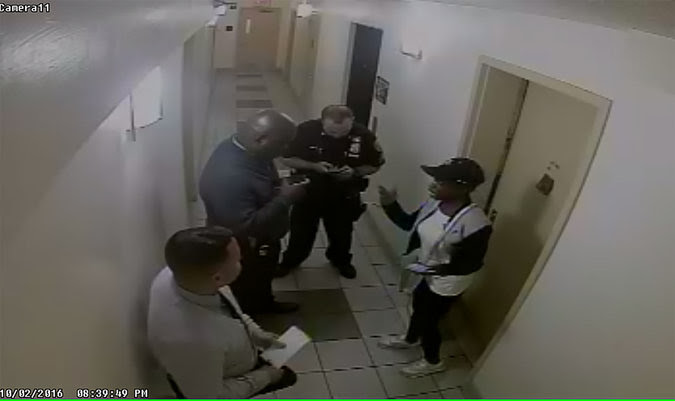
Photo

Photo
Photo
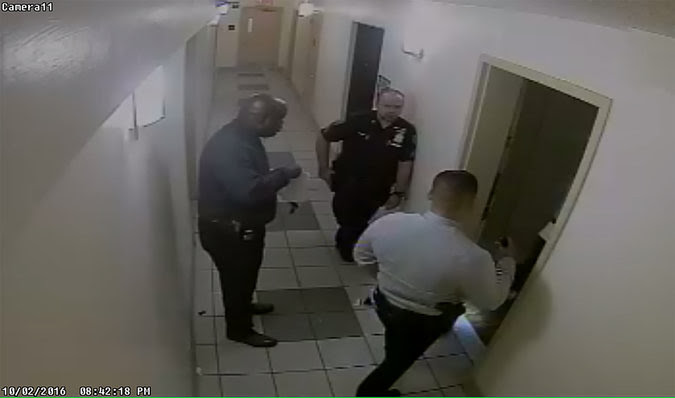
When Ms. Thomas’s lawyer sought to play the video in court, prosecutors in the Bronx dropped the case. Then the court sealed the case file, hiding from view a problem so old and persistent that the criminal justice system sometimes responds with little more than a shrug: false testimony by the police.


“Behind closed doors, we call it testilying,” a New York City police officer, Pedro Serrano, said in a recent interview, echoing a word that officers coined at least 25 years ago. “You take the truth and stretch it out a little bit.”
An investigation by The New York Times has found that on more than 25 occasions since January 2015, judges or prosecutors determined that a key aspect of a New York City police officer’s testimony was probably untrue. The Times identified these cases — many of which are sealed — through interviews with lawyers, police officers and current and former judges.
In these cases, officers have lied about the whereabouts of guns, putting them in suspects’ hands or waistbands when they were actually hidden out of sight. They have barged into apartments and conducted searches, only to testify otherwise later. Under oath, they have given firsthand accounts of crimes or arrests that they did not in fact witness. They have falsely claimed to have watched drug deals happen, only to later recant or be shown to have lied.
No detail, seemingly, is too minor to embellish. “Clenched fists” is how one Brooklyn officer described the hands of a man he claimed had angrily approached him and started screaming and yelling — an encounter that prosecutors later determined never occurred. Another officer, during a Bronx trial, accused a driver of recklessly crossing the double-yellow line — on a stretch of road that had no double-yellow line.
In many instances, the motive for lying was readily apparent: to skirt constitutional restrictions against unreasonable searches and stops. In other cases, the falsehoods appear aimed at convicting people — who may or may not have committed a crime — with trumped-up evidence.
In still others, the motive is not easy to discern. In October 2016, for example, a plainclothes Brooklyn officer gave a grand jury a first-person account of a gun arrest. Putting herself in the center of the action, the officer, Dornezia Agard, testified that as she approached a man to confront him for littering, he suddenly crouched behind a van, pulled from his waistband a dark object — later identified as a gun — and threw it on the ground.
“P.O. Agard testified that she heard a hard metal object hit the ground,” according to a letter the Brooklyn district attorney’s office wrote summarizing her testimony.
But prosecutors lost faith in her account in July 2017, after learning from other officers that she was not among the first officers on the scene. Officer Agard had arrived later as backup, according to the letter, which noted that the gun charges against the man were later dismissed. The prosecutors did not address why Officer Agard claimed to be a witness, or why the other officers present seem to have allowed her to process the arrest.
Police lying raises the likelihood that the innocent end up in jail — and that as juries and judges come to regard the police as less credible, or as cases are dismissed when the lies are discovered, the guilty will go free. Police falsehoods also impede judges’ efforts to enforce constitutional limits on police searches and seizures.
“We have 36,000 officers with law enforcement power, and there are a small handful of these cases every year,” said J. Peter Donald, a spokesman for the Police Department, the nation’s largest municipal force. “That doesn’t make any of these cases any less troubling. Our goal is always, always zero. One is too many, but we have taken significant steps to combat this issue.”
The 25 cases identified by The Times are almost certainly only a fraction of those in which officers have come under suspicion for lying in the past three years. That’s because a vast majority of cases end in plea deals before an officer is ever required to take the witness stand in open court, meaning the possibility that an officer lied is seldom aired in public. And in the rare cases when an officer does testify in court — and a judge finds the testimony suspicious, leading to the dismissal of the case — the proceedings are often sealed afterward.
Still, the cases identified by The Times reveal an entrenched perjury problem several decades in the making that shows little sign of fading.
So far in 2018, a Queens detective has been convicted of lying in a drug case and a Brooklyn detective has been arrested amid accusations that he fabricated the results of a photo lineup. These cases returned the phenomenon of police lying to the public eye, leaving police officials to defend the integrity of honest officers.
Kevin Richardson, the Police Department’s top internal prosecutor, said he believed so-called testilying was nearing its end. “I think it’s a problem that’s very much largely on its way out,” he said.
Indeed, it’s tempting to think about police lying as a bygone of past eras: a form of misconduct that ran unchecked as soaring street violence left the police overwhelmed during the 1980s and early 1990s and that re-emerged as police embraced stop-and-frisk tactics and covered up constitutional violations with lies.
But false testimony by the police persists even as crime has drastically receded across the city and as the Police Department has renounced the excesses of the stop-and-frisk years.
Some policing experts anticipate that the ubiquity of cameras — whether on cellphones, affixed to buildings or worn by officers — will greatly reduce police lying. For the moment, however, video seems more capable of exposing lies than vanquishing them.
In two recent cases, The Times found, officers appear to have given false accounts about witness identifications. These cases are particularly troubling because erroneous identifications by witnesses have been a leading cause of wrongful convictions.
After a 2016 mugging near a Brooklyn subway station, the police arrested a group of four people, one of whom was found to be in possession of the victim’s wallet. In preparing the case, prosecutors sought to pin down a few basic facts. Had the police brought the victim, who was punched and had his wallet taken, to positively identify the four suspects after they were taken into custody? If so, what had the victim said?
Getting a straight answer from the arresting officer, Chedanan Naurang, proved nearly impossible. It had been Officer Naurang’s quick thinking that had made the arrest possible: Having lost the suspects at one subway station, he followed a hunch and drove one stop down the line, where he caught up with the four men after they got off the train.
But certain details Officer Naurang gave prosecutors kept shifting over the next year, according to a February 2017 letter that prosecutors wrote in which they summarized his fluid story.
Officer Naurang said at one point that the identification had occurred inside a police station when the victim passed by the holding cells, saw the men and confirmed their involvement in the crime.
A few weeks later, he backtracked. No, the victim had actually never gotten to see the suspects at the police station, Officer Naurang explained. Instead, the victim had gotten a chance to view them on the street, shortly after their arrest. That’s when the victim got out of the police vehicle in which he had been waiting, Officer Naurang said, and pointed to one of the four men, identifying him as an attacker.
This version of events, however, was at odds with the recollection of the police officer who had driven the victim to the scene of the arrest. That officer, Christopher McDonald, told prosecutors that the victim had remained in the back seat while viewing the four suspects. And Officer McDonald said that the victim couldn’t say whether they were his assailants. He thought he recognized their clothing, but wasn’t sure.
Because of Officer Naurang’s changing story, prosecutors dropped the case against the men as part of a deal in which all four pleaded guilty to charges stemming from a second mugging they were accused of the same night.
Photo

Detective Michael Foder, right, walked out of Federal District Court in Brooklyn accompanied by his lawyer, James Moschella, after his February arraignment on perjury charges. CreditVictor J. Blue for The New York Times
Another case in which the police gave false information about a witness identification came after a carjacking in Brooklyn in 2015. In that case, the police began to focus on two suspects based on an anonymous tip and a fingerprint. A detective, Michael Foder, testified that he had then prepared two photo lineups — one for each suspect.
Each consisted of the suspect’s photograph printed on a sheet of paper, alongside the photos of “fillers” — people of vaguely similar appearance with no connection to the crime. The hope was that the victim, a livery cabdriver, might recognize the suspect’s photo and pick him out — an outcome that prosecutors regard as a strong indicator of a suspect’s guilt.
That’s what happened, Detective Foder testified, when the victim came to the precinct to view the photo lineup for one suspect in November 2015 and returned in February 2016 to view one for the second suspect.
But the photo lineups that Detective Foder had prepared — and were submitted as evidence in federal court — were fabrications. It was a federal prosecutor who first realized that many of the photos used in the lineups were not yet available at the time Detective Foder claimed to have shown them to the victim. The reason? The photos of some of the fillers had yet to be taken.
The lineup that was said to be from November 2015 included filler photographs that were not taken until December. And the one he claimed to have administered in February featured photos that were taken in March.
Last month, Detective Foder was indicted on federal perjury charges. The indictment accuses him of lying to “conceal the fact that he had falsified documentation” related to the photo lineups. Detective Foder’s lawyer entered a plea of not guilty on the detective’s behalf.
Photo
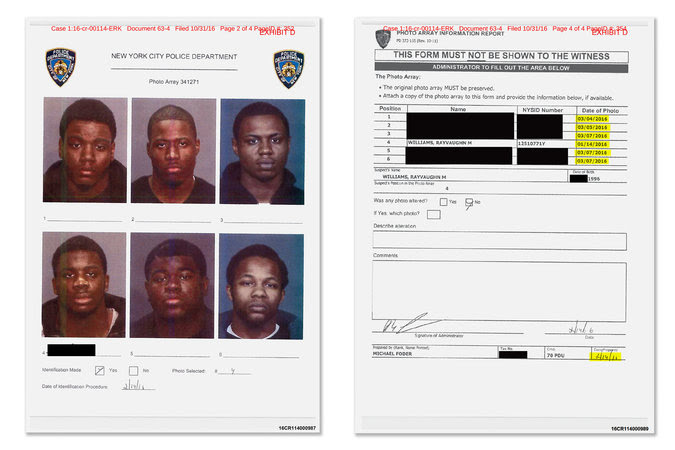
A prosecutor discovered that many of the photos in the array Detective Foder said he had shown the victim Feb. 14, 2016, were not even taken until after that date.
Detective Foder’s actions appear to be aimed at tilting the scales toward guilt.
But more often, The Times found, false statements by the police seem intended to hide illegal searches and seizures, such as questionable car stops or entries into apartments that result in officers finding guns or drugs. If the truth were to emerge that the case began with an illegal police search, the evidence would quite likely be thrown out and the case dismissed.
A series of stories examining the entrenched culture of ‘testilying’ in the New York Police Department.
The story that Christopher Thomas, a plainclothes police officer, told a grand jury in December 2014 sounded plausible enough. As he approached a parked car with a flashlight in hand, he said, he saw a man in the driver’s seat pull a firearm out of his waistband and stick it between the car’s center console and the front seat. The driver was indicted on gun-possession charges.
But by July 2015, as video of the encounter was about to emerge, Officer Thomas started backtracking. In conversations with the assistant district attorney on the case, Officer Thomas acknowledged that he had not seen the driver pull the gun from his waistband. In fact, he said, he had never seen the driver with his hand on the gun.
“He stated to the A.D.A. that he did not know why he had testified to those facts before the grand jury,” according to an email prosecutors later sent to a defense lawyer. This email, as well as several similar letters that prosecutors sent in other cases, were provided to The Times by Cynthia Conti-Cook, a Legal Aid Society lawyer who has been compiling a database of police misconduct allegations.
The video undermined Officer Thomas’s original claim of having seen the gun at the outset. It shows Officer Thomas and his partner approach the car and shine their flashlights inside. Their demeanor on the video suggests that they had seen nothing so far to cause alarm. One of the two officers — either Officer Thomas or his partner — is so unconcerned that he bends down for about seven seconds, and appears to tie his shoe.
Brooklyn prosecutors dismissed the gun case and, according to the prosecutors’ email, informed the Police Department’s Internal Affairs Bureau about the problems with Officer Thomas’s account. An internal police disciplinary process led to Officer Thomas losing 30 vacation days and being placed on dismissal probation for a year, according to a person familiar with the case.
He is now a sergeant in a narcotics unit.
Officer Thomas is not the only officer to have tried to withdraw earlier testimony as soon as video of an encounter emerged, or was about to.
“I misspoke when I was in grand jury,” Sean Kinane, an officer with the 52nd Precinct in the Bronx, testified in federal court in 2016. That was all the explanation he gave, or was asked to give, for why he was recanting his earlier testimony about witnessing what appeared to be narcotics transactions in the moments before he stopped a heroin dealer in the street.
That claim, if true, would have given the police justification to stop the man, who was discovered to be carrying 153 glassine envelopes of heroin and eight bags of crack cocaine. But after the drug dealer managed to get a video recording of the encounter, Officer Kinane’s story changed. He had misspoken.
Reached by telephone for comment, Detective Kinane — he was promoted in 2017 — hung up.
Many police officials and experts express optimism that the prevalence of cameras will reduce police lying. As officers begin to accept that digital evidence of an encounter will emerge, lying will be perceived as too risky — or so the thinking goes.
“Basically it’s harder for a cop to lie today,” the Police Department’s top legal official, Lawrence Byrne, said last year at a New York City Bar Association event, noting that there were millions of cellphones on the streets of New York, each with a camera. “There is virtually no enforcement encounter where there isn’t immediate video of what the officers are doing.”
As more police encounters are recorded — whether on the cellphones of bystanders or the body-worn cameras of officers — false police testimony is being exposed in cases where the officer’s word might once have carried the day. That is true for run-of-the-mill drug cases as well as for police shootings so notorious that they are seared into the national consciousness.
Yet interviews with officers suggest the prevalence of cameras alone won’t end police lying. That’s because even with cameras present, some officers still figure — with good reason — that a lie is unlikely to be exposed. Because plea deals are a typical outcome, it’s rare for a case to develop to the point where the defendant can question an officer’s version of events at a hearing.
“There’s no fear of being caught,” said one Brooklyn officer who has been on the force for roughly a decade. “You’re not going to go to trial and nobody is going to be cross-examined.”
The percentage of cases that progress to the point where an officer is cross-examined is tiny. In 2016, for instance, there were slightly more than 185 guilty pleas, dismissals or other non-trial outcomes for each criminal case in New York City that went to trial and reached a verdict. There were 1,460 trial verdicts in criminal cases that year, while 270,304 criminal cases were resolved without a trial.
To be sure, officers are sometimes called to testify before trial at so-called suppression hearings in which the legality of police conduct is evaluated. But those are rare. In Manhattan, about 2.4 percent of felony criminal cases have a suppression hearing, according to data from the Manhattan district attorney’s office. The rate for non-felony cases is slightly more than one-tenth of 1 percent.
Photo
Officer Pedro Serrano said he doesn’t engage in “testilying,” but he said it remains a problem in the New York City Police Department. “You take the truth and stretch it out a little bit.” CreditKarsten Moran for The New York Times
Several officers, all working in the Bronx and Brooklyn, candidly described in interviews how the practice of lying runs like a fault line through precincts. “You’re either a ‘lie guy’ or you’re not,” said the Brooklyn officer. Speaking on condition of anonymity, he described how he avoided certain officers and units in his precinct based on his discomfort with the arrests they made.
Earlier in his career, he said, a supervisor and a detective had each encouraged him to lie about the circumstances of drug arrests. Another time, he said, he had worked with an officer who, after discovering drugs while searching a suspect without cause, turned to the other officers present with a question — “How did we find this?” — and sought their help devising a false story.
Countless police officers have struggled with that question — “How did we find this?” — ever since 1961, when the Supreme Court ruled, in Mapp v. Ohio, that state judges must throw out evidence from illegal searches and seizures. Before this ruling, New York City officers could stop someone they thought might be dealing or using drugs, search their pockets and clothing, describe the encounter truthfully, and not worry that a court would throw out the drugs that they had discovered, even though the stop and search had been, strictly speaking, illegal. That changed with the Mapp decision, which greatly expanded the reach of the Fourth Amendment.
Immediately after the Mapp case, police officers saw many narcotics cases be dismissed. Then they made what one judge called “the great discovery.” If they testified that the suspect had dropped a bag of drugs on the ground as the police approached, courts would generally deem those arrests legal.
Within a year of the Mapp decision, courts in New York City were seeing a marked increase in what became known as “dropsy” testimony — in some units “dropsy” cases increased more than 70 percent, according to one 1968 study.
There was little reason to think drug users had grown more skittish. Rather, the influx of these cases was understood to be a sign that police officers were lying in a substantial number of cases. Ever since, courts in New York have been plagued with officers lying about how they came to discover that a suspect was carrying drugs or guns.
By 1994, a commission appointed to investigate police corruption noted that lying to make cases stick was common enough for “testilying” to become a well-known portmanteau.
The report by the Mollen Commission noted a few established patterns of falsehoods. Officers who illegally searched a car might later say they discovered contraband in “plain view.” Or an officer who found a gun or drugs in someone’s clothing during an illegal search might falsely claim to have seen “a bulge in the person’s pocket.”
Just like the dropsy testimony a few decades earlier, these stories of “plain view” and “suspicious bulges” became scripts that many police officers stuck to. They were rarely challenged, not even as officers in New York City began repeating them tens and then hundreds of thousands of times as police stops of mainly black and Latino men skyrocketed during the years Michael R. Bloomberg was mayor.
In recent years, the number of times police stopped and frisked pedestrians has declined precipitously. But certain plainclothes units, such as the so-called anti-crime teams, still engage in an aggressive style of policing that relies heavily on stop-and-frisk tactics. These teams make a disproportionate number of gun arrests, but they are also responsible for a substantial number of dubious stops of pedestrians and drivers, police officers and legal experts said in interviews.
Several uniformed patrol officers said they have long suspected that the track record of plainclothes anti-crime teams for making weapons and drug arrests was bolstered by illegal searches and a tolerance for lying about them.
These officers described a familiar scene: a group of black men ordered out of a vehicle for little reason and made to sit on the curb or lean against the bumper, as officers search the vehicle for guns and drugs.
“Certain car stops, certain cops will say there is odor of marijuana. And when I get to the scene, I immediately don’t smell anything,” said Officer Serrano, one of the few officers interviewed who was willing to speak on the record. “I can’t tell you what you smelled, but it’s obvious to me there is no smell of marijuana.”
Mr. Serrano’s testimony about a secret station-house recording he made was crucial evidence in a landmark stop-and-frisk trial in 2013. He and nearly a dozen other current and former officers are suing the Police Department over what they describe as arrest quotas.
Photo

Edwin Raymond, a New York City police sergeant, said plainclothes officers working with so-called anti-crime teams bend the truth “to fit the narrative.” CreditChristopher Anderson/Magnum Photos
“It’s the anti-crime teams, the plainclothes officers, everyone knows they will violate the law, get what they want and then write it to fit the narrative,” said Edwin Raymond, a police sergeant who is also a plaintiff in the arrest-quota case. “The narratives will be embellished to fit the parameters of probable cause, if need be.”
To be sure, there are other motives for lying, other than to cover up illegal searches.
Some police officers have said they faced pressure from commanders to write more tickets or make more arrests. A decade ago, narcotics detectives were found to have falsely accused people of dealing drugs in order to meet arrest quotas.
And there is pressure to solve — or at least close — cases. That may have motivated Officer Martinez’s gun-in-the-laundry-bag-in-the-doorway story.
What appears to have actually happened is that Officer Martinez and other officers searched inside the apartment for evidence from a nearby shooting. They had good reason to focus on that apartment. The victim, after being shot, had rushed there, along with others. Crime-scene photos taken by the department’s Evidence Collection Team suggest that a gun was found inside the apartment, in or near a laundry bag on the floor.
But whose gun was it? That was not clear. A number of people had been in the apartment in the preceding hours. And Ms. Thomas, who lived more than a mile away and arrived about an hour after the shooting, was one of the few people there when Officer Martinez showed up.
There is little, if any, evidence tying Ms. Thomas to the gun other than Officer Martinez’s false testimony that placed her in the doorway with the laundry bag in her arms. Prosecutors acknowledged that DNA testing indicates that Ms. Thomas did not handle the gun. Moreover, court papers that prosecutors filed after the case fell apart noted that the police appear to have focused on Ms. Thomas while ignoring other potential suspects. Several other people had entered the apartment shortly before Ms. Thomas — “none of whom are questioned by the police,” the prosecutors’ papers noted.
As for Officer Martinez’s false story of the laundry bag in the doorway, the prosecution’s legal papers noted only that “there are clear inconsistencies” between Officer Martinez’s “recollection of events and the video.”
“At no time in this video is there a laundry bag in the defendant’s hands,” the prosecution’s legal papers noted. “Neither is there a bag in the doorway of the apartment, and at no time is the arresting officer observed moving a bag before entering the apartment.”
By the time prosecutors officially dropped the case in November 2017, Ms. Thomas had already appeared in court 16 times, according to a tally of appearances kept by one of her lawyers, Alexandra Conlon, of the Bronx Defenders. On the last appearance, Ms. Thomas, 39, asked to address the court. “For 396 days I have been fighting for my life, my freedom and my sanity,” she said. “This has been such a surreal journey that I don’t wish on anyone.”
Officer Martinez remains in good standing at the 41st Precinct. Shortly after the case was dismissed, he was promoted to detective and given his gold shield. When a reporter tried to interview him in January about his testimony in the case, he declined to comment, saying, “That’s not something I can speak about directly with you.”
Photo

Ms. Thomas outside the Bronx apartment building where she was arrested on gun charges that were dismissed after a video contradicted the police officer’s account.CreditHilary Swift for The New York Times
…
[Message clipped] View entire message
of the United States, wars against the Constitution and engages in violation of the
Supreme Law of the Land. If a judge does not fully comply with the Constitution, then
his orders are void. In re Sawyer, 124 U.S. 200 (1888), he is without jurisdiction, and
he/ she has engaged in an act or acts of treason. U.S. v. Will 449 U.S. 200, 216, 101
S. Ct. 471, 66 EEd. 2d 392, 406 (1980); Cohens v. Virginia, 19 U.S. (6 Wheat) 264, 404,
5 L. Ed. 257 (1821). I have no problem with the statement – but note a judge who acts ultra vires creats a voidable judgment at best – not a void judgment.
b.) Judgement is a “void judgement” if court has rendered judgement lacked
jurisdiction of the subject matter, or of the parties, or acted in a manner inconsistent
with due process. Klugh v. U.S., D.C.S.C., 610 F. Supp. 892, 901. absolutely correct.
c.) A court lacks jurisdiction anytime it denies a citizen the Bill of Rights
or amendments, particularly Due Process 1308, (C.A. 10 (Colo.). 1994); VC.A. 10 Now we are getting into the area of distinctions. If a judge acts badly, or exceeds his authority an Appellate Court usually reverses the action. Here the action of the judge is subject to reversal and we can consider the judgment rendered voidable. A voidable judgment is fully enforceable until reversed.
(Colo.), 1994). “Spitzberg v Notaro – Judge Gerald Rosenberg void – There is a miscon-
ception by some attorneys and judges that only a judge may declare an order void, but
this is not the law: (1) there is no statute nor case law that supports this position, and
(2) should there be any case law that allegedly supported this argument, it would be
directly contrary to the law established by the U.S. Supreme Court in Vallely v. Northern This is true but, self help is prohibited. Thus if a judge enters an order that it is illegal to wear a red shirt, indeed that order is void. If Law Enforcement desires to enforce the order, it is protected UNTIL the order is ruled by a Court having jurisdiction as void. Ordinary citizens like you and me do not get to determine which orders are void, voidable, valid, or not applicable. This is the function of the judicial system. This is also the reason that CORRUPTION in the Courts is such a devastating crime.
Fire & Marine Ins. Co. 254 U.S. 348, 41 S. Ctr. 116 (1920) as well as other state courts, e.g.
by the Illinois Supreme Court in People v Miller. Supra.
d.) Per Black’s Law Dictionary, Sixth Edition, p. 1574, void
judgement is defined as “one which has no legal effect, invalidity of which may be
asserted by any person whose rights are affected at any time and at any place directly
or collaterally.”
e.) Violation of due process results in “void judgements”: “A court lacks jurisdic-
tion anytime it denies you the Bill of Rights or amendments, particularly Due Process”
1308 (C.A. 10 (Colo.), 1994); V.T.A., Inc. v. Airco, Inc., 597 F. 2d 220, 221 (1979). A judge-
ment reached without due process of the law is without jurisdiction and thus void. See above: I have no quarrel with these definitions – my quarrel is with the ‘lay’ interpretation by some that by their determination that a judgment is void – it is. In fact it is NOT. You may feel that your CONSTITUTIONAL RIGHTS have been violated, but only a Court having jurisdiction to make that determination has the authority to determine that facts.
Bass v. Hoagland, 172 F. 2d 205, 209 (1949). Any motion for relief from a void judgement
is timely reguardless of when it is filed. V.T.A., Inc., supra@ 224 (footnote no. 9). If a
judgement is void, it is a nullity from the outset and any Civ. R60 (B) motion is there-
fore filed within a reasonable time. Omer v. Shala, supra@1308 The Words that you should focus upon MOTION FOR RELIEF. A motion that refers to a voidable judgment has to be brought during term time or the statutory time (2 years) and must meet the criterion of GOOD FAITH and due diligence. This is a very important distinction.
f.) In my cases there was bias against a pro se litigant, which has become an
epidemic in American courts, where lawyers become judges who then protect the
business of lawyers (purportedly illegal in the court system). Justice is not needed to
be purchased according to the law and was written to be”of the people, by the people
and for the people; “we the people”. Yet it has been reported by Dr. Richard Cordero, Esq,
Phd University of Cambridge England, MBA University of Michigan Business School and
D.E.A. La Sorbonne Paris, who has taken up the cause of pro se litigants, through his
investigation that over 97% of pro se litigant cases are being illegally dismissed by courts;
and as such said rulings are “void judgments”. Bias does not create either a void or voidable judgment. Neither does a judgment entered by a judge who has been ‘wired!’ Such is indeed a violation of civil rights, but if you do not speak up and follow the procedure for addressing the problem (or cannot prove the bias) a valid judgment can be rendered against you. You also can waive the bias. (Merely proceeding in the case and allowing the judge to rule on issues can be deemed a waiver.
Ken Ditkowsky

I have yet to decide what actions and against whom I will take in the
debacle of a 76 year old I had been caring for recently. Baltimore City
Social Services case worker Jorge Mitchell forced him into a Manor Care
facility. When I questioned why none of the family or I as his them power
of attorney had been contacted. said case worker stated that the facility
It was his intent to see the elder apartment lease and be kept at Manor Care.
My wife, two of the elder’s brother and I went to see the situation for
ourselves. We found him not provided a simple tooth brush he had been
requesting. He was having problems swallowing and thus eating, but if he
did not finish his food in the allotted 1/2 hour, it was taken away and nothing else provided until the next meal.
Ken Ditkowsky
The problem that we face is corruption and hypocrisy. The local media here in Chicago must think that we – the great unwashed – are stupid. They accept millions – maybe billions of dollars – from political organizations that are totally irresponsible and promise in election years the world and deliver only corruption and hypocrisy. The news is slanted in most cases to glorify the POLITICAL ELITE and to reward favorites and punish those who are not liked.
We see multiple examples of the bias daily. Today, the Chicago Tribune was lauding one of the candidates for Assessor and crying over the fact that she had been removed from the ballot by the election commission only to be reinstated when the political elite candidate appeared to be having trouble in the primary election. The addition of the previously removed candidate splits the opposition vote and thus almost guarantees that the political elite candidate will be re-slated. This is an old ploy but an effective one. It is also being used in the Attorney General’s race for the nomination. These two offices are essential to maintaining power.
In particular, here in Illinois the JoAnne Denison disciplinary proceeding stands out for its infamy and its reach for the nadir of ethical conduct. The case started out as part of the cover-up of the Mary Sykes case 09 P 4585. One of the Guardian ad litem who was allegedly preying on the elderly matron/widow felt aggrieved that the blog Probate Sharks published a demand made by yours truly and Ms. Denison for an HONEST INVESTIGATION. The demand for an HONEST INVESTIGATION was prompted by the fact that all the protections of the Act 755 ILCS 5/11a – 3 and 755 ILCS 5/11a – 10 were ignored, including but not limited to service of a proper summons, prior notice to next of kin, the holding a hearing as to the extent and nature of any disability (755 ILCS 5/11a – 3), application of the proper standards etc. Heretofore, a public official – such as a guardian or conservator was considered a fiduciary and owed the ‘ward’ the highest standard of conduct. Heretofore, forfeiture of property and liberty was strictly prohibited by both the Illinois Constitution and the United States Constitution.
The demand for an HONEST INVESTIGATION, even though ignored, was a call to LAW ENFORCEMENT to protect the Constitution of the United States of America, the Illinois Constitution of 1970, and the Rule of Law. As there was three million dollars to be stolen sans Federal and State Tax enforcement, and millions in Federal Health Care money to steal the call for an HONEST INVESTIGATION was totally repugnant to the Establishment. Attorney Denison not only refused to ‘back off’ from her demand for the political organization to comply with the demand that its members respect the rule of law and the Constitution, but, she published in her blog –www.marygSykes.com – instances of criminal corruption by sitting Judges. Many of these Judges were acting in criminal concert promulgating the felonies of ELDER CLEANSING and HUMAN TRAFFICKING. Ms. Denison’s exposure of the continued criminal conduct and ‘OPERATION GREYLORD’ activities was not appreciated and connoted by the Administrator of the Attorney Registration and Disciplinary Commission as being akin to “yelling fire in a crowded theater.”
Mr. Larkin (the administrator) was not content with filing false pleadings under oath. He made certain that he punished Attorney Denison and sullied her reputation and ability to practice law. In so doing he himself violated the Law! He engaged as an example an unlicensed ‘court reporter!’ One of the transcripts of proceedings was indeed interesting. A judge (who presided over the Sykes case) admitted to telling a falsehood under oath during her direct examination according to Court watchers. The official transcript was filed with the admission (elicited under cross examination) deleted. The required standard of proof was modified from ‘clear and convincing’ to Jerome Larkin says it is true – to hell with the truth.
Unfortunately, the Denison perfidy is not an anomaly, but, is common place and as the investigation continues – S.O.P. Rule 8.3 compliance in HUMAN TRAFFICKING by people favored by the political elite is not tolerated and a lawyer who complies with Rule 8.3 is almost guaranteed an interruption of his/her law license. ELDER CLEANSING is a major fund-raising strategy for the POLITICAL ELITE.
We – the great unwashed – will have no Democracy, no Republic, and no Freedom UNLESS we react and rebel. The strategy of splitting our vote so that the machine candidate can be nominated or elected will be difficult to address – but, we must do so. The outright campaign lies, and demonization of the opposition may be more difficult. For instance, racism has become a catch word. What is racism? It certainly was not racism for Lanre Amu to have his license suspended for practicing law while black! Indeed, Mr. Larkin’s perjury goes unpunished even though we (and Larkin) all know that CRAINS CHICAGO BUSINESS make the very averment against Judge Egan that Amu did. Larkin’s prevarication was rubber-stamped in the face of unequivocal evidence of Egan’s perfidy and ethically challenged behavior on the bench. Hell – Egan did not even deny the misconduct! Today, to obtain the reinstatement of his law license, the Illinois Supreme Court is demanding that Amu admit that he lied – even though everyone knows that he told the truth and Larkin was very frugal with the truth under oath.
Of course, it was not racism in Illinois when Larkin’s legions denied admission to an icon of the Civil Rights movement. This esteemed lady = who marched with DR. KING and who was recognized as one of the planners of the Selma March (Diane Nash) was denied entry to one of the kangaroo hearings in which Attorney Denison was being denied her civil rights. (I personally was at the hearing and there was a vacant seat adjacent to me – I requested an apology for Ms. Nash from Mr. Larkin – no apology was ever given).
It does not guaranty that I can kidnap Mary Sykes, drag her before a corrupt judge lacking jurisdiction and ethics and deprive Mary of her liberty, her property, and the fruits of her American citizenship. (Amazing – but the Courts are protecting my whim (if I have sufficient political and judicial clout) to deprive others of due process, liberty and property)
The government supports health care fraud and its 700% surcharge. Philip Esformes was indicted in the US Court for the Southern District of Florida for stealing a billion dollars in Medicare Money. Seth Gillam was convicted of a serious Medicare Fraud involving Hospice, stealing from trust funds etc. These are not isolated cases – they are the norm and unfortunately both Gillman and Esformes are not the biggest players in this trillion dollar criminal enterprise. Florida elderly are not the only targets. Why then are prosecutions so rare? It is respectfully suggested that the POLITICAL ELITE are so invested in the Elder Cleansing frauds and the money that they can steal from both the government and the victim, that they have created a protected cottage industry.
It does not take a Philadelphia Lawyer to answer the query! Prosecutions are rare because the criminals are heavily tied in with the ESTABLISHMENT. In my Brewer case the canvass of the 50th Ward in Chicago revealed that my extremely qualified client received virtually NO VOTES from any of the nursing homes in the area. It appeared that every resident voted for the incumbent alderman. It appears that this was not an anomaly= it appears representative of nursing home voting. Let’s make this very clear – – a candidate running for public office can obtain enough votes from his/her relationship with the nursing home operator to swing the election either for him or against him. Even lifetime voters for the candidate not favored by the nursing home operator will be seen to have voted for the candidate favored by the operator of the facility. (Indeed – I am suggesting blatant vote fraud!)
ELDER CLEANSING (HUMAN TRAFFICKING) is not a minor event – it is a cancer that could destroy the America they we know. The persons engaged in the criminal conspiracy are well connected public servants. In Germany during the 1930s, and in Soviet Russia during the Gulags human cleansing/trafficking was a NATIONAL POLICY. Today in Southern Florida and in Cook County, Illinois it is so commonplace that it can be deemed public policy. The fact that so many of the practitioners and their political co-conspirators get away with it (and the life savings of the elderly) with such impunity suggests that America is in deep trouble! At the very least – it would be nice if the DEPARTMENT OF THE TREASURY had an agent or two wander into Mr. Jerome Larkin’s office and collect the FEDERAL INCOME TAXES due on the booty that Mr. Larkin protected for his 18 USCA 371 co-conspirators!
Ken Ditkowsky
…
Ken Ditkowsky
..
The health care fraud surcharge of 700% is alive and well. Corruption is alive and well in Illinois, Florida, *******. It would effect you personally unless you do something to address it effectively. In the F Estate even though the AG smelled a rat and tried to thwart the Fraud, the AG compromised the case and the miscreant lawyer escaped with a large sum of money totally free to taxes! Of course the IDR ignored the Illinois taxes – the lawyer engaged in this criminal enterprise was a member of the POLITICAL ELITE and therefore was entitled to a ‘blind eye’ enforcement procedure. Ditto for the UNITED STATES DEPARTMENT OF THE TREASURY!
Ken Ditkowsky
…
[Message clipped] View entire message
Ken Ditkowsky
Barbara Stone who is doing prison time for merely telling the truth and defending her elderly mother said it best: nursing homes are nothing but slums and ghettos for the elderly.
I still have the same challenge for all of you out there who say, “well some are good.” F no, they are not. Go take a survey at any nursing home. If the residents are not comatose and drooling in front of a TV droning or or in the hallways slumped over, they will 99% tell you they want to go home or live with a beloved child or relative or friend. Their beds are crap, the food is crap and you wouldn’t let a dog or cat live like the elderly do in nursing homes. Even a dog at the shelter has a chance for adoption. These people do not. They will assuredly die in the end without ever seeing the light of day again.
Again, who is looking into this? Answer: no one. Not the Chicago Police, not the FBI, the states attorneys, no one. Who give a flying you know what about the elderly? Targeted, drugged forced into nursing homes, why not bring back the cattle cars and human incinerators of World War II?
Are we really doing any better? Nope. I’m still waiting for ONE PERSON to answer my challenge about how 99% of nursing home patients want to go home, and no one investigates, no one helps them and no one cares about their human and civil rights violations. Why? the money is far too good, really great in fact. For $70k per month would YOU let a one of them go home?
read on. I am disgusted for sure.
Posted: 8:08 AM, November 02, 2017
NORTH MIAMI, Fla. – A total of 104 residents and patients were recently evacuated from a North Miami assisted living facility after state inspectors said the conditions were unsafe and unsanitary.
Inspectors with the Florida Department of Health and the Agency for Health Care Administrationshowed up at Eden Gardens, 12221 W. Dixie Highway, in August after a complaint about a bed bug infestation.
 Eden Gardens Assisted Living Facility was ordered closed by the state.
Conditions were so bad that the Agency for Health Care Administration is looking to permanently revoke the facility’s license to operate and fine the owners $20,000.
A man who identified himself only as Bobby said he saw bed bugs and rodents when he was a resident at Eden Gardens. He was among the residents who were moved to another facility in North Miami.

“How long did they give you to pack up?” Local 10 News investigative reporter Jeff Weinsier asked.
“Twenty minutes,” Bobby said.
“Is that enough time?” Weinsier asked.
“No,” Bobby answered.
Photographs taken by investigators and obtained by Local 10 News show dead rodents, bed bugs on sheets and rodent droppings.
According to state records, live and dead bugs were found in 20 rooms. Dead rodents and fresh rodent droppings were found in seven rooms.

Furniture and fixtures were accumulated with dust, food residue and dead insects. Eden Gardens was also cited for worn mattresses, broken beds and soiled sheets.
Records show the facility was ordered to stop serving lunch because wastewater was coming up through the drains and there was a bad smell.

Bobby said there were bed bugs in his room.
“They were everywhere,” he said.
The emergency order to shut down the facility said the bed bug issue was well known to those in charge, and efforts to eradicate the problem didn’t work.
“I don’t think it was right, you know, us living in conditions like that,” he said.
“Did you ever complain to them?” Weinsier asked.
“Who you going to complaint to?” Bobby said.
State records show Philip Esformes was listed as the owner/manager of Eden Gardens for 11 years.
Esformes is now in federal prison and is said to be the mastermind of a billion-dollar Medicare scheme. He is awaiting trial.
 Philip Esformes was listed as the owner/manager of Eden Gardens for 11 years. He is now in federal prison.
According the federal indictment, Eden Gardens was one of the facilities used in the scheme. Morris Esformes is now listed as the owner/manager. The father of Philip Esformes is a Chicago rabbi who was in business with his son for years.
A spokesman for Florida’s Long-Term Care Ombudsman Program said the agency received 83 complaints and opened 44 investigations on Eden Gardens since 2004.
The Agency for Health Care Administration cited deficiencies 14 times since 2010.
Eden Gardens is fighting the revocation of its license to operate. A December hearing has been set.
For now, Eden Gardens remains closed.
Below is a statement sent on behalf of Eden Gardens:
“Eden Gardens has been under the current ownership since 2004. For the past 13 years, it has never had a bed bug problem until recently. Eden Gardens spent significant resources trying to remedy the problem and thought that the problem had been resolved. In fact, six weeks prior to the incident which you are reviewing, the Department of Health inspected all rooms in the facility and found no bed bugs or rodent problems. When the Department of Health received the complaint, it came out and found bed bugs in some rooms and a rodent in a trap. This was photographed by the Department of Health. The facility immediately responded by indicating to the Department of Health that it would evacuate the Facility and tent it to assure that all insect or rodent problems would be permanently eliminated. It did that at great cost but without any incident of resident complaint. The Facility has been recently reviewed by the Department of Health and found to be free of the prior problem. The prior residents of the facility are anxious to return and the owners are hopeful that the Facility can be reopened to allow that to occur. For these residents, Eden Gardens has been their home for many years and the fine staff of the facility has been their family. The incident that occurred was an aberrant situation that was not reflective of the facility’s past history or quality of care and certainly not what it expects to provide in the future.” — Attorney Harvey M. Tettlebaum
Ken Ditkowsky
Ken – what a great ending to a fictional professional guardianship fraud story. Many of us have enacted out this scenario in our mind I believe – only it wasn’t just the guardian left tied to a chair by thugs! I’ve talked to a couple of ladies who do target practice so that they can pretend the target is a judge.
This is what we’ve come to – the shoot-out at the OK Corral! Anyone who travels to Tombstone, Arizona hears the controversy that still rages on – was Wyatt Earp a good guy or someone wearing a sheriff’s badge to kill his enemies?
From: kenneth ditkowsky [mailto:kenditkowsky@yahoo.com]
Sent: Wednesday, March 14, 2018 2:51 PM
To: White House; The Wall Street Journal; Probate Sharks; Chicago FBI; Nasga Us; JoAnne M. Denison; Jay Goldman; Robert Grundstein; J. Ditkowsky; Bev Cooper; ABAJournal.com; Andy Ostrowski; Harry Heckert; ABA Commission On Racial and Ethnic Diversity In the Profession
Cc: Better Government Association; Scott Evans; Janet Phelan; Dow Jones; ISBA Main Discussion Group; The State of Illinois; Cynthia Stephens; Candice Schwager; Angela Woodhull; ACLU; The Disability Discussion Docket – Official E-mail List of the Commission On Disability Right; Diane Nash; KRISTI HOOD; Aging Contact (Aging); Fiduciary Watch; 60m Cbs News; John Howard Wyman; Cook County States Attorney; Rabbi Moshe Soloveitchik; Lisa Madigan Ill Atty Gen Office; Eric Blair; Ginny Johnson; Dr. Rich Swier; Alyece Russell; The Wall Street Journal; Edward Carter; Douglas Kinan; ACLU of Illinois; Beverly Newman; The New York Times; Newseditors; Endxploitation; AARP Inc; Summer Chicago; Governor Rick Scott; Doug Franks; Kenneth Ditkowsky’ via Lawsters; Kevin Pizzarello; Marti Oakley; Elaine Renoire; Glenda Martinez; DOEA INFO; FBI-; Mary Richards; ABA Commission On Racial and Ethnic Diversity; FOX News Network LLC; Candy Schwager; Len Holland; Paul K. Ogden; Mr. Lanre Amu — Honest Atty Unfairly Persecuted By ARDC; SUNTIMES; Marty Prehn; Teresa Lyles; Illinois ARDC; Tribune Alert; Cook Sheriff; Garr Sanders; Chicago Lawyer Magazine; Sylvia Rudek NASGA; Janet Pipes; Doug Franks; The Huffington Post; American Bar Association; Legal Abuse Syndrome; Eliot Ivan Bernstein; PA Governor’s Office; Attorneygeneral Info; Brenda & Norm Krit; Rosanna Miller
Subject: Re: WE NEED AN HONEST INVESTIGATION (equivalent to yelling fire in a crowded theater)
It is always interesting to get an accurate view of the past. Channel 274 (Direct TV) is replaying the episodes of BOSTON LAW. This afternoon I accidentally tuned in on a program that featured the hero addressing the situation in which a conservator (guardian) was appointed to handle the Estate of 80 year old woman who was placed in a nursing home.
As the woman was elderly the Boston Court appointed a Conservator for her. When the woman recovered her senses she discovered that she was a prisoner and the Court appointed conservator was spending all her money. She tried to escape, but she and her helper were apprehended. The high powered law firm heroes of BOSTON LAW were engaged. To my surprise they went to Court and a judge appeared who was a double for one of our Cook County judges was depicted as presiding. She did exactly what a Cook County, Illinois judge would have done leaving the conservator/guardian with full power to continue the ELDER CLEANSING/HUMAN TRAFFICKING.
I was glued to the Television — I waited for the fictional solution. I personally in the Sykes case 09 P 4585 and several other cases I tried everything I could think of. Maybe the creative fiction writers could create a solution!
The solution was so simple – it was one that I thought of myself, but rejected as I just did not practice law or conduct business that way. The lawyer hero, Alan Shore, hired a bunch of thugs who went to the conservators’ home, beat him up, and left his tied like a steer at roundup time. To add to the decor the thugs duct taped the mouth of the lawyer conservator. Alan Shore made it a condition precedent to releasing the guardian/conservator his (the conservator) victim from hostage. Simple, direct, economical, however, unlawful and unethical — HOWEVER human trafficking, theft, tax evasion, kidnapping, fraud ******* in most jurisdictions (apparently not in Illinois, Florida, Massachusetts *******)is also a bit anti=social and illegal even when applied to the elderly and the infirm.
I know about Illinois — In the Sykes case when Ms. Denison and I were quoted by PROBATE SHARKS blog crying out for an honest investigation the Supreme Court of Illinois, Mr. Jerome Larkin, and the Illinois Attorney Disciplinary Commission (IARDC) went bonkers and Larkin authored one false pleading after another. Ken Ditkowsky!
On Tuesday, March 13, 2018, 12:20:58 PM CDT, kenneth ditkowsky <kenditkowsky@yahoo.com> wrote:
I keep mentioning Attorney JoAnne Denison’s blog however I wonder if anyone other that me actually looks at it. Certainty, assuming that the Supreme Court Justices are honorable people, one or two should have looked at it and was more than a rubber stamp of Jerome Larkins perjury and perfidy.
Just for the record I went to the blog and copied a portion for your edification, to wit:
(see recent posts)
Co-Host: John Waihee
Identification of the 21 Major “Standing” Issues in Foreclosure Litigation Today —
With Returning Special Guest: Illinois Foreclosure Defense Attorney Douglas Matton
ldentification of the 21 Major “Standing” lssues in Foreclosure Litigation Today
In a criminal case, the 8th and 14th amendment confer the right of a defendant to appear pro se. However, Sec. 35 of the Judiciary Act of 1789 confirms the right of a civil litigant to appear pro se.
From O’Reilly v. NY Times 692 F.2d 863 (C.A.2 (N.Y.), 1982):
We start with the proposition that the right to self-representation in civil cases conferred by Sec. 35 of the Judiciary Act of 1789, although not enjoying the constitutional protection subsequently afforded to the right of self-representation in criminal cases, Faretta v. California, 422 U.S. 806, 95 S.Ct. 2525, 45 L.Ed.2d 562 (1975), is a right of high standing, not simply a practice to be honored or dishonored by a court depending on its assessment of the desiderata of a particular case. As the Court said in Faretta, supra, 422 U.S. at 830 n. 39, 95 S.Ct. at 2538 n. 39: “The Founders believed that self-representation was a basic right of a free people.” 5 Section 1654 comes to us freighted with history; it calls back visions of days when much litigation, especially on the “law side”, was carried on by strong self-reliant citizens who preferred to appeal to the sense of justice of “the country” rather than entrust their causes to lawyers trained in the intricacies of the law. In light of all this and with a citation to Faretta, we recognized in Phillips v. Tobin, 548 F.2d 408, 411 (2 Cir.1976), the “long established principle that in the federal courts the parties have the right to plead and conduct their own cases ….”, although holding the principle inapplicable when a layman sought to represent a corporation of which he was a stockholder in a derivative suit.
The few qualifications which this court has put on the clear language of the self-representation clause of Sec. 1654 are consistent with its high purpose. One such qualification, enunciated in criminal cases, see United States v. Bentvena, 319 F.2d 916, 938 (2 Cir.1963); United States ex rel. Maldonado v. Denno, 348 F.2d 12, 15 (2 Cir.1965), cert. denied, 384 U.S. 1007, 86 S.Ct. 1950, 16 L.Ed.2d 1020 (1966), but equally applicable in civil cases, is that the right to self-representation must be timely asserted. The right is “unqualified” if invoked prior to trial but is “sharply curtailed” if first asserted after the trial has begun. Denno, supra, 348 F.2d at 15. An untimely request is committed to the discretion of the trial court, which may consider, among other factors, the reason for the
Page 868
request, the quality of the counsel representing the moving party, the party’s prior proclivity to substitute counsel, and the potential disruption to the proceedings. See Sapienza v. Vincent, 534 F.2d 1007, 1010 (2 Cir.1976). Rev. O’Reilly asserted his right in timely fashion, well before trial. The fact that his request came swiftly on the heels of defendant’s notice of motion for summary judgment does not make it untimely under Denno or confer discretion on the judge to treat it as such.
A second qualification recognized in our cases is that the rights of self-representation and representation by counsel “cannot be both exercised at the same time.”United States v. Mitchell, 137 F.2d 1006, 1010 (2 Cir.1943), cert. denied, 321 U.S. 794, 64 S.Ct. 785, 88 L.Ed. 1083 (1944). Although a trial judge may in his discretion permit a party to enjoy both halves of the statutory right, see United States v. Swinton, 400 F.Supp. 805, 806 (S.D.N.Y.1975) and cases cited therein, Section 1654 does not itself confer any right to “hybrid representation”. United States v. Wolfish, 525 F.2d 457, 462-63 (2 Cir.1975), cert. denied, 423 U.S. 1059, 96 S.Ct. 794, 46 L.Ed.2d 649 (1976). Accord, United States v. Hill, 526 F.2d 1019 (10 Cir.1975), cert. denied, 425 U.S. 940, 96 S.Ct. 1676, 48 L.Ed.2d 182 (1976); United States v. Daniels, 572 F.2d 535 (5 Cir.1978). Thus, a party seeking to assert his statutory right of self-representation must clearly and unequivocally discharge any lawyer previously retained. See Wolfish, supra, 525 F.2d at 462. Rev. O’Reilly has done just that. In his initial letter to Judge Broderick of April 29, 1982, he stated that “I have discharged my attorney, William O’Reilly, [and] … shall henceforth plead and conduct my own case on a pro se basis.” He repeated this in his letters to the court of May 3 and May 7, 1982, as well as in the oral argument on his formal motion.
Notwithstanding this, the Times contends here, as it did before Judge Broderick, that what Rev. O’Reilly really seeks, despite his avowals, is “hybrid representation”. In support of this contention it cites our decision in United States v. Private Brands, Inc., 250 F.2d 554 (2 Cir.1957), cert. denied, 355 U.S. 957, 78 S.Ct. 542, 2 L.Ed.2d 532 (1958). In that case a corporation and Carey, its President and controlling stockholder, had been jointly prosecuted for fraudulently misrepresenting the quality of chloroform sold to Government agencies. On the day trial was to begin, but before a jury was empanelled, Carey sought permission to proceed pro se and to have Driscoll, the attorney who had up to that point represented both him and the corporation, continue to represent the latter. The trial court denied Carey’s request and we affirmed. In a passage on which appellee seizes, we stated:
In the case at bar Mr. Carey in effect wished to be represented by the attorney for the corporation, whose interests were identical with his own, and also act as his own attorney. The trial judge may well have thought this would cause delay and confusion in the trial. We cannot see any abuse of discretion in the way he handled the matter …. (emphasis supplied) 6
You can find the entire case here:
https://openjurist.org/692/f2d/863/oreilly-v-new-york-times-company
 Photo: Shutterstock
The FBI has charged a South Texas judge with accepting bribes after a lawyer working as a confidential informant helped agents record the jurist allegedly accepting $6,000 in cash in exchange for favorable rulings.
Federal agents arrested 93rd State District Judge Rodolfo “Rudy” Delgado of Edinburg on Feb. 2. Delgado was charged with “bribery concerning programs receiving federal funds,” and released on $100,000 bond. The criminal complaint filed against Delgado alleges the FBI worked with an unnamed lawyer, who confessed he had a history dating back to 2008 of bribing Delgado.
The lawyer-turned-informant, listed in the complaint under the initials CHS, worked with the FBI for over a year and participated in numerous recorded phone calls and meetings with Delgado.
The attorney provided Delgado with pre-recorded government funds on two occasions, according to the complaint. In each instance, Delgado allegedly accepted a bribe to place the attorney’s clients on bond.
The attorney wore a recording device as he met with Delgado at a restaurant to hand off an envelope containing the bribery money on Jan. 17, according to the complaint. Delgado allegedly accepted the bribe and then asked for the client and case number. Delgado placed the attorney’s client on bond the next day.
However, on Jan. 29, Delgado sent a text message to the attorney, which stated, “Good evening, please call me. The campaign contribution needs to be by check. I need to return that to you so you can write a check. Sorry about the confusion, I though you knew and I did not open the envelope till today.”
The complaint alleges the text message was an attempt by Delgado to cover up the bribe.
“Delgado had solicited contributions from CHS in the past, but when CHS offered Delgado the bribe, he did not say that it was a campaign donation. Furthermore, CHS offered and Delgado accepted a thick white envelope full of prerecorded government funds,” the complaint alleges. Delgado did not return a call for comment. Neither did his attorney, Adolfo “Al” Alvarez.
Eric Vinson, executive director of the State Commission on Judicial Conduct, said Delgado will automatically be suspended from the bench upon indictment.
The commission normally suspends judges without pay automatically if they are indicted for a felony or a misdemeanor involving official misconduct. Judges are allowed to petition the commission to resume their pay or to return to the bench after an indictment, Vinson said, but the commission has historically not allowed indicted judges to sit in Texas.
“The Feds have 30 days to indict and we’re going to kind of watch and see what happens and go from there,” Vinson said.
Delgado has a history with the commission. He was suspended from the bench in 2005 after a grand jury indicted him in connection with a driving while intoxicated incident. That suspension was later lifted by the commission in 2007 after the criminal charges against Delgado were dismissed by a visiting judge—a decision that was later upheld by Corpus Christi’s 13th Court of Appeals.
At just about every juncture, everyone I talk to now who complaints about corruption in their casein Illinois, and in particular, Cook County, says you file a complaint with the Illinois ARDC and the JIB and in the end it is either lost or denied.
Folks, these are valid grievances.
How does this happen? we can get a clue from the lawsuit filed in New York wherein a whistleblower at their offices make the following admission in a complaint (Anderson v. New York, find the complaint at this link:
https://drive.google.com/open?id=1fB30h_PVdnh6xKBVwuZhRD6xjwfVXMmq
19. For more than six years, Plaintiff was employed as a Principal Attorney at the DDC, which is responsible for investigating and disciplining attorneys found guilty of misconduct in representing the public.
20. Upon learning of the DDC’s pattern and practice of whitewashing and routinely dismissing complaints leveled against certain select attorneys – to the detriment of the very members of the public the DDC is duty-bound to serve – Plaintiff reported these wrongdoings. In response, rather than attempting to address and rectify the problem, the DDC embarked upon a campaign of abuse and harassment of Plaintiff – including a physical assault upon Plaintiff – purposefully impeding and obstructing her ability to fulfill and serve in her legitimate job functions, and ultimately culminating in her retaliatory dismissal. That retaliatory dismissal also came in the middle of Plaintiffs pending grievance and violated the Union procedural rules for due process.***
29. For example, when Plaintiff learned of a complaint of misconduct against an attorney who was “favored” by her superiors, she witnessed that her fair and even-handed approach was not welcome in light of defendants desire to whitewash the pending complaint and contrive a quick dismissal of all charges.
A. Plaintiff Discovers Corruption At The DDC
30. From early 200 1 through in or about early 2003, as a Principal Attorney, Plaintiff worked independently, investigating complaints of misconduct from the public and adjudicating the merits of those complaints, as standard procedure. Plaintiff set forth her conclusions in memoranda, in the form a recommendation, which either argued in favor of bringing charges against the respondent or dismissing the complaint. Plaintiff’s work was then reviewed by her “case load supervisor,” Judith Stein. Ms. Stein would review Plaintiffs recommendations, and once approved, the recommendation would be sent to Defendant CAHILL. Once Defendant CAHILL reviewed and signed off on the recommendation, it would be sent to the Policy Committee, a body commissioned with the final recommendations for discipline. After reviewing the entire file, the Policy Committee would decide the ultimate level of discipline to be imposed. Defendant CAHILL’s First Deputy at the time was Sarah Jo Hamilton, who, while in that position, had not been involved in this review and approval process.
31. In or about the Spring of 2003, Hamilton stepped down from her position of First Deputy to Cahill. She then assumed the position of Secretary of the Committee on Character and Fitness. She was replaced in the position of First Deputy by defendant Cohen.
32. At first, Plaintiff’s job remained unaffected, as the First Deputy had never played a role in the direct supervision or the review of her work, as a Principal Attorney. Plaintiff thus continued to report to Stein, her caseload supervisor, who in tum reported to Chief Counsel Cahill, who would sign off on the matter. Suddenly, Cohen inserted herself into Plaintiff s work product, to advance her own agenda.
33. In 2005 Plaintiff began to discovered that Cahill and Cohen were apparently engaged in a “numbers game” and practice of selectively disposing of complaints – dismissing complaints that involved certain parties. These actions were taken for their own personal or political reasons, and lor if they believed that a complaint would be burdensome or otherwise “unworthy” of prosecution for them.
34. In addressing these dismissals to Cahill, Plaintiff stated that any such dismissal would constitute a fraud upon the public – as well as a grave injustice to the complainant to whom the DDC was duty-bound to serve. Plaintiff discovered that such complaints were being dismissed regardless of their merits – much to the detriment of the complainants.
35. Plaintiff was highly disturbed, as she knew that any such pattern or practice of
whitewashing certain complaints – in complete disregard oftheir merits – would plainly violate the rules and served to be completely inconsistent with the law, the mission of the DDC and constituted a grave and devastating fraud on the public.
36. Plaintiff, was extremely concerned at this situation, and Plaintiff began to become increasingly uncomfortable in her job, as she observed the actions of Defendants. Plaintiff also acknowledged and reminded CahiIl that she had a duty, pursuant to DR l-103(A), to report acts of misconduct.
37. In or about 2003, Plaintiff observed one such instance of corruption. Following a highly sensitive investigation which uncovered overwhelming concrete evidence of misconduct on the part of the respondent, Plaintiff concluded her investigation with a recommendation that the respondent be brought up on charges. Plaintiff received the approval of her case load supervisor, who in turn referred Plaintiff’s recommendations on to Defendant CAHILL.
38. At some subsequent point, however, Plaintiff was informed that the complaint had been dismissed. Plaintiff was stunned. In light of the copious evidence of misconduct uncovered during her investigation, both she and her supervisor had readily and reasonably recommended charges. Plaintiff queried the final result. Upon information an belief, it was soon discovered that the Policy Committee had never received the recommendation that she authored and that Stein had approved.
39. More shockingly, Plaintiff later discovered that the large file of evidence she had amassed during the course of her investigation had been gutted; the overstuffed file containing undisputable evidence of misconduct was suddenly paper-thin, lacking any of Plaintiffs significant evidentiary investigative findings.
40. Upon information and belief, the case file of the complainant in question had been gutted by Defendants CAHILL and COHEN, who conspired to cover-up the respondent’s misconduct and Plaintiffs recommendation, for their own personal and/or political incentives.
41. Upon information and belief, when Plaintiff inquired as to the final disposition of complaints -and discovered the cover-ups – Plaintiffs actions were closely observed by her superiors, Defendants CAHILL and COHEN. Shortly thereafter, upon information and belief, Plaintiff began to be regarded as a threat, as someone who was not a “team player” in the estimation of Defendants
CAHILL and COHEN.
42. Defendants CAHILL and COHEN’s corrupt pattern and practice of fraudulently
whitewashing certain complaints continued. In or about September 2005, Plaintiff completed an extremely complex investigation of a respondent. Although Plaintiff believed that the conduct complained of argued strongly in favor of charges, because of both a lack of actual proof of a conversion, and initial lack of cooperation from the client, Plaintiff and her case load supervisor, Ms. Stein, agreed that the matter be recommended for an admonition.
43. Ms. Stein referred the recommendation to Defendant CAHILL. Both Ms. Stein and
Defendant CAHILL approved the admonition. Defendant CAHILL simply requested an introductory paragraph, explaining to the Policy Committee the reasons that the DDC chose to recommend an admonition as opposed to charges. (The Policy Committee, after reviewing the entire file, decides the level of discipline to be imposed.)
44. Plaintiff complied and inserted such an explanatory paragraph, however, Defendant COHEN intervened. Despite Defendant CAHILL’s prior approval, Defendant COHEN stated that she intended to re-write the admonition because it was “too harsh” in its tone, and that she was afraid the Committee might send the admonition back to the DDC for the imposition of charges. Defendant Cohen
stated that she did not want to “tie up” an attorney “for six months” on a trial, if no charges were determined to be imposed.
45. Plaintiff responded that Staff attorneys were tied up on trials all the time, and that it was improper to re-write a document in order to skew it to achieve a particular result. Over Plaintiff s objections, Defendant COHEN stepped in and re-wrote the admonition, deleting facts Plaintiff had uncovered during her investigation, and misrepresented the conclusions that Plaintiff had reached.
Plaintiff was shocked, and such action was unprecedented.
46. By the time Defendant COHEN had completed her re-write, the document no longer reflected the conclusions Plaintiff had reached. Plaintiff refused to have her name used on Defendant COHEN’s new creation, as the document was no longer an honest and accurate representation of the facts uncovered and conclusions reached as a result of Plaintiff’s investigation.
47. Upon information and belief, Cohen intervened on this matter because she had a prior working relationship with the respondent’s counsel. Upon information and belief, Cohen sought to prevent the respondent from being brought up on charges as a favor to this counsel.
48. Nine months later, when Cohen had finally completed her re-write, she sent it to the Policy Committee. Lacking knowledge as to Cohen’s manipulations, the Committee unwittingly signed
off on the recommendation. Plaintiff was troubled that the Committee had never received an honest rendering of the facts; she believed that they had been deceived.
49. Plaintiff was also concerned that Cahill and Cohen, actively and tacitly – were engaged in a corrupt, criminal pattern and practice of fraudulently obstructing and manipulating the disposition of certain complaints. Such behavior in which defendants were engaged was doing a disservice to the public. Plaintiff was compelled to reported her concerns to Cahill, advising him that she believed
Cohen’s actions had been unethical and that he, also, had orchestrated and been a party to that unethical conduct.
You can read more in the complaint about how the NY Disciplinary Board wholly ignored certain complaints and how Plaintiff was a good whistleblower who had no protection.
But this is obviously going on in Illinois, judging from information I have seen in complaints about attorneys working in probate (Sykes, Alice Gore, both murder, both had millions missing; Jay Brouckmeersch–murdered, no action taken; Helen Rector–murdered and false arrests, no action taken; Mary Teichert, murdered, assets stolen, destroyed, looted, no action taken against attorneys at OPG Nathan Goldenson, etc. too many cases to mention.)
We all know the ARDC dismisses scores of perfectly valid complaints about probate court and mortgage fraud. They stand idly by the Probate Court on the 18th floor targets, isolates, guardianizes and lets others steal estates (Estates of Sykes-$3 million; Alice Gore-millions; Mary Teichert-$2 million, etc.) They have the lawyers stacked in Probate guardianship court to do as they please with impunity. (Stern, Farenga, Martin, etc.)
Apparently another method to cover up employed by Jerome Larkin and James Grogin is to discipline a lawyer lightly that steals and then make the records difficult or impossible to find.
From a client, take a look at the “Lawyer Search” on http://www.iardc.org of “Arthur Engelland”
The Lawyer Search says no problems, as of today:
LAWYER SEARCH: ATTORNEY’S REGISTRATION AND PUBLIC DISCIPLINARY RECORD
ARDC Individual Attorney Record of Public Registration and Public Disciplinary and Disability Information as of March 5, 2018 at 1:13:00 PM:
Full Licensed Name: Arthur E. Engelland, Jr. Full Former name(s): None Date of Admission as Lawyer
by Illinois Supreme Court:November 29, 1955 Registered Business Address: Arthur E Engelland Attorney At Law
19 South LaSalle Street Suite 507
Chicago, IL 60603-1456Registered Business Phone: (312) 345-7500 Illinois Registration Status: Active and authorized to practice law – Last Registered Year: 2018 Malpractice Insurance:
(Current as of date of registration;
consult attorney for further information)In annual registration, attorney reported that he/she does not have malpractice coverage. (Some attorneys, such as judges, government lawyers, and in-house corporate lawyers, may not carry coverage due to the nature of their practice setting.)
|
|
However, when you click on “rules and decisions” and search you find the following:
DECISION FROM DISCIPLINARY REPORTS AND DECISIONS SEARCH
| Filed January 5, 2015
In re Arthur E. Engelland, Jr. Commission No. 2013PR00099 Synopsis of Hearing Board Report and Recommendation Respondent represented a client who trained racehorses after six of his horses tested positive for an unauthorized substance. After several months of litigation including the filing of a TRO and appeal, Respondent applied the client’s costs credit to his outstanding balance for attorney’s fees. The client maintained he never authorized this and asked for a refund of the unused costs. The Administrator’s one-count First Amended Complaint charged Respondent with failing to promptly deliver funds to a client, in violation of 1.15(d), and engaging in conduct involving dishonesty, fraud, deceit or misrepresentation, in violation of 8.4(c). The Hearing Panel found the Administrator failed to prove Respondent violated 8.4(c) and failed to prove Respondent failed to promptly deliver funds to the client. However, the Hearing Panel did find Respondent failed to provide a prompt and appropriate accounting to the client in violation of Rule 1.15(d). Given Respondent’s disordered office management, particularly with respect to his financial accounts, and his poor client communication, the Hearing Panel recommended Respondent be suspended for ninety days, stayed in its entirety, by a one-year period of probation with conditions.
|
From the decision, it further seems if you are a “friend” of the ARDC and the ARDC wants to do you a favor and cover up tracks, you don’t need an Attorney Trust or IOLTA account:
At the outset, we note Respondent was not charged with failing to hold Mr. Canani’s funds separately from his own, in violation of Rule 1.15(a). This is especially curious given that the Administrator presented evidence that Mr. Canani’s funds were at all times held in Respondent’s business account and argued they should have been held in an IOLTA account. There was also some disagreement as to whether Respondent even maintained an IOLTA account. In addition, the Administrator argued the language of the initial and supplemental
PAGE 12:
retainer agreements indicated the funds received from Mr. Canani were arguably a security retainer, and therefore should have been held in a client trust account pursuant to Dowling v. Chicago Options Associates, Inc., 226 Ill. 2d 277, 875 N.E.2d 1012 (2007). Nevertheless, we will not consider such evidence in our findings as there is no charge pursuant to Rule 1.15(a).
It seems that some $23,000 went into Engelland’s business account and never came out, and the accounting and billing was sloppy or non-existent.
For that, the attorney was suspended 3 months and put on probate, and Larkin and the aRDC being animal lovers, at least at the race track, made sure this discipline does not appear on the law search tab, but only on Rules and Decisions page because no one would know to look there.
Or would they?
I will send this for comment to Larkin and Company but I bet I receive no response, just as I received no response on his home property records. I would like to see just who is paying his mortgage off for him. Please provide the deposit records Mr. Larkin, so I can publish.
Cc: Jerome Larkin and James Grogin, for comment via fax. Comments will be published, as received, don’t hold your breath.
As a followup today, the ARDC fax at 312 565 2320 is not working, I have faxed this post several times, so I drop it in the mail tonight. Sometimes they block my fax or maybe they don’t any more grievances by fax.
I just send my fax through Fax Zero and it went through after numerous times from my fax number on my business cards. Apparently the ARDC has bloccked my fax! If they aren’t going to do their job, then it seems to be no one at the ARDC should be getting paid.
Just when you thought (anti) “family court” could not possibly get more bizarre, along comes this story:
Mom Jailed for Baptizing Daughter without Father’s Permission
Judge Claims Mom Acted in “Bad-Faith Disregard”
“I’m scared…I don’t see how [jailing me] is in the best interest of the family.”
– Kendra Stocks
A North Carolina judge threw a mother in jail for seven days for having her daughter baptized without the father’s presence and consent.
Kendra Stocks of Charlotte, N.C., will report to jail Friday to begin her seven-day sentence after District Court Judge Sean Smith ruled in March 2017 that she acted in “bad-faith disregard” and was therefore in contempt of court for having her daughter baptized without consulting Paul Schaaf, the child’s father, according to Fox8. Stocks’ sentence is based on a previous custody battle between her and Schaaf, to whom the court gave final authority on all legal decisions regarding the child, including decisions about religion, according to WSOC.
… “I’m scared,” Stocks told The Charlotte Observer. “I’m sad about what has happened. I don’t regret having her baptized. That was in her best interest … I don’t see how this is in the best interest of the family. Her father is sending her mother to jail.”
Excerpts from:
Mom Thrown In Jail For Baptizing Her Daughter
http://dailycaller.com/…/16/mom-jailed-for-baptizing-daugh…/
COALITION NOTE: It’s no surprise that a family court judge took power away from this mother, the children’s primary bond, and gave “final authority on all legal decisions” to the father. That’s what Family Courts are designed to do. It is also no surprise that the judge used the harshest form of punishment—incarceration—to punish, disempower, and oppress a mother when she did what she thought she should have the right to do.
There are many women sitting in jail and prison as we speak, thanks to family court judges punishing women who dare challenge male authority in the family.
Enough!
It’s time to take judges’ power over our children and us away from them! Join @The Women’s Coalition to fight for a fair system. www.WomensCoalitionInternational.org
[Pictured: Kendra and children (left); Judge Sean Smith (right)]
some more to think about: