MaryGSykes.com

CONFIRMED BY ILL. SUPREME COURT– YOU ARE VIEWING THE MOST DANGEROUS BLOG IN ILLINOIS. This blog warranted a 3 year suspension by the ARDC/Jerome Larkin! Mottos: "Sunlight is the best disinfectant". Justice Louis Brandeis ; "If the truth can destroy something, then it deserves to be destroyed" Carl Sagan; "Justice is Truth in Action" Benjamin Disraeli. Illinois uses the ARDC to quash dissenting attorney activist blogs ; "The freedom of the press is one of the greatest bulwarks of liberty, and can never be restrained but by despotic Governments" — (1776-First Amendment preamble adopted by 8 US colonies)

MaryGSykes.com
Unknown's avatar

About Joanne M Denison

Former Patent and Trademark Attorney practicing in Chicago, Illinois accepting clients nationwide. We also did trademarks, general intellectual property and business litigation. See our website at www.DenisonLaw.com. Now suspended for 3 years by the Illinois Atty Regn and Disciplinary Commission for blogging about corruption and telling truths that the ARDC wants to cover up. And while I am doing that, I will continue on my blogging work. Now I work full time on court corruption and corruption at the ARDC and JIB (Illinois attorney and judge discipline boards)

From FB: Tori Harper has kids removed by DFS for being “mentally unstable” without proof and without any abuse reports.

https://fox17.com/news/ferrier-files/ferrier-files-do-criminals-have-more-rights-than-parents-in-tennessee

Thisis a parent’s worse nightmare, and it happens a whole lot of times in a whole lot of states.

FERRIER FILES: Do criminals have more rights than parents in Tennessee?

(Fox 17 News)

AA

FERRIER FILES: Do criminals have more rights than parents in Tennessee?

And even if you do absolutely nothing wrong, your children can be taken from you. It may sound like a ridiculous question but not when you consider what happened to a Williamson County, Tennessee, mom.

It all started when Tori’s 3-year-old son told her something inappropriate happened to him when he was with their father. The couple is divorced.

Tori followed the law and reported it to DCS.

“I was interrogated for two to three hours with no videotape, no attorney present,” Harper said. “I was a little intimidated, but at that time I still didn’t think I had done anything wrong when I realized they were investigating me.”

Remember, there is no allegation against Tori Harper, yet DCS asked her to surrender her kids on the spot and relinquish custody during the investigation.

“There was no way I was going to give strangers custody of my children even for a day or two especially with that going on,” Harper said. “I wanted my children.”

The next day she said DCS secretly went to Williamson County Juvenile Judge Sharon Guffee and asked for an ex-parte order to get custody of the kids. The judge signed the order even though Tori wasn’t present to defend herself.

DCS claimed Tori Harper was mentally unstable…

“I’ve never had a speeding ticket,” Harper said. “I have no mental health history. I’m a good mom. I love my kids. I was a room mom that year for my oldest son.”

Her lawyer, family law specialist Connie Reguli, said this is standard practice, and it is nasty stuff.

“For people who don’t know what e x-parte means it is behind the back,” Reguli said. “They knew Tori. They certainly had an opportunity to get it before the court. Instead they get an ex-parte order to get her children in custody of DCS. DCS can do whatever they want to them. They obviously didn’t want Tori or her lawyer there.”

The only consolation was that Tori’s parents would be the foster parents during the investigation. When they all went back to court, Judge Guffee ordered Harper and her parents be drug tested eventhough none of them had any drug history.

Her father couldn’t get to the drug test because he was keeping the kids and didn’t have car seats. Harper said DCS locked herself and her mom in a room after their drug tests and told them they would send a squad car out with the boys’ car seats so Harper’s dad could go take the drug test.

Once police finally arrived at the home, they brought a new court order signed by Judge Guffee giving DCS custody of the kids, who were going into foster care that night.

“The things that these people did to our family was so against our fourth amendment rights,” said Tori’s dad Tom Naïve. “I said boys you got to go with the policeman and so I watched them walk to that police car and get in the back of the police car. All I could do is go inside and blow up and blow up. I was helpless.”

The oldest boy Ethan still remembers that night.

“I was scared,” Ethan said. “When I got in the car, I started crying. They told me my grandpa didn’t want me. He had never told me that. It hurt my heart.”

This family without a single allegation of abuse or neglect or even a failed drug test lost their two boys to DCS.

“There is nobody that knows me that would say there is anything I love more than being a mom,” Harper said. “But one thing I know is I am a good mom, a good mom and I love my kids so much.”

So what was DCS and the court hinging this removal on? That Tori Harper was mentally unstable. She got an independent psychological evaluaton and passed flying colors; doctors, dentists, records, report cards, high test scores formed a lazer-focused rebuttal to DCS and Williamson County Juvenile court.

DCS dismissed the case and Judge Guffee returned the children to Harper. The children were in state custody for two months.

Family law attorney Connie Reguli said this story may sound shocking, but it is common.

“Criminals have more rights and protections than parents,” Reguli said. “Once they have your children in the system they are in total control…and while this may have a happy ending. There are scars and trauma, real trauma.”

“So when i got my son back, keep in mind he always held my hair when I would sing him to bed every night,” Harper said. “Well when he was in foster care he was so upset that he would pull his own hair in bed, and he ended up with a big bald spot.”

Her son Andrew now believes in monsters and holds his mom’s hair, praying they will never come back.

DCS said the law prohibits it from commenting on specific juvenile case but pointed out that all of its actions were approved by a judge. Tennessee judges are also prohibited from discussing cases.

From JP: Interesting case quotes on Fraudulent Concealment, Fundamental Liberties, and Civil Rights

FRAUDULENT CONCEALMENT


  1. A few of the definitions of “fraudulent concealment” are discussed in: Woods v. Davis, 11 U.S. 271 (1812) quoting,


“Party having superior knowledge who takes advantage of another’s ignorance of the law to deceive him by studied concealment or misrepresentation can be held responsible for that conduct. Fina Supply, Inc. v. Abilene Nat. Bank, 726 S.W.2d 537, 1987. Knowing failure to disclose material information, necessary to prevent statement from being misleading, or making representation despite knowledge that

it has no reasonable basis in fact, are actionable as fraud under [the] law.” Rubinstein v. Collins, 20 F.3d 160, 1990.


Party in interest may become liable for fraud by mere silent acquiescence and partaking of benefits of fraud. Bransom v. Standard Hardware, Inc., 874 S.W.2d 919, 1994.


When circumstances impose duty to speak and one deliberately remains silent, silence is equivalent to false representation. Fisher Controls International, Inc. v. Gibbons, 911 S.W. 2d 135, 1995.


When a person sustains to another a position of trust and confidence, his failure to disclose facts that he has a duty to disclose is as much a fraud as an actual misrepresentation. Blanton v. Sherman Compress Co., 256 S.W. 2d 884, 1953.


  1. Petitioner’s right of review under 5 USC 702 statutorily defined:
  1. A person suffering legal wrong because of … or adversely affected or aggrieved … within the meaning of a relevant statute, is entitled to judicial review thereof. Nothing herein (1) affects other limitations on judicial review or the power or duty of the court to dismiss any action or deny relief on any other appropriate legal or equitable ground; or (2) confers authority to grant relief if any other statute that grants consent to suit expressly or impliedly forbids the relief which is sought.”(Pub. L. 89–554, Sept. 6, 1966, 80 Stat. 392; Pub. L. 94–574, § 1,Oct. 21, 1976, 90 Stat. 2721.)


  1. Neither law nor equity may be invoked to redress a wrong.

The courts should not lend their aid to willful violations of the law.  See

Clouse v. Myers, 753 S.W.2d 316 (Mo. Ct. App. S.D. 1988) See also: Glazier v.

Lee, 171 Mich.App. 216, 429 N.W. 2d 857 (1988); Preston v. State, 152 A.D.2d

943, 543 N.Y. S.2d 823 (4th Dept. 1989; Picture Plays Theater Co. of Tampa v.

Williams, 75 Fla. 556, 78 So. 674, 1 A.L.R. 1 (1918).


In Freeman on Judgments, 5th Ed., Sec. 338, pg. 678 it is said:


[“There must be some appropriate application invoking the judicial power of the court in respect to the matter sought to be litigated; for such as the filing of a petition, complaint or other proper pleading, for it is this manner that the court’s power over the subject matter is invoked.”]


“Fundamental” Liberties


In the parlance of United States constitutional jurisprudence, a “fundamental” right is a civil liberty of paramount importance. Whenever an individual can show that the government is interfering with an exercise of a “fundamental” civil liberty, the government has the burden to prove to a court that the government action can survive the “strict scrutiny” standard of court review.

The strict-scrutiny test upholds state intervention as proper only if (1) an authorizing state regulation exists that can be justified by a compelling state interest, (2) the means chosen are essential to furthering that interest, (3) there is a clear and present danger to the interest the state may lawfully protect, and (4) the tactic used is narrowly tailored and the least restrictive means of discharging the government’s compelling interest.


“Non-Fundamental” Rights


In contrast to a “fundamental” liberty, other rights are entitled to very limited protection. Whenever an individual can show that the government is interfering with an exercise of a “non-fundamental” civil liberty, [i.e. private-power of attorney contract] the individual has the burden to prove to a court that the government action fails the “rational basis” standard.

The rational-basis test stops state intervention as improper only if (1) the governmental action does not represent a reasonable means to a legitimate state interest, and (2) the relationship between the reasonable means and the legitimate state interest is not at least debatable. The test does not require the government to use the least intrusive or most creative regulatory scheme to achieve legitimate state ends.


In the case of Ableman v. Booth, 62 US 506 – Supreme Court 1859.  “complex character of our Government, and the existence of two distinct and separate sovereignties within the same territorial space, each of them restricted in its powers, and each within its sphere of action, prescribed by the Constitution of the United States, independent of the other.”


The 10th Amendment (Amendment X) to the United States Constitution, which is part of the Bill of Rights, was ratified on December 15th, 1791.  It expresses the principal of federalism, which strictly supports the entire plan of the original Constitution for the United States of America, by stating the federal government possesses only those powers delegated to it by the United States Constitution.  All remaining powers are reserved for the States or the people.  However, once the State incorporates and begins operating in commerce, it loses part of its once dejure sovereign status or what is considered to be a misnomer, operates under its quasi-sovereign corporate defecto alter-ego as a legal fiction, i.e. corpus ficti in exchange for participation for federal grants to the States through fund incentive programs Congressionally approved as b) the instrumentalities of interstate commerce. . . . under PL 89-97 during the 89th session that involve special “demonstration” projects and/or public private contractual arrangements which are nothing more than, “express lanes to abuses” of federally protected fundamental civil rights.

  1. The state citizen is immune from any and all government attacks and procedure, absent contract.” see, Dred Scott vs. Sanford, 60 U.S. (19 How.) 393 or as the Supreme Court has stated clearly, “…every man is independent of all laws, except those prescribed by nature.”


  1. He is not bound by any institutions formed by his fellowmen without his Consent.” CRUDEN vs. NEALE, 2 N.C. 338 2 S.E. 70.


  1. “The individual may stand upon his constitutional rights as a citizen. He is entitled to carry on his private business in his own way. His power to contract is unlimited. He owes no such duty [to submit his books and papers for an examination] to the State, since he receives nothing therefrom, beyond the protection of his life and property. His rights are such as existed by the law of the land [Common Law] long antecedent to the organization of the State, and can only be taken from him by due process of law, and in accordance with the Constitution.”


  1. “Among his rights are a refusal to incriminate himself, and the immunity of himself and his property from arrest or seizure except under a warrant of the law. He owes nothing to the public so long as he does not trespass upon their rights.” (See Hale v. Henkel, 201 U.S. 43 at 47)


Many federal question cases have applied state law to issues involving state-created rights where the result were of such application would not be contrary to a strong federal interest. E.g. Helvering v. Stuart, 317 US 154 (1942); Blair v. Comm’r, 300 US 5, (1936); Security Mortgage Co., v. Powers, 278 US 149 (1928); See Prudence Realization Corp v. Geist, 316 US 89, 95 (1942); Huron Holding Corp., v. Lincoln Mine Operating Co., 312 US 183 (1941); Kavanugh v. Fowler, 146 F.2d  961 (6th Cir 1945); United States v. Michaelson, 58 F. Supp. 796 (D. Minn 1945).

However, the interest of the state may not be too great, or in many instances unarticulated. In any event it can be argued that the federal policy of encouraging private anti-trust enforcement would override any contrary state policy.

Our Federal courts have addressed the matter of courts “usurping authority” that is not delegated to them by constitution or statute. See Dellenbach v. Letsinger, 889 F.2d 755 (7th Cir 1989): “Where there is clearly no jurisdiction over the subject- matter, any authority exercised is usurped authority, and for the exercise of such authority, when want of jurisdiction is known to the judge, no excuse is permissible.” According to CHIEF JUSTICE, WAITE in MEYER v. CONSTRUCTION COMPANY; 100 U.S. 457 (____)


RULE 81 EXCEPTIONS

A civil action filed in a state court may be removed to federal court [under any one of the enumerated provisions cited below] if the claim is one “arising under” federal law. § 1441(b). To determine whether the claim arises under federal law, we examine the “well pleaded” allegations of the complaint and ignore potential defenses: “[A] suit arises under the Constitution and laws of the United States only when the plaintiff’s statement of his own cause of action shows that it is based upon those laws or that Constitution.

Avco Corp. v. Machinists, 390 U. S. 557 (1968). We later explained that holding as resting on the unusually “powerful” pre-emptive force.  Avco stands for the proposition that if a federal cause of action completely pre-empts a state cause of action any complaint that comes within the scope of the federal cause of action necessarily ‘arises under’ federal law.” Franchise Tax Bd., 463 U. S., at 23–24 (footnote omitted).

“The necessary ground of decision [in Avco] was that the pre-emptive force of § 301 is so powerful as to displace entirely any state cause of action ‘for violation of contracts between an employer and a labor organization.’ Any such suit is purely a creature of federal law, notwithstanding the fact that state law would provide a cause of action in the absence of § 301. Avco stands for the proposition that if a federal cause of action completely pre-empts a state cause of action any complaint that comes within the scope of the federal cause of action necessarily ‘arises under’ federal law.” 463 U. S., at 23–24 (footnote omitted).


Similarly, in Metropolitan Life Ins. Co. v. Taylor, 481 U. S. 58 (1987), we considered whether the “complete preemption” approach adopted in Avco also supported the removal of state common-law causes of action. Thus, a state claim may be removed to federal court in only two circumstances—when Congress expressly so provides or when a federal statute wholly displaces the state-law cause of action through complete pre-emption. When the federal statute completely pre-empts the state-law cause of action, a claim which comes within the scope of that cause of action, even if pleaded in terms of state law, is in reality based on federal law. This claim is then removable under 28 U. S. C. § 1441(b), which authorizes any claim that “arises under” federal law to be removed to federal court where the federal statutes at issue provided the exclusive cause of action for the claim asserted and also set forth procedures and remedies governing that cause of action. Of course, a state claim can also be removed through the use of the supplemental jurisdiction statute, 28 U. S. C. § 1367(a), provided that another claim in the complaint is removable.


Title 28 USC § 1331 states:

This so-called “arising under” or “federal question” jurisdiction has long been governed by the well-pleaded complaint rule, which provides that “federal jurisdiction exists only when a federal question is presented on the face of the plaintiff’s properly pleaded complaint.” Caterpillar Inc. v. Williams, 482 U. S. 386, 392 (1987). A federal question “is presented” when the complaint invokes federal law as the basis for relief.


28 U.S. Code § 1443 – Civil rights cases


Any of the following civil actions or criminal prosecutions, commenced in a State court may be removed by the defendant to the district court of the United States for the district and division embracing the place wherein it is pending:


(1) Against any person who is denied or cannot enforce in the courts of such State a right under any law providing for the equal civil rights of citizens of the United States, or of all persons within the jurisdiction thereof;


(2) For any act under color of authority derived from any law providing for equal rights, or for refusing to do any act on the ground that it would be inconsistent with such law. (June 25, 1948, ch. 646, 62 Stat. 938.)

Petitioner will -reuse- his Prayer for Relief in his certificate of appealability application.

Special Note:  https://www.law.cornell.edu/wex/nonfederal_grounds


APPEALABILITY OF CASES ON REMAND

In any event, the appealability of remand orders was reinstated by 28 U.S.C. § 1447 (d) (1964) (originally enacted as Civil Rights Act of 1964, § 901, 78 Stat. 266) (see note 19 infra); Note, 43 N.C.L. REv. 628 (1964). This provision has been upheld by recent court of appeals’ decisions, see, e.g., New York v. Galamison, 342 F.2d 255, 257 (2d Cir.), cert. denied, 380 U.S. 977 (1965), and by the United States Supreme Court, see Georgia v. Rachel, supra at 786-87 & n.7. -9 28 U.S.C. § 1447 (d) (1964) (originally enacted as Civil Rights Act of 1964, § 901, 78 Stat. 266) provides in part: ” an order remanding a case to the State court from which it was removed pursuant to section 1443 of this title shall be reviewable by appeal or otherwise.” There is substantial indication in the legislative history that Congress enacted § 1447 (d) to provide an opportunity for the appellate courts to reinterpret the Strauder-Powers cases. See, e.g., 110 CONG. Rec. 2770, 2773 (1964) (remarks of Representative Kastenmeier, who favored lifting the appeal bar to remand orders); id. at 2771-73 (remarks of Representative Dowdy, who was opposed to lifting the appeal bar); id. at 6551 (remarks of Senator Humphrey); id. at 6564 (remarks of Senator Kuchel); id. at 6955-56 (remarks of Senator Dodd). 20 Compare Baines v. City of Danville, 357 F.2d 756 (4th Cir.), aff’d mem., 384 U.S. 890 (1966), and Wallace v. Virginia, 357 F.2d 105 (4th Cir.), aff’d mem., 384 U.S. 891 (1966), with Peacock v. City of Greenwood, 347 F.2d 679 (5th Cir. 1965), aff’d in part and rev’d in part, 384 U.S. 808 (1966), and Rachel v. Georgia, 342 F.2d 336 (5th Cir. 1965), aff’d, 384 U.S. 780 (1966). See Johnson, supra note 17, at 139-49; Note, 44 N.C.L. Rev. 1152 (1966); 44 Texas L. Rev. 200 (1965); notes 95-96, 146, 194 infra and accompanying text. 21 384 U.S. 780 (1966). 22384 U.S. 808 (1966).

Petitioner, Brian Van Akin, submits that he has fulfilled the preemptive requisites necessary to pursuit this claim in federal court. Petitioner has indicated in the last sentence (Initial EMERGENCY Petition) that which fulfills, if not exceeds the plain statement of facts requirement under Title 28 USC 1446(a) allowing this Court to proceed under both federal question and Constitutional & Public Policy Questions whereas both venue and jurisdictional basis have been satisfied as grounds for this Emergency Petition for Declaratory Relief be permitted to advance through this Court the ends of justice, so require.


From LB: Marvin Siegel’s estate dips by 5 million within a few years of being in probate court guardianship

One attorney was billing $200k per year to this estate!
This is horrible and has to end!

ISOLATE, MEDICATE, LIQUIDATE: How to Fleece a Senior

Warning to Seniors: Rich or Poor, You’re Worth a LOT to Lawyers, Courts, and Service Agencies!

by Lonnie Brennan

It started out simply: a retired Boxford lawyer, Marvin Siegel, got along in years, and as he approached his 83rd year amongst his fellow men, he began to slip a bit, needing some help around the house. His family pitched in, and at one point, a service that provided checkups on the elderly would visit with Mr. Siegel and see to his needs.

As time went on, his needs increased and a family member related that it made sense for his youngest daughter, a lawyer like her dad, to move into the family home with her father. (The eldest daughter lives thousands of miles away, and the middle daughter has some “issues” according to her younger sibling.)

Things appeared fine at first, having one daughter, her husband and two of his grandchildren fill the voids in his previously silent home. Dinners together, helping out with laundry care, just watching TV together and bringing joy to Mr. Siegel…Then one day, the grandkids returned home with their mom, and found their grandfather being taken away in an ambulance.

According to statements from the daughter and court documents (and we’re in the process of obtaining more documents, and scrutinizing hundreds of pages of filings and transcripts and listening to the court recordings), the visiting helper felt that Mr. Siegel was in an ill condition, tired and apparently forgetful. She called for an ambulance and he was transported to Beverly Hospital. From there, he was transported to another facility for evaluation, and that’s where the drugging began.

According to his youngest daughter, Mr. Siegel is medicated against his wishes, isolated from her, has had his cell phone taken away from him by his court-appointed guardian, and has 24/7 “guards” (medical providers) with him at his home in Boxford. She notes that within months of the ambulance ride, and the subsequent involvement of court-appointed personnel, she and her family were kicked out of her dad’s home, and she’s been prohibited from visiting with or having any communication with him.

That was five years ago.

Oh, and his bank accounts have dwindled over the past five years, with his net worth apparently oozed away, going from approximately $9 million to less than $4 million, and shrinking.


Ah, the money. Follow the money.

And where has that money gone?

As an example, various court documents reveal that one local lawyer, Marsha Kazarosian of Haverhill, billed the retired lawyer’s holdings in excess of $200,000 in just one 12-month period. Apparently, other lawyers and groups associated with the Mr. Siegel similarly drew sums of money from the multi-millionaire, against his expressed wishes.

 Kazarosian billed more than $200K in one 12-month period

Ironically, one of the daughters had initially hired Atty. Kazarosian to help ensure her father’s original estate planning would remain intact. The daughter relates and presented to court an argument that despite a filing by Atty. Kazarosian detailing under oath that the multi-millionaire was fully competent of handling his own personal affairs, something changed. Within a short period of time, Atty. Kazarosian switched teams, signed on to work for a court-appointed guardian for Mr. Siegel, and began working against Mr. Siegel’s daughters.

But wait, it gets better.

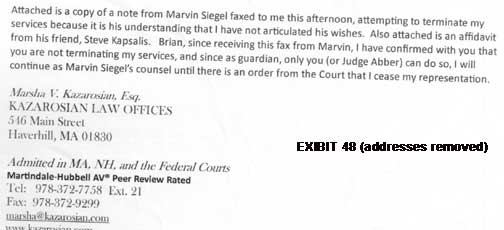
Mr. Siegel attempted to fire Kazarosian for going against his wishes, but she refused to be fired. Instead, she took his signed, hand-written dismissal letter and consulted with the court-assigned guardian, Attorney Brian Cuffe. Together, the two – in spite of the letter – agreed that he would keep her on the dole, his team, protecting Mr. Siegel’s estate from his daughters and grandchildren.

 Cuffe


Yes, you read that right. To date, two of the three daughters have been accused by the various court-appointed parties and those who have drained money from their father’s estate of taking advantage of their father, specifically blaming the daughters for the loss of funds. What? Why? Because, if the daughters would simply shut up and go along and get along, and not object to the guardian’s and the lawyer’s handling of their father’s funds, then no one would have to go to court to fight the daughters. That way the lawyers would not have to bill such large sums, draining his accounts so quickly. What?

At one point, one of the daughters submitted that she was offered a $100K settlement if she would just simply walk away from her father and his millions. She termed it a bribe, and refused.

Out-gunned, Out-maneuvered

Two of the daughters filed multiple “complaints for emergency and preliminary injunctive relief” against various parties whom they have accused of having a part in the taking of funds from their father. The accused parties have included, but are not limited to the following:

BNY MELLON ASSET
MANAGEMENT, LLC,

BRIAN NAGLE of BNY Mellon,

BURNS & LEVINSON, LLP,

LISA CUKIER, ESQ,

LAURA STUDEN, ESQ.,

TARLOW BREED HART &
RODGERS, PC,

EDWARD TARLOW, ESQ.,

ALBERT DeNAPOLI, ESQ.,

CATHERINE WATSON, ESQ.,

KAZAROSIAN COSTELLO &
O’DONNELL, LLP,

MARSHA KAZAROSIAN, ESQ.,

WALTER COSTELLO, JR., ESQ.,

BRIAN CUFFE, ESQ.,

JAMES FELD, ESQ.,

ROBERT LEDOUX, ESQ.,

MAXA BERID, ESQ.,

BERID & SCHUTZ BANK, LLC,

ELDER SERVICES OF MERRIMACK VALLEY, INC.,

THOMAS BARBAR, ESQ.,

 Barbar

DIANE POWELL, SCOTT DAILEY, MICHAEL SPRINGMAN, with Elder Services of Merrimack Valley, Inc., and individually,

CHERI MYETTE, ESQ.,

MICHAEL NOVACK, LICSW, with ELDER RESOURCES, INC., and individually,

MARY ANN REMILLARD, ESQ., in her official capacity as a State actor and individually, NORTHEAST HOSPITAL CORPORATION, d/b/a BEVERLY HOSPITAL,

WHITTIER HEALTH NETWORK, INC., d/b/a WHITTIER PAVILION,

RICHARD GARMIL, ESQ., in his official capacity with Whittier Pavilion and individually,

MERRIMACK VALLEY HOSPITAL, d/b/a STEWARD FAMILY HOSPITAL, INC.,

DR. JANICE FUNK,

DR. PING CUI,

PIERCE & MANDELL, PC ,

BRANDON SAUNDERS, ESQ.,

DR. KAI HAYES,

DR. ROBERT PORTNEY,

DR. PETER W. COHEN,

KENNEY ENTERPRISES, LLC,  d/b/a RIGHT AT HOME,

BRENDA WOJICK, R.N., in her official capacity with Right At Home and individually,

SHERYL SIDMAN,

ALAN SIDMAN,

COMMONWEALTH OF MASSACHUSETTS

But the family notes that they are out-gunned, out-financed, and at every turn out-maneuvered. The lawyers they have gone up against, and the corporations, and those (Cuffe and others) who can use their own money as well as their multi-millionaire’s father’s money against them have had a clear advantage. And the courts have not been kind to the daughters.

Indeed, in one rebuke, the daughters were apparently slammed by the courts for excessive filings. “We’ve been hit with judgments because we’re fighting these people and have submitted too much paperwork, can you imagine?” daughter Lisa Siegel Belanger related. “I submit the documentation because I don’t want this to be about our opinion, or who is credible or not credible. I submitted the documents so that anyone who cares can read them and rule on the facts. The facts are there. The documents show what they have done, how they are drugging, isolating, and draining my father’s funds.”

To summarize the case, which has been in and out of probate court, and pending now in new filings, the family wrote the following:

“With well-established circumstances, Attorney Siegel memorialized his own unequivocal intentions and desires in a panoply of executed estate planning, he explicitly designated his youngest daughter, Attorney Lisa Siegel Belanger, as his attorney-in-fact and his eldest daughter, Devora Kaiser, as successor attorney-in-fact. The two outmost important things Attorney Siegel cared about was: 1) his reputation and dignity and 2) his three (3) daughters.

Through a convoluted vortex of circumstances, on August 4, 2011, multi-millionaire Attorney Siegel was thrusted under a court appointed guardianship and conservatorship, unlawfully ending up with judicially deemed ward of the Commonwealth on August 17, 2011.”

With their father’s wishes being ignored, and getting no relief from probate court, the daughters had attempted an appeal to federal court. One portion of the transcript notes a daughter stating: “This initially starts off before that where my father, Attorney Siegel, had his established durable power of attorney and array of estate planning instruments for a long and continuous [time]…we’re here because of the fraudulent ouster and dismantling of that durable power of attorney.”

In English, that means that the daughter is accusing and presenting evidence that those in power – from the doctors to the hospitals to the lawyers entrusted with handling her father’s estate, dismantled years of estate planning instruments, stripped away all powers from the multi-millionaire, began a process of administering various drugs, have aided in isolating him from his family, and have been a party to draining his estate.

On page 31 of 97 of just one filing, the family states that a lawyer, cognizant that Mr. Siegel was being “involuntarily drugged with antipsychotics,” did “surreptitiously, through fraud and deception…” secure a signature from Mr. Siegel which set off a chain reaction, undoing years of his estate planning, while Mr. Siegel was in a psychiatric facility for two days of evaluation. The results of the evaluation showed no psychiatric issues and Mr. Siegel was subsequently released to his home.

EDITOR’S NOTE: While our team continues to acquire, inspect, assess, and evaluate the copious documents related to this case, we have been given two warnings which we have been instructed to relate to our readers:

1.  All parties on both sides are presumed innocent until proven otherwise, through all appeals processes.

2. Seniors who don’t have millions of dollars are similarly at risk. Why? Because they may be worth tens or hundreds of thousands of federal or state dollars in Medicaid or other government programs, and that any assets they may have may similarly be subject to plunder by those who are unscrupulous.

We’ll relate more on this case, and others, in future issues of the Boston Broadside.

From ND ILL Fed Ct–Changes to Rules re: filing of Answers and Motions to dimiss

Apparently a Mandatory Answer with a Motion to Dismiss is no longer required.

The Northern District of Illinois launched a Mandatory Initial Discovery Pilot (“MIDP”) on June 1, 2017.  The three-year pilot has now been in effect for 18 months, and the judges of the district have decided to modify it slightly.

During the first 18 months, the MIDP has required parties in civil cases to file answers to complaints even when they file a Rule 12(b)(6) motion to dismiss or similar motion.  Answers are not required if motions to dismiss assert jurisdictional or immunity defenses.  As you know, answers trigger the 30-day period for the exchange of MIDP responses.  The MIDP requires these early answers to ensure that MIDP responses are exchanged at the outset of the case.

Effective December 1, 2018, the MIDP will be amended to provide that answers are due under the time periods established by Rule 12(a).  Rule 12(a)(4) provides that answers need not be filed while a Rule 12 motion is pending.  As a result, answers no longer will be required — and the MIDP response period will not be triggered — while a motion is pending under Rule 12(b)(6) or any other provision of Rule 12.  Under Rule 12(a)(4), even if a motion to dismiss is filed, the Court retains authority to order an answer and/or permit the parties to make Rule 26(a)(1) initial disclosures and commence discovery under the Federal Rules of Civil Procedure.

The District is making this change in response to comments suggesting that the early-answer requirement of the MIDP imposed unnecessary costs on parties who ultimately succeed on Rule 12 motions.  Making the change midway through the MIDP will also allow the FJC to evaluate both approaches to mandatory disclosures.

The Standing Order Governing Mandatory Initial Discovery Pilot Project and related documents will be amended to reflect this change.

This message was sent by the United States Courts

[Message clipped]  View entire message

From JP: Case Law on pro se litigants

this is for when you’re pro se and screw up a bit.

The courts should help you out, at least a bit.

Due process issue unique to pro se litigants is what role the Rules of Civil Procedure should play. The Rules attempt to define a fair method of procedure, but an unrepresented litigant kindly asks for exceptions because when applied the method of procedure needs to be learned. In effect, courts liberally interpret the Rules to the benefit of pro se litigants. As described above, this is supported by Rule 1, which states that courts should consider the goals of fairness, speed, and cost, and Rule 94, which allows the rules to be relaxed or dispensed with when necessary. Since the plaintiff is attempting proper procedure in good faith, I ask the court to grant this leave to file a proper objection found in prior judgment. However, the Rules also place a premium on uniform treatment. The Alaska Supreme Court has noted that the Rules were promulgated for the “specific purpose of giving fair and reasonable notice to all parties of the appropriate procedural standards that should be uniformly applied when any party, including a pro se litigant, seeks relief in [civil litigation].” Reconciling the preference for efficiency and fairness with the preference for uniformity creates problems when applying the Rules to pro se litigants. Another source of difficulty stems from the diverse population of pro se litigants. For the represented litigant, the judge can rely upon a set of expectations of what the attorney will know. With a pro se litigant, on the other hand, the judge is likely unaware of how much legal knowledge any particular pro se litigant has. Thus, it is unclear what degree of leniency is necessary to permit a fair result for a particular unrepresented party. For this reason the court must allow pro se litigant to correct his prior pleadings.

Non lawyers do not have the same know how as lawyers and are left Technically Challenged:

Even though the pro se litigant took on the court procedure by himself, the plaintiff is not to be held to the same standard as a lawyer. Jenkins v. McKeithen, 395 U.S. 411, 421 (1959); Picking v. Pennsylvania R. Co., 151 Fed 2nd 240; Pucket v. Cox, 456 2nd 233 Pro se pleadings are to be considered without regard to technicality; pro se litigants’ pleadings are not to be held to the same high standards of perfection as lawyers. The plaintiff just would like a fair shake at reaching justice since abused by the court.  Maty v. Grasselli Chemical Co., 303 U.S. 197 (1938)

“Pleadings are intended to serve as a means of arriving at fair and just settlements of controversies between litigants. They should not raise barriers which prevent the achievement of that end. Proper pleading is important, but its importance consists in its effectiveness as a means to accomplish the end of a just judgment.” Since the prior error was not intentional, and no party would be prejudiced, this court should grant the relief requested.  Just because Plaintiff is pro se, no punishment come to the plaintiff for that reason alone. Sherar v. Cullen, 481 F. 2d 946 (1973)

“There can be no sanction or penalty imposed upon one because of his exercise of Constitutional Rights.”

From Joanne;

I hope this helps some pro se litigants.

I have some more articles on pro se leniency on this blog.

From FB: Chicago’s Homan Ave Police station riddled with police violence and torture–demand it be shut down!

Documents disclosed in Guardian lawsuit reveal for first time how Chicago police used punches, baton blows and Tasers at the off-the-books interrogation site

‘I was struck with multiple blows with open and closed fist by two officers ... I felt my face start to swell and deform instantly.’
 ‘I was struck with multiple blows with open and closed fist by two officers … I felt my face start to swell and deform instantly.’ Illustration: Jan Diehm for the Guardian

Internal documents from the Chicago police department show that officers used physical force on at least 14 men already in custody at the warehouse known as Homan Square.

Police used punches, knee strikes, elbow strikes, slaps, wrist twists, baton blows and Tasers at Homan Square, according to documents released to the Guardian in the course of its transparency lawsuit about the warehouse. The new information contradicts an official denial about treatment of prisoners at the facility.

The injured men are among at least 7,351 people – more than 6,000 of them black – who, police documents show, have been detained and interrogated at Homan Square without a public notice of their whereabouts or access to an attorney.

None of the men identified in these newest documents had fled custody or were injured in the course of a lawful arrest. All were subject to force by Chicago police officers after they were already in custody at Homan Square. According to depositions with officers and more than two dozen first-hand accounts, handcuffing is standard. Police applied force to some arrestees sufficient enough to warrant hospitalization.

Some of those injured by police inside Homan Square told the Guardian they had experienced chronic pain or impairment years later. One said he was instructed by police to lie about his strangulation, which police claimed on an official form resulted from the already handcuffed man “manag[ing] to put another flex cuff around his neck”.

The Chicago police department, now under federal investigation after suppressing video evidence of its lethal shooting of 17-year old Laquan MacDonald, last year took exception to the Guardian’s reporting about the Homan Square warehouse.

While the department conceded that it uses the warehouse headquarters for the organized-crime bureau as a site for conducting “interviews”, it “unequivocally” denied using violence on detained men and women.

“The allegation that physical violence is a part of interviews with suspects is unequivocally false, it is offensive, and it is not supported by any facts whatsoever,” the CPD insisted on 1 March 2015.

Yet facts supporting the claim for at least 14 men were contained in police files at Homan Square itself. They were released after the Guardian sued under Illinois’ freedom of information law for extensive documentation about the detentions and interrogation practices of the warehouse.

Pinterest
 ‘The business going on at Homan Square is like nothing else’ – video

Documents released to the Guardian include the account of a man who died in police custody under questionable circumstances. His family and friends, supported by an independent autopsy that materially differs from the one Cook County performed, believe the police killed him and covered it up. The Guardian will tell his story tomorrow.

The documents include hospitalization records and a standard form documenting the use of physical force called a Tactical Response Report. The form includes a follow-up review conducted by a superior officer. In all cases obtained by the Guardian, the reviews found the use of force to be justified, even when the officers did not interview the victims.

One case described in the documents reveals that a man was Tasered in Homan Square and had to be treated at Mount Sinai hospital.

According to two Tactical Response Reports, the man represented an “imminent threat of battery” and performed an “attack without weapon”. Police listed that attack as “swinging arms” and “kicking legs”. One of the forms details that police “restrained the offender legs”.

A lieutenant who reviewed the case “concluded that the member’s actions were in compliance with department procedures and directives”.

One week later, police hit another prisoner who was listed as an “assailant” launching an “attack without weapon”, namely “spitting blood”. His subsequent hospitalization was described as “for injury that occurred at the Homan Square police facility and not as a result” of his actual arrest. A reviewing officer wrote that the “arrestee stated he was not fighting with arresting officer. Arrestee stated he did not assault anyone.”

Another Homan arrestee who “had to be carried and again spit on and struck and kicked officers” was punched, “placed in an armbar” hold, and subjected to a “take down/emergency handcuffing”, a procedure to force someone to the floor.

A fourth man, arrested for marijuana possession, was punched in custody at Homan Square, to the point where the officer conceded on the form that the man was injured. It was said he “grabbed the officer’s leg”.

A Tactical Response Report from the Chicago police department.
Pinterest
 A Tactical Response Report from the Chicago police department. Photograph: Chicago Police Department

A fifth man, taken to Homan Square on 4 July 2014, was struck in the knee after he “flail[ed] arms and body”, according to the documents. An interview with the review officer recorded the man saying “he was tired of the streets and started crying … he was tired of letting his family down and he was selling drugs because he was homeless. Subject stated he was sorry for resisting the Officer and is just tired of jail.” The review officer concluded the knee strike was “in compliance with department procedures and directives”.

In a statement to the Guardian, the Chicago police department said: “The Chicago Police Department takes allegations of excessive force very seriously. In Chicago, all use-of-force cases require extensive documentation using the tactical response report. These cases are then vigorously investigated by an external, civilian-led agency known as the Chicago Independent Police Review Authority (IPRA). We stand behind our initial statement and our unwavering commitment to the highest levels of accountability and professional standards for our officers.”

Other incidents described in the newly released documents raise questions about the veracity of the police accounts.

A hospitalization case report from the Chicago police department.
Pinterest
 A hospitalization case report from the Chicago police department. Photograph: Chicago Police Department

On 27 December 2001, Mark Rideaux, then 40 years old, took “someone from the block to pick up some drugs”, he remembers. Unbeknownst to Rideaux, an undercover officer was standing in line to buy drugs, and on his way back, police stopped the car he was driving. It was stolen. Police took him to Homan Square.

Rideaux was secured by his left wrist to the wall of a second-floor cell. What Rideaux said happened next directly contradicts a highly unusual account that police at Homan Square placed on an official report.

Mark Rideaux.
 Mark Rideaux. Photograph: Illinois Department of Corrections

According to the hospitalization case report, disclosed to the Guardian as part of its lawsuit, a desk officer “heard a scream” coming from the cell and found Rideaux “unconscious” from a “self-inflicted” injury.

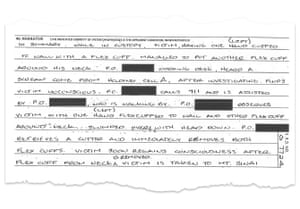
“While in custody, victim, having one hand (left) cuffed to wall with a flex cuff, managed to put another flex cuff around his neck,” an unspecified officer’s report states. Police cut off the cuff and sent him to Mount Sinai hospital for treatment.

Rideaux tells a far different story.

Letter from Mark Rideaux.
Pinterest
 Letter from Mark Rideaux. Photograph: Mark Rideaux

In his Homan Square cell, an officer aggressively questioned him about guns and drugs until things got “out of hand”, he remembered.

“I did not recall what I said that made him so up-set, but thats when he [put] the Flex-Cuff around my neck,” Rideaux wrote to the Guardian from prison, where he is serving a narcotics sentence.

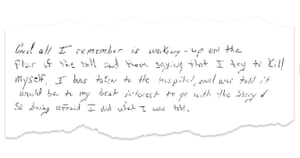
“All I remember is waking up on the floor of the cell. and them saying that I try to kill myself. I was taken to the hospital and was told it would be in my best interest to go along with the story! So being afraid, I did what I was told.”

Officers took Rideaux from his Mount Sinai hospital bed to the notoriously violent Cook County jail. Despite the jail’s reputation, Homan Square hung over Rideaux’s head.

“I was told that I would have to go back to Homan Square if I [didn’t] keep my mouth shut!! So I did, and that’s the story.”

More than 12 years later, as police were arresting 22-year-old Dwand Ivery on a drug-distribution charge, one officer suspected Ivery had swallowed the illicit evidence. His response was to choke Ivery into spitting out “whatever it was he believed I ingested”, Ivery recalled in a letter to the Guardian from prison, with the officer’s partner, the driver of their vehicle, urging him to stop, “telling him ‘not outside’”.

CPD’s Tactical Response Report on Dwand Ivery
Pinterest
 CPD’s Tactical Response Report on Dwand Ivery (A/OS: arresting officers; Unit 189: Homan Square-based narcotics unit). Photograph: Chicago Police Department

As they drove to Homan Square, the officer, still convinced he could get Ivery to spit out drugs, used a metal object “in the shape of a short ink pen” as a tongue depressor “while applying pressure to my stomach with his left elbow”. He pressed down on the back of Ivery’s neck, effectively folding him over. “He held my head in that position until we reached the garage of Homan Square police station,” Ivery wrote, and despite his vomiting, “no drugs was never recovered”.

Ivery has asthma issues, he said, and the pressure on his stomach, neck and throat had caused him to continue vomiting. He was having trouble breathing. As the car pulled into Homan’s garage, he refused to get out and demanded the officers take him to the hospital. Additional officers rushed over – not to aid Ivery, but to restrain his legs. “I was cuffed around my ankles and [dragged] upstairs and placed in a cage,” he recalled.

The police version describes the incident somewhat differently: “Ivery was aggressive in the transport vehicle, yelling, attempting to kick A/Os [arresting officers] and headbutted A/O [redacted] in the backseat. Ivery spit on all A/Os in the vehicle. At Unit 189 [the Homan Square-based narcotics unit] Ivery had to be carried and again spit on and struck and kicked officers.”

From his “cage”, Ivery was moved into an interrogation room and cuffed to a metal bench. When the officers told him to stretch his legs straight out so they could remove his shoes, Ivery again refused and demanded medical attention. According to Ivery’s account, the police turned violent.

Letter from Dwand Ivery
Pinterest
 Letter from Dwand Ivery. Photograph: Dwand Ivery letter

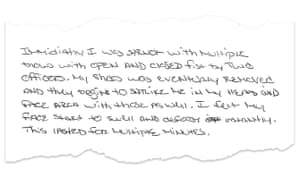
“I was struck with multiple blows with open and closed fist by two officers. My shoes was eventually removed and they began to strike me in my head and face area with those as well. I felt my face start to swell and deform instantly. This lasted for multiple minutes,” he wrote, until a plainclothes officer, hearing the commotion, went over to the interrogation room and told the cops Ivery had had enough.

Ivery recalled being left alone for the the next three to four hours before the plainclothes officer returned, asking if Ivery wanted “to help myself out”. Ivery requested a phone call and an asthma pump.

“He told me if I give him a address of a house that I knew had drugs and or guns in there he could turn the info over to the state prosecuter and they would release me. I didn’t have that type of information,” Ivery wrote.

Left by himself at Homan Square for what he estimates was another “2-3 hours”, Ivery recalled that he “constantly screamed” for medical attention and a phone call. Like hundreds of others, he instead was taken to the nearby formal police district station at West Harrison Street and South Kedzie Avenue for booking. But the booking officers there “refused to accept me [due] to my condition and the deformation of my face”, he wrote, and insisted they couldn’t book Ivery until he received medical attention.

The police report on Ivery acquired by the Guardian bears that out: “Subject is currently being treated at St. Anthony’s hospital,” it reads.

Checked boxes on the Tactical Response Report describe the police’s repertoire of force. The boxes checked for Ivery’s behavior are: “Did Not Follow Verbal Direction”, “Stiffened (Dead Weight)”, “Pulled Away” and – regarding a man restrained at the wrists and ankles – “Imminent Threat of Battery” and “Attack Without Weapon”. Other boxes are checked to indicate that an officer out of uniform suffered an injury.

The police officers’ responses are described through checked boxes as well: “Member Presence”, “Verbal Commands”, “Escort Holds”, “Wristlock”, “Armbar”, “Open Hand Strike”, “Take Down/Emergency Handcuffing”, “Closed Hand Strike/Punch”.

The form also includes a review by a senior officer into the incident. While the name of the officer is redacted, he or she concluded “the officers used reasonable force to effect the lawful arrest of the assailant/suspect” and the force used was “in compliance with department procedures and directives”. The reviewing officer did not interview Ivery.

The beating “leaves me with a deformed face, lack of vision in my left eye and multiple mental health problems that I now have to be medicated for, including anxiety and depression”, Ivery wrote to the Guardian. “That situation changed my life in a number of different ways.”

Zach Stafford in Chicago contributed reporting.

From NL: how do I write a summary judgment motion and what is that?

I have to tell you, most law school grads don’t know how to write one either, so if you are pro se, don’t fret this.

The stages of litigation, for your background info are this 1) file and prepare complaint; 2) draft up written discovery to your opponent(s) which will be interrogatories (fancy word for questions), requests for documents and requests to admit; 3) get back answers (if you don’t, you have to file a motion to compel and maybe a rule to show cause); 4)  depositions of fact witnesses (you will likely need a lawyer for this, get one cheap and limit his or her representation to just your depns); 5) experts.  hire a expert if needed or helpful.  they will produce a report.  your opponent will likely then get an expert.  if there are depositions, get a lawyer, just for those, you will likely not know how to make objections and preserve testimony for trial, plus lawyers know how to ask the really incisive (annoying) questions; then you have to do your trial prep and 6) hire a lawyer for trial.

This will keep things cheap unless you can find a contingency fee lawyer.  But due to corruption in the courts, your chances of getting that are slim to none. This is because you will need an honest lawyer that can’t be paid off.  Many lawyers can be paid off (sad to say).  And your lawyer must be honest enuf they won’t every bribe anyone. So that means your opponent in the current environment will be at a disadvantage because in our current system, we don’t test for psychopaths with a PET brain scan, so your opponent will bribe, but you and your lawyer will not.  So you will often be pro se fighting a difficult system.  But we have to do it to clean up the current system. Take everything to a jury trial. Do not settle or you are just a hypocrite too.

At the first stage of the trial, and after depositions and discovery is all returned, you may wish to file a Summary Judgment Motion and/or Judgment on the Pleadings.  You can really file both, and they’re pretty much the same.  That’s two bites at the apple.  Many lawyers do not do this, but you can.

What you are saying is that your opponent found no credible evidence of anything and you are entitled to judgment as a matter of law.

How to write  Summary Judgment Motion:

  1.  Write an introductory paragraph.  This will say what litigant is filing it (name and if you are plaintiff or defendant or a cross claimant, etc.) and your best reasons (use 3 to 5) of why you are entitled to Summary Judgment as a matter of Law.
  2.  Next is your “Statement of Facts”.  You do this in the following format:  “1. on X date, this happened.  2. on Y date this happened.”  You might want to include the procedure in the portion of your Motion, or you might want to do a separate “Statement of Procedure” to bring your judge up to date.  Remember you write these pleadings for an appellate judge or a new judge.  Don’t skip over facts because you think “the judge knows my case, s/he knows me”. Forget that nonsense.  The judge has 20 other cases per day, they are elderly and likely have short term memory loss and bad eyes.  Tell your story. Don’t skip this important part.  Your judge can be diagnosed with cancer or heart disease any day. Write like you are writing for the appellate court or a new judge every time you file a Motion.
  3. Motions are supposed to be in short, concise numbered paragraphs. They are short (3 to 5 pages).  Put your details and case law in a Brief to accompany the motion.  If the judge or court has a page limit, be sure to stick to that.  But most judges get tired of reading after 15 pages, so 15 pages of great concise writing is a laudable goal.
  4. Tell the court why you are entitled to Summary Judgment as a matter of law. Look at the complaint.  Do they have all the required elements of each cause of action to go to trial.  Look at your case law.  They should have pulled 2 to 3 cases at the time you prepared your complaint to find the elements for each tort.  Find cases that say they are missing one or more elements.
  5. MOST IMPORTANT.  A clear list of undisputed facts that will entitled you to summary judgment.  You can put this as an exhibit.  Make your opponent dispute this.  All you need is just ONE disputed material fact to get before your jury.  So look at the depositions and affidavits filed. Come up with your own affidavits to dispute some facts.

I have seen some really terrible SJM motions.  You have to be clear about what is undisputed. SJM’s are not favored; jury trials are.  Or at least in theory.

If you are defending a SJM, come up with disputed facts and put them in an affidavit or declaration.

Whatever court you are in (federal, state, etc.) read the rules before submitting any pleading. There are generally specific rules for Summary Judgment Motions. Read them carefully before filing your pleading.  Law is all about following rules.  Someone with a weak argument can easily win over good case law with no compliance with rules.  No compliance with rules can easily tick off a judge into oblivion and win your case.  Remember, judges are often perfectionist entities who went to law school with tons of reading and tons of deadlines and case law. they want you to be conservative about this and perfect in your pleadings.

In Illinois, always file verified pleadings.  Once one pleading is verified, your opponent must also verify pleadings.  If they don’t, ask to strike or dismiss the pleading.

Always do a Notice of Filing, a Certificate of Service and Verification at the end of your pleadings.

Good Luck

Email me if you have questions and I will be glad to do a general blog post in response.

Joanne


From JB: what about criminal complaints for Probate perps?

One common question I get, is why won’t the states attorneys, police, FBI, etc. do anything about the fact that the probate court system is a large criminal enterprise where the elderly or disabled are targeted for a paid up home, cars, bank accounts, etc.  Then they are guardianized, often without notice, service, they want to fight the gship, but they either get no attorney, or the attorney is tied into the system. Then the house is sold and everything is sold, and the elderly person is forced into a nursing home, drugged with psych drugs (which are illegal and not FDA approved for the elderly) and massive attorney’s fees, courtroom vendor fees (case managers, etc.) are charged against the estate.  When that is quickly depleted, then food and water is with held and the senior quickly perishes. The body is quickly cremated to destroy all trace of chemicals and lack of food in the stomach for days.

Many ask, why aren’t these crimes prosecuted?

The reality is, that’s up to the prosecutor. Prosecutor’s have “prosecutorial discretion” which means that they are the only ones to bring criminal charges and they do this based up the evidence, how the judges respond to these types of cases with this type of evidence and how juries respond.  They have to have a criminal deft found guilty beyond a reasonable doubt, which is a very, very high standard.  One reasonable doubt and the defendant must be acquitted.

In addition, if the prosecutor loses, then the defendant can sue for 42 USC 1983 deprivation of civil rights under color of authority, false arrest, false imprisonment, abuse of process, malicious prosecution and intentional infliction of emotional distress, and damages can be substantial, especially if someone was harmed during the arrest.

And taxpayers pay for those cases.

Many people want to reinstitute the grand jury system or people’s grand juries where 12 or more persons decide what and whom to charge.  If they do that, the people should be trained to minimize the risk of suit against the state or US.

Finally, your prosecutor is elected.  Campaign against these prosecutors who let this happen.  Force them out of office by convincing the voters he or she is not doing their job.

You could sue the prosecutor for misfeasance or malfeasance in office if they are not doing their job and going after all criminals too.

But this basically explains the problem with criminal charges in probate in a nutshell.

From DK; this Guardian is so abusive she took away an abused ward’s library card and bicycle!

Please feel free to write or call this woman and tell her to stop her abuse of poor Douglas Keegan who is now fighting for his rights to be free of an abusive guardianship in Orange County Florida…. more to come.

JUSTICE 4 EVERY1, NFP
5330 W. Devon Ave. #6 JoAnne Denison, Executive Director*
Chicago, IL 60646 Cell Phone 773-255-7608
ph 312-553-1300 http://www.justice4every1.com
fax 312-553-1307 JoAnne@Justice4Every1.com

November 7, 2018

Via Email heather.ramos@gray-robinson.Com

Heather Ramos
301 East Pine Street, Suite 1400
Post Office Box 3068 ( 328 0 2-3068 )
Orlando, Florida 32801
Tel 407-843-8880
Fax 407 -244 -5690

RE: In re Guardianship of Douglas Keegan 20 I 4-CP-002772-0.

Dear Ms. Ramos;

I am in receipt of a letter dated 4/24/18 which you sent to the putative “guardian” of Mr. Doug Keegan in which you 1) asserted cooperation in wrongfully terminating his library card; and 2) offered cooperation in a highly abusive guardianship case.

As you are aware, under the Rules of Professional Conduct for Florida you should be taking no such action against a person who 1) is clearly competent, knows the time, date, place who the President is, etc.; 2) had complained reasonably about his guardianship being a ruse and the guardianship has been extremely physically and emotionally abusive to Mr. Keegan. All these documents are of public record.

From the Rules of Prof. Conduct, preamble:

A lawyer’s conduct should conform to the requirements of the law, both in professional service to clients and in the lawyer’s business and personal affairs. A lawyer should use the law’s procedures only for legitimate purposes and not to harass or intimidate others.

This is to advise you that Mr. Keegan is under an abusive guardianship. Your taking action against an alleged Ward of the State of Florida who only wants to use a computer to contest his court case and read books is amazingly unethical, immoral and utterly reprehensible.

I am demanding at this time that you fully restore the rights of Mr. Keegan to full library access and treat him as the highly respected individual that he truly is.

Very Truly Yours,

/s/joannemdenison/

JoAnne Denison
Executive Director
Justice 4 Every1, NFP
cc: http://www.marygsykes.com

Request for aide to Ward in abusive guardianship–Man in Fla. in immediate need of bicycle

Please contact me if you can get a man in an abusive gship a bicycle. He is in Orlando.  The Guardian keeps on stealing his bicycle and selling it, so if you have a good lock, that would be great.

This man is completely competent, was working as an engineer, is extremely intelligent, and got caught up in an abusive guardianship when some attorney relative got mad at him and sucked him into the Florida gship system, which we all know is very, very corrupt.

They have sold his homes for lawyer fees, his cars and anything they could get their hands on. He is always on the run.

Joanne

from JK on Facebook: Star Chambers mean no representation and self representation was banned

From James Kelly

A quote from In Faretta v. California, 422 U.S. 806, 821 – 23 (1975). The Supreme Court:

“ In the long history of the British jurisprudence there was only one tribunal that ever adopted a practice of forcing counsel upon an unwilling defendant in a criminal proceeding. The tribunal was the Star Chamber, that curious institution which flourished in the late 16th and 17th centuries, was of mixed executive and judicial character, and characteristically departed from common law traditions. For those reasons and because it specialized in trying “political” defenses, the Star Chamber has for centuries symbolized disregard for basic, individual rights. The Star Chamber not merely allowed, but required defendants to have counsel. The defendants answer to an indictment was not accepted unless it was signed by counsel. When counsel refused to sign the answer, for whatever reason, the defendant was considered to have confessed (See, J.Stephen, “A history of the criminal law in England”, 341-42 (1883) As Stephen commented on this procedure, “There is something especially repugnant to justice in using rules of practice in such a manner as to debar a prisoner from defending himself, especially when the object of the rules so used is to provide for his defense” (end quote)

and now rewritten:

“ In the long history of the American jurisprudence there was only one tribunal that ever adopted a practice of forcing counsel upon an unwilling person in a quasi-criminal proceeding. The tribunal was the Family Courts, that curious institution which flourished in the 20th and 21st centuries, was of mixed executive and judicial character, and characteristically departed from common law traditions. For those reasons and because it specialized in trying “psychological” defenses, the Family Courts have for decades symbolized disregard for basic, individual rights of children. The Family Courts not merely allowed, but required children to have counsel. The children’s answer to a motion was not accepted unless it was signed by counsel. When counsel refused to sign the answer, for whatever reason, the child was considered to have supported it (See, the millions of families that have gone through the process of a custody proceeding. As they regularly comment on this procedure, “There is something especially repugnant to justice in using rules of practice in such a manner as to debar a child from their Constitutionally protected rights, especially when the object of the rules so used is to provide for the child’s best interests” (end quote).

from YT and JO: what is it that states attorneys actually do for their pay?

We all know when we have corrupt court cases we are supposed to go to our state AGs and complain. But most of the time we just get a sigh and they’re not interested. In the case of Lisa Madigan, she not only sighs but says “we don’t do such things” when we know for a fact she is charged with such things. But then again, she’s not running I am told.

So take a look at what the John Oliver investigative team found out about state AGs

From FB: District Court judge admits severe problems in TX foster care system

https://www.impactfund.org/social-justice-blog/texas-broken-foster-care-system?fbclid=IwAR1qeOCEJ0tSxgzOui4rSPLEeip5RkmPllDs2f80OmXHL9sd4CLPfrcjdYY


Kristopher Sharp – who spent years in Texas foster care – opens up about his experience and praises a recent federal court ruling in M.D. v. Perry calling for specific reforms to the state’s child welfare system. The case was brought by national advocacy organization Children’s Rights and Texas co-counsel Haynes and Boone, LLP and Yetter Coleman LLP.

In her Dec. 17 ruling against Texas’ foster care system, U.S. District Judge Janis Jack was scathing. For more than two decades, she wrote, the state has created a situation where “children have been shuttled throughout a system where rape, abuse, psychotropic medication, and instability are the norm.”

I was one of those children.

I was born in Dumas, deep in the heart of West Texas. I entered the foster care system shortly before my 10th birthday. My mother was an addict — meth being her drug of choice — and would routinely beat me when she was high. My father was a Vietnam War veteran who suffered from PTSD and lived in and out of psychiatric intuitions and halfway houses for most of my childhood.

When the state removed me from my family in the winter of 2000, I thought I would finally have the chance to escape the abuse I had become so accustomed to at home. Instead, I was thrust into a nightmare that was worse than anything I had experienced before.

Throughout the more than eight years I spent in Texas foster care, I lived in upwards of 25 different placements and went to roughly the same number of schools all across the state. For the most part, I lived in what is commonly referred to as “congregate care settings,” residential facilities and group homes that typically provide care to 12 or more children, but often housing 30 or more children at a time. Some are the size of prisons.

No matter their size, where they were located or how many children they were charged with caring for, each and every one of them was imbued with abuse.

Growing up in foster care, abuse is the only constant that exists. When I was 13, I was placed in a residential treatment facility in Denton. At that facility, I was molested for the first time by one of my caregivers there — and I was just one of many victims.

The most horrific thing was that I couldn’t tell anyone. At the now-closed facility, we were forced to go to school on the grounds, our phone calls were monitored by caregivers — often by the very person who was molesting us — and it had doors that magnetically locked to guarantee that no child could escape. I was 13 and living in a state-sponsored hell, and there was nothing I could do about it. That was our reality. That was Texas foster care.

By the time I turned 15, I had been beaten and raped more times than I care to remember.

The trend continued until I turned 18 and aged out of system in Houston. Overnight, I was homeless, on the streets with no family, no support and nowhere to turn. Eight years under the conservatorship of the State of Texas, and this was what it lead me to. I spent the next six months on the streets, sleeping on the roof of a shopping strip in Houston at night and relying on the street economy to survive during the day.

There’s no denying that the Texas foster care system is badly broken. Abused and neglected children are being taken from their families, thrust into a system that will almost certainly expose them to more abuse and neglect and then leaving them with little support once they reach adulthood. Instead of caring for these children, Texas has created a state-sponsored pipeline that leads them straight from foster care to the criminal justice system or the streets.

Judge Jack’s findings in this case support what advocates have been saying for decades: The Texas Legislature is vastly underfunding the state’s child welfare system, and our most vulnerable population is suffering because of it.

Although the state has appealed the ruling, the stage is set for what will prove to be a defining moment in the future of tens of thousands of children who will inevitably pass through the system at some point. Will lawmakers give them the tools they need to succeed by investing in their futures and adequately funding the agencies charged with caring for them? Or will they stay the course and continue to allow them to fall through the cracks?

CHIP IN $5 FOR SOCIAL JUSTICE
Please link to the story and read the comments which confirm what is going on.

From FB: Judge scorched by appeals court for denying parents the right to home school their children.

Studies show properly home schooled children fare better on test scores and in graduation rates than public school kids. This judge is right on.

I recently heard of an Illinois case where a judge told a mom not to keep her kid out of Kindercare or she would sanction mom because “kids need to go to school.”  Kindercare?  Really?  It’s daycare, not school, and learning at home with mom (who has a PhD) certainly has to be more enriching than Kindercare.  Some Illinois judges are really idiots and just need to be removed from the bench.  This is one.  Illinois parents have the right to home school, esp. by parents who have advanced degrees, come on now.  And the kid is not even in Kindergarten and her school is only daycare with no educational format by a certified teacher.

Parents have rights.

This mom was beyond words with this judge, so I am not surprised to find this article recently.

https://www.law.com/dailyreportonline/2018/10/22/appeals-court-scorches-judge-for-barring-home-school/

Judge Stephen Dillard. (Photo: John Disney/ALM)Judge Stephen Dillard, Georgia Court of Appeals. (Photo: John Disney/ALM)

Georgia Court of Appeals Chief Judge Stephen Dillard, known for his friendly banter about the Oxford comma and college football with his 14,000 Twitter followers, has taken a trial judge to task for nothing less than what he called usurping the fundamental right of parents to raise their children.

Dillard wrote a 12-page special concurrence for a 10-page decision released Thursday reversing a trial judge who had ordered a mother to stop home schooling her youngest child and commanded the mom to enroll the child in a Montessori school instead.

“The liberty interest of parents to direct the upbringing, education, and care of their children is the most ancient of the fundamental rights we hold as a people,” Dillard said, adding that the concept is “deeply embedded in our law.”

Dillard said this right “preexists government, and may not be interfered with by the State except in the most compelling circumstances.” He said no such compelling circumstances were presented in this case, in which the ruling below was reversed by a panel of three that included Judges Amanda Mercier and Sara Doyle, as well as Dillard. Mercier wrote for the majority.

“I concur fully in the majority’s thoughtful and well-reasoned opinion. As a result, it may be cited as binding precedent,” Dillard said in the first of his 24 footnotes, two of which took up nearly an entire page.

“I write separately to express my serious concerns with the court’s decision to summarily substitute its judgment regarding the child’s education for the mother’s without identifying evidence of the compelling circumstances necessary to interfere with her constitutional parental rights,” Dillard said. “In doing so, the trial court failed to give sufficient consideration to the federal and Georgia constitutions, both of which afford significant protection of a parent’s right to the care, custody, and control of his or her child—which undoubtedly includes the right to make educational decisions.”

Dillard went so far as to invoke the fictional “Big Brother” in George Orwell’s totalitarian tale “1984.”

“When state actors engage in this sort of Orwellian policymaking disguised as judging, is it any wonder that so many citizens feel as if the government does not speak for them or respect the private realm of family life,” Dillard asked rhetorically. “In sum, I take this opportunity, yet again, to remind our trial courts that, in making any decision or taking any action that interferes with a parent-child relationship, our state statutes are subordinate to and must be construed in light of the fundamental rights recognized by the federal and Georgia constitutions—which both include a parent’s fundamental right to homeschool a child.”

The appeal that sparked the chief’s ire is a long-running divorce and custody battle in Bartow County Superior Court before Judge Suzanne Smith. According to the appeals court, Brian and Stefanie Borgers were divorced in 2013. The mother was awarded custody of their three minor children. In the following years, the judge held several more hearings over child support and visitation issues, during which the father was critical of the mother home-schooling the children. After one such hearing, in June 2017, the judge expressed agreement with the father.

“The Court finds it to be a shame that the Defendant Mother has not taught her children to be independent,” the judge said in an order. She added her opinion was “based on the expert witness testifying that the children have issues in small classes as they have been previously home schooled by the Mother.”

The judge held another status hearing in August 2017, after which she issued the home-school order. Mercier’s majority opinion quoted the judge’s order citing the “court’s own beliefs as to the child’s best interest” and ordering the mother to “immediately enroll the child in school and ensure the child is not ‘home schooled.’ ”

The mother argued on appeal that because the final divorce decree made her the primary physical custodian and final decision-maker regarding the children, which included the authority to make decisions regarding the children’s education, the trial court’s order constitutes an “improper modification of custody in this contempt action,” Mercier said. Mercier said that the case was not exactly like others in prior rulings, but concluded that “where a child goes to school is a parental decision.”

The mother was represented on appeal by Joel Thornton of the International Human Rights Group in Rome.

“It’s a case of first impression. This judge was extremely hostile to home schooling,” Thornton said Friday evening. “My client is thrilled to have her right to choose the educational opportunities of her children upheld.”

The father was represented at the trial court by Samir Patel of White & Choate in Cartersville. Patel said by email Friday that the father chose not to fight the appeal because “it would continue the difficulty.”

Patel said the case involved many hearings, but no transcript, and so the appellate record is not complete.

“For example, a psychologist testified that home-schooling the children in this case would be harmful to the children’s welfare,” Patel said. “Certainly I think the court understands a parent’s right to educate her children in the way she sees fit, but the court’s concern in this case was … adequate supervision and whether the children’s home schooling would even meet the very minimal requirements prescribed by state law.”

Though that concern was not fully documented in the record, it’s not at all clear that it would have changed the outcome of the appeal.

“Indeed, this ‘cherished and sacrosanct right is not a gift from the sovereign; it is our natural birthright. Fixed. Innate. Unalienable,’ ” Dillard concluded. “Thus, regardless of a court’s personal feelings or perception of a parent’s fitness to care for or retain custody of his or her child, careful consideration of these bedrock constitutional principles and safeguards must remain central to each case without exception. And when this fails to occur, we will not hesitate to remind our trial courts of the solemn obligation they have to safeguard the parental rights of all Georgians.”

The case is Borgers v. Borgers, No. A18A0910.


From Justice Roberts of the US Supreme court: Bret Kavanaugh will be investigated

If you did not receive a letter like this recently, you might want to call and refile your complaint.

https://drive.google.com/open?id=13s2OteOJ0ibZKKHBcmwRPfFxPHfAR78W

It will be interesting to see what has happened since his prior jurisdiction, the DC Federal Court of Appels received 478 complaints while BK was at that court and all were dismissed without an investigation according to Dr. Cordero.

See the study of the US judiciary and US federal judges at:

The study of judiciaries and judges

From EB: Probate court destroys the lives of both mother and daughter; theft is alleged against lawyers and judge

http://www.oaklandpost.org/2018/10/07/perils-probate-probate-court-destroys-lives-mother-daughter/?fbclid=IwAR37apCvyjeQmySNAPsORnMWgb2FD8DO9Q5fo4-xuys_FoI9ScOWFMJABhQ

Probate court detroys lives of Mother and Daughter

Gerarda White-Penny (left) and daughter London Penny.

Bonnie Lou White and Gerarda White-Penny had a perfect life.  Mother and daughter lived together, each doing their part to get by.  Things changed rapidly after Bonnie Lou White wrote her will and trust, and a cousin found out she wasn’t a beneficiary.

The cousin petitioned the probate court in 2017, and the probate quickly bypassed any claim the cousin thought she had. But that wasn’t the end of it. Probate court officials immediately took over anyway, took out a $900,000 reverse mortgage and installed new doors, windows and floors, all at White’s expense.

After the upgrades, the court was gracious enough to allowed White to live in her home a few months before the conservator moved White to a nursing home.

White has made it clear to the court that she wants to live at home. White has no mental incapacity, she wants to be at home with Gerarda and her grandbaby.

White has been in the nursing home since January, and in September the daughter received an eviction notice.

“I’ve got less than a month before I lose mom’s home.  Our home is worth over $1 million but they’ve listed it at $780,000.  The court is probably going to sell it to one of their friends,” Gerarda said. “They say they’re going to pay medical expenses, but my mom has long-term care insurance.  Why are they doing this to my family?  We were doing fine. The Court said our house needed upgrades so they put in new windows, doors and floors.  Who really needs these things, us, or the people they intend to sell it to?”

“My cousin filed the petition, which made us come to court and they conserved my mother. My cousin is not in my mom’s will and she is excluded in the trust.  All she got was to see my family destroyed.”

The purpose of the probate court is to conserve families, and do what’s in their best interest.

Unfortunately many court appointed officials don’t abide by the rules written in the Probate Handbook.  In the Handbook is written, “when at all possible keep the Conservatee in the home, that’s the best place for them to be.”

Current probate officials are quick to take over conservatorship because that’s how they make their money.  It’s a business, a profession. Gerarda’s story is a common one.

Gerarda is fighting back.  She has filed a petition to dismiss her mother’s conservatorship and taken the civil case to the Alameda County district attorney’s office.  “When people file a petition, especially one where their name ain’t on nothing, the court needs to consider the person’s motivation bringing the petition, or just abide by what the will and trust says. They bypass your trust like it doesn’t exist.  Courts allow these petitions because that’s the wedge they need to take over people and their estates,” she said.

SHOUT OUT JUSTICE and Cedar California recently joined with national probate fighting network “Probate Warriors.”  “We find that the only time we get the court to stop running over us is when we get media attention,” says, SOJ’s Venus Gist.  “Probate Warriors are families committed to fight what is becoming an epidemic of abuse by probate officials and judges nationwide.”

from EB: Hillary Hogue in Fla. hunts down probate court corruption

https://www.yoursun.com/charlotte/news/a-better-system-despite-change-some-still-see-elderly-guardianship/article_764ea9ee-a24d-11e8-bd76-b7a60a2fda87.html?fbclid=IwAR3pj5akqNqHvmk6ByVEs9Dt1CE0cAgf74GS-1ohoBdfVNgQfeGzwjo-E5s

A better system? Despite change, some still see elderly guardianship problems

  • Updated 
  •  3

Hogue lives in Naples, but she said she takes trips around the five counties of the circuit to search for victims of abusive guardianships.

“This is the perfect place for such crimes as Florida is a retirement capital,” Hogue said. “This has become an industry that is fueled by ruthless greed.”

Guardianship reform has been a hot topic across the nation in the last few years, and Florida recently made changes to give the state greater oversight of the system.

As a result, a first-of-its kind administrative hearing in Palm Beach County may bar a guardian from practicing after the Office of Public and Private Guardianship (OPPG), along with the Clerk of Court Inspector General, conducted an investigation into her practices. The Palm Beach Post reported the OPPG is seeking sanctions against guardian Betsy Savitt which have the potential to bar her from practicing in the county and may include repayment of up to $190,000 in guardianship fees.

Hogue believes the problem is just as bad in Southwest Florida and stated attorneys and judges are complicit in guardians’ attempts to control the lives of their elderly wards and deplete their savings.

However, Sara Miles, spokesperson for the 20th Judicial Circuit, which includes Charlotte County, said the allegations of corruption are unfounded and untrue.

“Our judges work diligently to ensure due process and fairness,” Miles said. “The Legislature has recently enacted new guidelines and requirements and a complaint procedure for people to use as a means of maintaining checks on guardians.”

Forty-six adult guardianship cases have been filed in Charlotte County in 2018 so far, but no one tracks how many adults are actually under the care of a guardian. The clerk of court closes the cases once a guardian has been appointed, according to Clerk Roger Eaton. In Sarasota County, 111 guardianship cases have been filed since Jan. 1.

How guardianship works

Adult guardianship happens when the court finds an individual’s ability to make decisions is so impaired that it gives the right to make those decisions to another person. According to Florida law, guardianship is only warranted when no less restrictive alternative is available, such as durable power of attorney, trust, health care surrogate or proxy, or any other form of pre-need directive.

Anyone can file a petition to find an individual incapacitated and have a guardian appointed. Sometimes family is unable to care for an individual, or family members who can’t agree on a loved one’s care may go to the court for a third party decision. However, the petition could be filed by anyone who claims the individual is unable to care for themselves.

There are three types of guardians: family, public, and professional.

Despite the name, family guardians aren’t necessarily performing guardianship services for a parent or grandparent. ‘Family guardian’ simply designates a guardian with three or fewer wards under their care. Professional guardians have more than three wards, and guardianship is their profession.

Gina Rossi, executive director for the Florida State Guardianship Association, said some professional guardians enter the field after becoming the guardian for a family member, while others come through social work or finance fields.

“If you want to become a professional guardian you have to take a 40-hour, in-person course,” she said. “After that, there’s an extensive background check with includes FBI fingerprinting, an expansive credit check, and the Florida guardianship examination. Then if you pass, you are bonded, and you take all that information to the Office of Public and Private Guardians.”

According to Ashley Chambers, spokesperson for the Department of Elder Affairs which houses the Office of Public and Private Guardians (OPPG), the state has the least control over professional guardians, who are paid out of the ward’s assets. Until recently, the guardianship office in the Department of Elder Affairs was called the Statewide Public Guardianship Office.

Now, the OPPG can discipline professional guardians, but their interaction is still limited. While professional guardians register with the OPPG, they conduct their business on their own.

“We have no oversight over professional guardians,” Chambers said. “The only thing we have to do with professional guardians is we do some of their training and keep a registration list.”

In fiscal year 2016-2017, there were approximately 550 professional guardians registered with the OPPG.

Public guardians, who are typically professional guardians who agree to take on guardianship cases for indigent persons, provided services for more than 3,000 indigent wards in fiscal year 2016-2017.

Recent changes

In 2016, facing news reports and personal accounts of guardians taking advantage of the elderly, the Florida state Legislature granted the OPPG statutory power to investigate and discipline professional guardians, changing the name of the Statewide Public Guardianship Office to the Office of Public and Private Guardianship.

“That was the huge change,” Chambers said. “It completely changed the scope of the office. In 2016, the law was signed to give us authority to investigate all the accusations against certain professional guardians. The Legislature acted in order to give us a disciplinary role.”

A statewide toll-free hotline was developed to receive complaints made against registered professional guardians, as well as a website to submit complaints online. As of December 2017, the OPPG had received more than 80 legally sufficient complaints against registered professional guardians. The complaints are investigated by the Clerks’ Statewide Investigations Alliance, and the findings are turned over to the Department of Elder Affairs to decide on next steps.

“There is a range,” Chambers said. “It can be something like a letter of concern, like, ‘We’ve found x, y, and z. This is a letter of concern. It looks bad. It looks like you might not know the procedure.’ And then the higher end of it is an administrative complaint.”

In an administrative complaint, the OPPG could seek anything from restitution for the victim up to revocation of a guardian’s registration, so they can no longer practice.

According to Gina Rossi, most guardians were in favor of the new process and the Florida State Guardianship Association even helped the OPPG write the code of conduct for guardians.

“The standards, generally speaking, raised the profession of guardianship and most guardians, that’s what they want,” she said. “They want the work they do to be reflected in a standard of practice. Guardians felt like this is what they’ve been doing all along, but now it’s part of the law.”

Too little, too late?

Despite the new standards and complaint process, Hogue and others say they felt helpless when their loved ones were placed in guardianship, and some are still fighting the system even after a loved one’s death.

Punta Gorda resident Cristi Kessler is still involved in litigation in her father’s guardianship case in Collier County, even though he passed away last year. Kessler has been unable to get back a special medical bed for her veteran husband’s throat cancer, which she says has been locked down with her father’s property. The bed, intended to help her husband breathe at night, had been loaned to her father when they learned he was sleeping on a 40-year-old mattress.

“This is nothing more than abuse by a probate guardian to a veteran who served his country honorably and lovingly cared for his father-in-law,” she said.

Another Charlotte County woman’s mother-in-law died under the care of a guardian who denied family’s wishes, documented in emails in the court file. Though she declined to share her story, court documents record a disagreement over whether the ward should have been placed in a stroke center, rather than the hospice care the guardian chose.

In Hogue’s situation, she said every 20-minute conversation with her father’s guardian or court appointed attorney would rack up unreasonable bills. Her sister filed the initial petition alleging their father was incapacitated, while Hogue states that petition was full of lies. She says her father never had the opportunity to defend himself, but was instead placed under an emergency temporary guardianship until he could be evaluated for competency.

After the petition was filed, three examiners evaluated Mr. Hogue, one of whom was a gynecologist.

Chambers said while that might seem strange, it’s common for examiners to come from a variety of backgrounds, and all court-appointed examiners receive special training to evaluate competency. Members of the examining committee must receive a minimum of four hours training, per Florida statute.

Ultimately, a professional guardian was not appointed, though Hogue claims both the temporary guardian and her father’s court-appointed attorney pushed for one. Instead, Hogue and her sister agreed to an order which allows Mr. Hogue to live with Hillary while his accountant serves as his power of attorney.

Now, several months after the process has ended, her father is still afraid to leave the house, and her young son fears the “guardianship police” will come take his grandfather away. Still, she considers herself lucky her father got out so easy.

A guardian’s perspective

Gina Rossi said while she doesn’t have knowledge of specific cases, most guardians take their jobs very seriously, and few people realize the amount of scrutiny they are under. Any medical decisions are discussed with family, doctors, nurses, and hospital ethics teams — “everybody you would listen to if it was somebody in your family,” she said.

When it comes to money, guardians must submit detailed financial reports to the court on a yearly basis, which are closely audited by the clerks of court. People might think of guardians as rogue individuals taking control of a ward’s life, Rossi said, but none of the decisions made by a guardian are made in a vacuum.

“A guardian cannot just come in and spend all your money,” she said. “I guess there’s always cases of people being really bad people, but generally speaking the system is not set up so that’s easy to do. You’re literally stealing in front of a judge. That takes a lot of nerve.”

After a ward’s death, Rossi said sorting out the property can be a lengthy process due to the court overseeing the accounting.

“Every case is so different,” she said. “Occasionally, someone will be like, ‘Oh no, that’s my ring, my mom promised it to me,’ but the guardian would not be in a position to give it away.”

In addition to education and networking for guardians, the Florida State Guardianship Association works to educate the public on alternatives to guardianship and how to avoid it.

“We would just encourage people to be educated about guardianship to find out exactly what it is and make sure that all your documents are in place, that you’ve done the best to care for yourself so you won’t need a guardianship,” Rossi said.

She also wants people to know guardians aren’t villains.

“I know so many guardians who have totally changed people’s life, took them from a terrible situation to a safe situation where they had a great quality of life,” she said.

Since creating the complaint investigation process, the state has received 126 guardianship complaints across the state. The administrative complaint against Betsy Savitt is the only one yet to be filed, though Chambers said there may be others going that direction. However, for the five complaints involving professional guardians in Charlotte and Sarasota counties, no disciplinary action was warranted based on the investigate findings, according to the OPPG.

“As a department, if you ever hear of any requests for help from a constituent complaining for something that is putting an elder in jeopardy, that concerns us,” she said. “Now that we have the authority to investigate complaints when they come in, we take that seriously because protecting vulnerable adults is of the utmost priority for the department.”

1

From AA: why is a judge charged with corruption running for office?

DISGRACED “PEOPLE FOR CASH” ​ EXJUDGE STEVE BAILEY,
RUNNING FOR CALIF. ATTORNEY GENERAL? What?
“Ole Juryless, Constitution Out The Window Bailey”–, CHARGED WITH OBSTRUCTION OF JUSTICE FROM THE “PROBATE BENCH”
 
THIS “STINKS”—-DESPITE BEING CHARGED WITH RIGGING CASES AS PROBATE JUDGE. “PEOPLE FOR CASH” TYPE CHARGES, EX PROBATE JUDGE STEVE BAILEY while facing a CA ethics committee during the current election season, is the GOP nominee for California attorney general. Former probate judge Steven Bailey has been accused and evidence presented of his using his judgeship for election purposes, illegally receiving gifts, and rigging cases to direct business and funds to a firms where his son and nephew worked and benefited from……ALL IN VIOLATION OF LAW. Bailey served as an El Dorado County judge from 2009 through the end 2017.
 

From EB: more on Kise Davis and her abusive guardianship in NM

http://www.krwg.org/post/new-mexicos-guardianship-system-raises-serious-questions

New Mexico’s Guardianship System Raises Serious Questions

  OCT 7, 2018

CREDIT PETER GOODMAN

Commentary: A new AARP article reminded me of the day I said farewell to a delightful, courageous Japanese lady named Kise.

A year earlier, her stepson approached me in the market and asked me to help free his Japanese stepmother. She was “like a second mother.” When he first went to Japan at 14, she not only welcomed him but effected a reconciliation with his father.

She’d moved to the U.S. with her husband, who died in 1993. She loved her garden and her cat, but she was aging, and her stepson lived in California. They’d discussed her moving there when living alone got too hard. He’d arranged home-help for her here, but she fired the help.

It was a shock when a neighbor called: authorities had put her somewhere — for her own safety.

He and his wife came to Las Cruces. They wanted to take her to California. They couldn’t. The guardians and their lawyer vilified him.

I helped them awhile, as a lawyer, then referred them to a firm.

As a columnist, I’ve learned from other sources of heartbreaking abuses of New Mexico’s guardianship laws. I was even advised that “clients” were in the charge of a woman who had been fired, allegedly for questionable treatment of clients. (An October 2017 New Yorker article detailed abuses of Nevada’s law, which was especially favorable to guardians taking over people’s lives, even where family was willing and able to help.)

New Mexico’s Supreme Court created a commission to look into abuses and make recommendations. The Commission heard many horror stories. It recommended that when someone is in danger of being committed, family must be notified and given a voice. It also recommended making hearings public. While we’d like to keep such proceedings confidential to protect the person involved, confidentiality allows guardians to abuse their power. (In Nevada, there were numerous cases of an agency taking over a person’s life, collecting handsome sums from the person’s bank account, and refusing families’ efforts to help – or even visit.) Sometimes, though, guardians do wonderful and essential work.

In January 2017, Judge James T. Martin ordered the guardians to try to help Kise move to California. They made excuses. (They’d made clear to me that they had no intention of moving her.) They kept her living with people far less functional than she; and their willfulness cost her and her stepson lots of money. (During one visit, a lady who was intently watching a TV show for young children kept confusing Kise and me with characters in the show. Kise whispered, “You don’t get smarter in here.”)

In February 2018 the Judge ordered them to comply with his 2017 order.

We celebrated with lunch at Aqua Reef. We were so relieved that Kise could finally move to a facility near her stepson’s home, join them for meals, and go to their house to garden. She called them “a godsend.”

I wished I had a videotape of our conversation to show her “guardians.” What was remarkable about our good-bye lunch was that it wasn’t remarkable. Kise was charming and quick-witted. Her stepson and his wife treated her with the love and respect she deserved.

As I hugged everyone, I realized how moved I felt.

It seemed incredible that for over a year her guardian and court-appointed lawyer (perhaps well-intentioned), had charged Kise big bucks to keep her locked up and away from her family.

[I can’t say much more about Kise’s case, except that when I’ve had a chance to talk with her and her stepson, things sound so much better than when she was here.  Nothing against the facility in which she was kept, where the people who worked with her seemed to genuinely like her and be liked by her.  The key problem is that operating in relative darkness, guardians have pretty absolute power over their charges, particularly since in any disagreement a competent-appearing professional has a pretty significant credibility edge on a person who is or may be approaching dementia.  And we know what Lord Acton said about absolute power corrupting absolutely.  Perhaps it’s a wonder that some — perhaps the majority of — guardians are honest and caring and thoughtful.]

[In California, Kise read this column and appreciated it.  She commented that “you don’t normally read something in the newspaper so truthful.”  Thursday is her birthday — she’ll be 87 — and I’ll be thinking of her.]

[Again, I do not mean by this column to indict an industry.  Or anyone.  I mean to join the chorus warning that there are dangers here Kise did need some kind of intervention.  But the guardians, in my opinion, dug in too deeply when faced with a loving family.  Her stepson became the Enemy, and battling him seemed to become their mission.  I’m told that under the new rules, they would have been required to serve him with papers right from the start, which would have helped here.]

[By the way, although stories have also appeared in the Albuquerque Journal, the AARP Magazine piece (by Kenneth Miller), which sparked my publication of this column, is in the October/November issue and is entitled “AARP Investigates: A Legal Hostage” and subtitled, “A court-ordered guardianship nearly shattered the life of Kise Davis in a trend that now too often leads to isolation and exploitation of older Americans.”  (I’d written the column months ago, but not thought it appropriate to publish it while the case was in the courts and before the information in it had become public.)]

From EB: more on the abusive guardianship of Kise Davis

http://www.krwg.org/post/new-mexicos-guardianship-system-raises-serious-questions

New Mexico’s Guardianship System Raises Serious Questions

  OCT 7, 2018

CREDIT PETER GOODMAN

Commentary: A new AARP article reminded me of the day I said farewell to a delightful, courageous Japanese lady named Kise.

A year earlier, her stepson approached me in the market and asked me to help free his Japanese stepmother. She was “like a second mother.” When he first went to Japan at 14, she not only welcomed him but effected a reconciliation with his father.

She’d moved to the U.S. with her husband, who died in 1993. She loved her garden and her cat, but she was aging, and her stepson lived in California. They’d discussed her moving there when living alone got too hard. He’d arranged home-help for her here, but she fired the help.

It was a shock when a neighbor called: authorities had put her somewhere — for her own safety.

He and his wife came to Las Cruces. They wanted to take her to California. They couldn’t. The guardians and their lawyer vilified him.

I helped them awhile, as a lawyer, then referred them to a firm.

As a columnist, I’ve learned from other sources of heartbreaking abuses of New Mexico’s guardianship laws. I was even advised that “clients” were in the charge of a woman who had been fired, allegedly for questionable treatment of clients. (An October 2017 New Yorker article detailed abuses of Nevada’s law, which was especially favorable to guardians taking over people’s lives, even where family was willing and able to help.)

New Mexico’s Supreme Court created a commission to look into abuses and make recommendations. The Commission heard many horror stories. It recommended that when someone is in danger of being committed, family must be notified and given a voice. It also recommended making hearings public. While we’d like to keep such proceedings confidential to protect the person involved, confidentiality allows guardians to abuse their power. (In Nevada, there were numerous cases of an agency taking over a person’s life, collecting handsome sums from the person’s bank account, and refusing families’ efforts to help – or even visit.) Sometimes, though, guardians do wonderful and essential work.

In January 2017, Judge James T. Martin ordered the guardians to try to help Kise move to California. They made excuses. (They’d made clear to me that they had no intention of moving her.) They kept her living with people far less functional than she; and their willfulness cost her and her stepson lots of money. (During one visit, a lady who was intently watching a TV show for young children kept confusing Kise and me with characters in the show. Kise whispered, “You don’t get smarter in here.”)

In February 2018 the Judge ordered them to comply with his 2017 order.

We celebrated with lunch at Aqua Reef. We were so relieved that Kise could finally move to a facility near her stepson’s home, join them for meals, and go to their house to garden. She called them “a godsend.”

I wished I had a videotape of our conversation to show her “guardians.” What was remarkable about our good-bye lunch was that it wasn’t remarkable. Kise was charming and quick-witted. Her stepson and his wife treated her with the love and respect she deserved.

As I hugged everyone, I realized how moved I felt.

It seemed incredible that for over a year her guardian and court-appointed lawyer (perhaps well-intentioned), had charged Kise big bucks to keep her locked up and away from her family.

[I can’t say much more about Kise’s case, except that when I’ve had a chance to talk with her and her stepson, things sound so much better than when she was here.  Nothing against the facility in which she was kept, where the people who worked with her seemed to genuinely like her and be liked by her.  The key problem is that operating in relative darkness, guardians have pretty absolute power over their charges, particularly since in any disagreement a competent-appearing professional has a pretty significant credibility edge on a person who is or may be approaching dementia.  And we know what Lord Acton said about absolute power corrupting absolutely.  Perhaps it’s a wonder that some — perhaps the majority of — guardians are honest and caring and thoughtful.]

[In California, Kise read this column and appreciated it.  She commented that “you don’t normally read something in the newspaper so truthful.”  Thursday is her birthday — she’ll be 87 — and I’ll be thinking of her.]

[Again, I do not mean by this column to indict an industry.  Or anyone.  I mean to join the chorus warning that there are dangers here Kise did need some kind of intervention.  But the guardians, in my opinion, dug in too deeply when faced with a loving family.  Her stepson became the Enemy, and battling him seemed to become their mission.  I’m told that under the new rules, they would have been required to serve him with papers right from the start, which would have helped here.]

[By the way, although stories have also appeared in the Albuquerque Journal, the AARP Magazine piece (by Kenneth Miller), which sparked my publication of this column, is in the October/November issue and is entitled “AARP Investigates: A Legal Hostage” and subtitled, “A court-ordered guardianship nearly shattered the life of Kise Davis in a trend that now too often leads to isolation and exploitation of older Americans.”  (I’d written the column months ago, but not thought it appropriate to publish it while the case was in the courts and before the information in it had become public.)]

from EB: 277 arrested in Fla. for human trafficking scheme including doctors and cops

https://www.nbc4i.com/amp/news/u-s-world/doctors-and-cops-among-277-arrested-in-human-trafficking-online-prostitution-sting-in-florida/1096287648

POLK COUNTY, Fla. (WFLA) – A week-long undercover sting targeting human trafficking and online prostitution in Polk County ended with 277 arrests that included doctors, pharmacists and law enforcement officers.

“That’s the most we have ever arrested in the history of the sheriff’s office,” Sheriff Grady Judd said.

Operation No Tricks, No Treats” started last Tuesday, October 10 and ran through Monday, October 16. During that time, undercover detectives posted fake ads or profiles online posing as prostitutes or someone who solicits prostitutes. Other detectives responded to profiles and ads posted by prostitutes.

According to the sheriff’s office, 51 of the arrests were related to those who advertise as prostitutes online and 209 of the arrests were those who solicited undercover detectives posing as prostitutes. Seventeen arrests were made for other offenses.

Sheriff Judd identified some of the suspects arrested in the undercover operation as doctors and pharmacists, former and current law enforcement officers, a lawyer, two men who traveled to have sex with minors and two sex offenders.

These are some of the men arrested that the sheriff identified:

  • Cancer surgeon at Tampa General Hospital
  • Pediatrician at Health Care Alliance in Wesley Chapel
  • Teacher from Lake Academy
  • Active Colonel in the US Marine Corps
  • Air Force veteran
  • Retired Broward County deputy sheriff
  • Retired police officer from Birmingham, Alabama

The sheriff’s office even caught one of their own. Former Sergeant Luis Diaz resigned from the force after 17 years.

“We are absolutely embarrassed,” Sheriff Judd said. “We hold our own accountable. He messed up and no longer works for the Sherriff’s Office.”

Investigators say 215 suspects drove to Polk County from locations throughout Florida. Some were in the state visiting from Alabama, California, Delaware, Georgia, Louisiana, Michigan, Missouri, New Jersey, New York, North Carolina, Oregon, Tennessee, Texas and Virginia.

“Welcome to Polk County,” Judd said to them during his news conference.

Polk County detectives worked with detectives and investigators from Haines City police, Lakeland police, Lakes Wales police and Winter Haven police.

“We are committed to fighting human trafficking by arresting those who engage in prostitution and trying to identify human trafficking victims,” Sheriff Judd said in an earlier news release. “It’s no secret…you need to stay out of Polk County if you’re going to commit crime.”

Those arrested for soliciting a prostitute were:

1 Adams Mark 2/11/66 WM Ruskin, FL
2 Aderhold Jr John 7/30/83 WM Statesboro, GA
3 Albert John 8/12/86 BM Winter Haven, FL
4 Alcantar Cesar 10/2/79 HM Lakeland, FL
5 Aldana Nelson 5/3/77 HM Tampa, FL
6 Alejandro Samuel 11/5/94 HM Kissimmee, FL
7 Andrews Dexter 4/11/91 BM Kissimmee, FL
8 Antoine Eddy 3/28/53 BM Riverview, FL
9 Auguste Steve 5/14/86 BM Orlando, FL
10 Barbosa Joel 9/12/81 BM Kissimmee, FL
11 Beltran-Aponte Pedro 11/22/98 HM Kissimmee, FL
12 Benjamin Shuai 2/17/96 BM Kissimmee, FL
13 Bennett Justin 5/12/89 WM Mulberry, FL
14 Berti Deigo 1/14/76 HM Kissimmee, FL
15 Blas-Aviles Aldo 3/25/97 HM Mulberry, FL
16 Bowman Ryan 3/17/79 WM Tampa, FL
17 Branch Lashown 10/24/88 BM Lakeland, FL
18 Brito Jonathan 5/26/81 HM Tampa, FL
19 Brown William 4/6/81 BM Davenport, FL
20 Brown Jr Guy 2/27/86 BM Clermont, FL
21 Burgess Stephen 2/24/69 WM Tampa, FL
22 Burke Marvin 5/1/90 BM Apopka, FL
23 Caballero Jorge 8/27/66 HM Auburnale, FL
24 Carias Juan 6/24/79 HM Tampa, FL
25 Castro Harry 12/8/75 WM Oviedo, FL
26 Cebero Carlos 8/22/74 HM Mulberry, FL
27 Chaemchoey Navapat 3/19/84 OM Lakeland, FL
28 Chan Robert 10/22/71 AM Lakeland, FL
29 Chapelle Spencer 10/7/87 WM Key Largo, FL
30 Chen Peter 1/21/67 AM Plant City, FL
31 Conte Richard 2/3/75 WM Clermont, FL
32 Courtney Arthur 3/6/88 WM Kissimmee, FL
33 Cruz Richard 8/6/94 HM Kissimmee, FL
34 Cunha Eduardo 4/2/68 HM Apopka, FL
35 Daulta Hemant 2/6/93 IM Tampa, FL
36 Davis Eric 10/26/69 BM Land O’ Lakes, FL
37 Davis Larry 2/25/43 WM Lakeland, FL
38 Debesa Serafin 6/22/81 WM Winter Haven, FL
39 Diaz Luis 11/22/73 HM Polk County,FL
40 Dos-Santos William 4/27/83 OM Kissimmee, FL
41 Dowdy Donald 8/2/63 WM Plant City, FL
42 Dugue Diego 11/22/78 HM Kissimmee, FL
43 Duran Christian 7/23/91 HM Ruskin, FL
44 Dustal Kevin 3/12/66 WM Lakeland, FL
45 Ellison Eric 6/14/71 BM Tampa, FL
46 Escobar Alec 8/9/97 HM Lakeland, FL
47 Escobar Julio 10/26/88 HM Winter Garden, FL
48 Espina-Palma Owen 3/28/78 HM Plant City, FL
49 Etheridge, Jr. Percy 3/14/70 BM Winter Haven, FL
50 Felton Dennis 12/29/92 WM Tampa, FL
51 Feregrino Alegandro 11/14/95 HM Davenport, FL
52 Fernandez Jeran 5/28/95 HM Dundee, FL
53 Fernandez Edgar 11/26/97 HM Davenport, FL
54 Ferrer Daniel 5/3/91 WM Davenport, FL
55 Figueroa Francisco 6/2/92 HM Orlando, FL
56 Fisher Jason 4/19/85 WM Brandon, FL
57 Floresca Virgil 9/1/77 AM St. Pete, FL
58 Flores-Solorzano Frederik 2/16/91 HM Lake Worth, FL
59 Forero Harold 1/31/71 HM Tampa, FL
60 Forest Jonathan 3/28/88 WM Polk City, FL
61 Foster Chandler 5/1/92 WM Keizer, OR
62 Franquiz Jesus 3/31/72 HM Davenport, FL
63 Freeman Frank 5/28/65 WM Magnolia, DE
64 Galindo Druso 2/22/68 HM Odessa, TX
65 Garcia Renado 1/29/88 AM Lakeland, FL
66 Geddada Suresh 5/10/84 AM Tampa, FL
67 Gibril Amro 6/21/89 IM Orlando, FL
68 Gilbert Jonathan 2/22/87 BM Tampa, FL
69 Gonzalez Carlos 10/30/92 HM Winter Haven, FL
70 Gonzalez Alexis 6/15/79 HM Davenport, FL
71 Gonzalez-Quintana Yandy 6/1/84 HM Tampa, FL
72 Govey John 6/22/62 WM Winter Haven, FL
73 Gregg Ron 3/22/95 BM Brandon, FL
74 Gupta Shobhit 11/15/89 WM Clermont, FL
75 Ha Chau 9/7/79 WM Lakeland, FL
76 Hall Thomas 10/8/63 BM Tampa, FL
77 Harris William 6/10/77 WM Pinellas Park, FL
78 Harrison Carlon 3/4/80 BM Kissimmee, FL
79 Hawkins Marcus 11/30/98 OM Riverview, FL
80 Hernandez Jr Miguel 6/4/97 HM
81 Hernandez Jr Alberto 12/31/81 HM Plant City, FL
82 Hill Creston 6/7/88 BM Tampa, FL
83 Hong Alfredo 12/15/89 OM Kissimmee, FL
84 Houston James 5/16/80 BM Delmar, DE
85 Howell Emery 3/24/62 WM Highland City, FL
86 Hoyos Ulises 9/7/87 HM Dover, FL
87 Huggins Braxton 4/27/94 BM Lakeland, FL
88 Hulbert Justin 7/25/93 WM Orlando, FL
89 Hull David 5/10/58 WM Land O’ Lakes, FL
90 Hundley Jordan 2/28/99 BM Lakeland, FL
91 Huntsinger Chris 5/14/73 WM Gastonia, NC
92 Jacob Salil 11/23/66 WM Valrico, FL
93 Johnson Demetres 8/21/70 BM Kissimmee, FL
94 Johnson Daniel 7/18/89 WM Winter Garden, FL
95 Jones Darius 4/20/89 BM Lakeland, FL
96 Jones Dortrie 6/11/83 BM Orlando, FL
97 Juan-Martinez Jose 3/3/95 HM Tampa, FL
98 JUVENILE   17 yrs old HM Orlando, FL
99 JUVENILE   16 yrs old HM Clermont, FL
100 JUVENILE   17 yrs old HM Orlando, FL
101 JUVENILE 17 years IM Lakeland, FL
102 Kamble Shashikant 3/10/87 IM Temple Terrace, FL
103 Kawasmeh Saad 10/4/74 OM Orlando, FL
104 Khadse Akshay 7/15/92 OM Orlando, FL
105 Khaled Gebarin 1/19/51 OM Tampa, FL
106 Kimmell Samuel 8/10/92 WM Nevada, MO
107 King Tony 5/13/80 WM Tarrytown, GA
108 Klotch Douglas 4/24/46 WM Palmetto, FL
109 Lagoan Aben 6/3/85 BM Lakeland, FL
110 Lanier Raymond 3/22/84 WM Plant City, FL
111 Lee Elliott 2/25/85 BM Dunwoody, GA
112 Letchworth Samson 9/11/80 WM Lakeland, FL
113 Lopez Angel 9/14/89 HM Lakeland, FL
114 Lopez-Borrego Jose 8/23/74 HM Tampa, FL
115 Lopshire Jordan 8/5/87 WM Matthews, NC
116 Lowes Adrian 12/8/73 WM Winter Springs, FL
117 Lucas Marco 2/21/93 HM Lakeland, FL
118 Lyken Lawrence 4/22/93 BM Dublin, GA
119 Lynn Robert 10/31/83 WM Cleveland,TN
120 Maclin Justin 7/17/97 BM Riverview, FL
121 Maldonado Yonatan 3/6/98 HM Orlando, FL
122 Marin-Sosa Migdonio 4/19/63 HM Orlando, FL
123 Martinez Alejandro 12/5/84 HM Longwood, FL
124 Martinez-Maldonado Carlos 4/24/81 HM Riverview, FL
125 Mathes Kevin 7/26/67 WM Mulberry, FL
126 McGowan John 3/29/96 WM Avon Park, FL
127 McSwain Nicholas 4/5/82 BM Lakeland, FL
128 Mejias Omar 10/22/91 HM Cape Coral, FL
129 Melendez Alfredo 11/23/91 HM Tampa, FL
130 Melia Anthony 7/22/64 HM Dickenson, TX
131 Merkiel Michael 3/25/87 WM Plant City, FL
132 Merrill Willie 3/14/78 BM Lakeland, FL
133 Miller Michael 5/19/73 WM Melbourne, FL
134 Miller David 3/4/59 WM Ocala, FL
135 Miranda Luis 10/16/95 BM Lakeland, FL
136 Mitchell Foley 12/7/82 BM Detroit, MI
137 Montanez Francisco 8/24/54 HM Lakeland, FL
138 Montesano Anthony 6/2/73 WM Lakeland, FL
139 Morales Richard 12/3/78 HM Brandon, FL
140 Muscato David 11/4/56 WM Lithia, FL
141 Neto Mario 6/25/97 HM Lakeland, FL
142 Paschall Deatrick 4/5/76 BM Lakeland, FL
143 Patel Bhavikkumar 8/5/75 IM Lakeland, FL
144 Patterson Mark 7/21/59 WM Plant City, FL
145 Pena Jose 8/11/77 HM Clermont, FL
146 Perez Juan 8/7/84 HM Kissimmee, FL
147 Perez Gonzalo 4/15/96 HM Plant City, FL
148 Perez Christian 3/5/82 HM Sefner,FL
149 Perez Jose 11/23/87 HM St Petersburg,FL
150 Persaud Shawn 4/6/95 IM Orlando, FL
151 Peti Richard 9/29/65 WM Elizabeth, NJ
152 Pilato Chase 10/2/96 WM Orlando, FL
153 Ponce Carlos 10/1/76 HM Lakeland, FL
154 Potnuru Samrat 3/16/91 IM Lake Mary, FL
155 Proctor Patrick 3/17/56 WM Toronto, CA
156 Quintero Enrique 2/1/90 HM Frostproof, FL
157 Rachko Jared 3/8/99 WM Winter Park, FL
158 Ramirez Hector 1/16/92 HM Norman Park, GA
159 Ramirez Raul 10/11/90 HM San Jose, CA
160 Ramirez Matthew 6/21/96 HM Wimauma, FL
161 Ramirez Antonio 5/14/96 HM Norman Park, GA
162 Ramjit Ryan 4/12/84 IM Orlando, FL
163 Ramos Eduardo 8/6/83 HM Orlando, FL
164 Rector James 10/7/58 WM Clermont, FL
165 Reddick Shaquon 2/27/97 BM Eustis, FL
166 Rey Christopher 11/25/86 WM Clearwater, FL
167 Reynolds Donald 10/2/54 WM Hoover, AL
168 Richman Brian 6/6/79 WM Winter Springs, FL
169 Rivera Jessie 6/5/93 HM Plant City, FL
170 Rivera Hector 2/15/86 HM Tampa, FL
171 Rivera Christopher 1/4/72 WM Davenport, FL
172 Rodriguez David 10/21/90 HM Baton Rouge, LA
173 Rodriguez Juan Luis 11/2/78 HM Orlando, FL
174 Saikho Sengdao 3/23/71 AM Lakeland, FL
175 Salgaldo Luis 3/18/90 HM Orlando, FL
176 Sanchez Dalbim 12/25/89 HM Brandon, FL
177 Scott Kevin 10/29/65 BM Norfolk, VA
178 Serebrowski Yisroel 8/12/77 WM Orlando, FL
179 Serrano Merlin 9/17/76 HM Miami, FL
180 Silva Da Rosa Allessandro 2/21/78 HM Orlando, FL
181 Singh Vijay 8/1/70 OM Tampa, FL
182 Smith Joshua 1/29/75 WM Belleview,FL
183 Smith,Jr. Charles 2/18/69 WM Plant City, FL
184 Steinhauer Joshua 4/4/78 WM Brandon, FL
185 Stokes Christopher 8/19/84 WM Mulberry, FL
186 Suarez Omar 2/28/83 HM Brooksville, FL
187 Summers Robert 5/17/74 WM Tampa, FL
188 Swain Malcolm 11/22/59 WM Longwood, FL
189 Tadlock Rex 7/9/53 WM Plant City, FL
190 Taipale Christopher 2/26/79 WM Sumpter, MI
191 Tanner Charles 8/21/78 BM Plant City, FL
192 Tazi Hicham 7/11/83 OM Orlando, FL
193 Tercero Santiago 2/25/85 HM Tampa, FL
194 Tomaino Steven 9/21/66 WM Austin, TX
195 Torres Joseph 4/14/94 HM Orlando, FL
196 Torres Aramis 3/18/72 HM Davenport, FL
197 Trejo-Martinez Joakin 5/4/94 HM Mulberry, FL
198 Vasquez Juan 3/13/75 HM Winter Haven, FL
199 Vega Santo 1/23/77 HM Kissimmee, FL
200 Walsh Michael 10/13/87 WM Clermont, FL
201 Ward Christopher 12/27/74 WM Bartow, FL
202 Waters Raymond 6/24/68 BM Palmetto, FL
203 Wilkerson Leon 11/14/77 BM Riverview, FL
204 Willett Tyler 8/22/85 WM Ocoee, FL
205 Williams Kenneth 9/26/81 BM Lakeland, FL
206 Wood Travis 2/3/91 WM Mulberry, FL
207 Yagual Jose 9/25/73 HM Groveland, FL
208 Zhu Ye 12/5/82 AM Cape Coral, FL
209 Zoll Justin 12/14/78 WM Riverview, FL

Those arrested for offering to commit prostitution were:

1 Abraham Elly 11/24/95 HF Kissimmee, FL
2 Allen Priscilla 10/5/90 BF Tampa, FL
3 Baihat Tabatha 2/2/85 WF Orlando, FL
4 Buckley Shannon 6/18/94 WF Kissimmee, FL
5 Castendyk Paul 9/11/97 WM Mulberry, FL
6 Collins Latoya 8/25/81 BF Orlando, FL
7 Cortes Eduardo 1/22/71 BM Tampa, FL
8 Cradrado Giselle 11/7/91 HF Orlando, FL
9 Davila-Rodriguez Yesenia 12/27/89 HF Clearwater, FL
10 Dobbs Amber 4/18/96 WF Orlando, FL
11 Doby-Morris Antoine 2/16/88 BM Hollywood, FL
12 Eaves Kokiela 10/20/89 BF Tampa, FL
13 Figueroa Amanda 3/13/95 HF Kissimmee, FL
14 Finn Steven 4/28/80 WM Coral Gables, FL
15 Glenn Catiesha 11/28/85 BF Tampa, FL
16 Gonzalez Victoria 3/29/90 HM Tampa, FL
17 Gonzalez-Perez Yoel 8/8/84 HM Tampa, FL
18 Harris Regina 10/18/88 BF Atlanta, GA
19 Heiser Heather 6/21/80 WF Tampa, FL
20 Herron Kiana 10/19/95 BF Orlando, FL
21 Isaula Junior 6/1/97 HM Miami, FL
22 Jeune Yasmick 4/5/88 BM Pompano Beach,FL
23 Johnson Leah 8/4/78 WF Lakeland, FL
24 Knockenus Rhonda 9/18/84 WF Bartow, FL
25 Martinez Victoria 9/28/89 HF Tampa, FL
26 Miranda Yessenia 1/20/86 HF Davenport, FL
27 Morejon Eduardo 7/13/90 HM Tampa, FL
28 Mukesh Arlene 6/23/97 IF Winter Garden, FL
29 Nazario Nicole 9/27/96 HF Orlando, FL
30 Newton Shornlin 7/5/84 BF Orlando, FL
31 POSSIBLE HUMAN TRAFFICKING VICTIM 21 yrs old BF Ocoee, FL
32 POSSIBLE HUMAN TRAFFICKING VICTIM 36 yrs old WF Spring Hill, FL
33 POSSIBLE HUMAN TRAFFICKING VICTIM 27 yrs old HM Richmond Hill, NY
34 POSSIBLE HUMAN TRAFFICKING VICTIM 25 yrs old WF Gainesville, FL
35 POSSIBLE HUMAN TRAFFICKING VICTIM 28 yrs old WF Orlando, FL
36 Powers Josefina 8/29/60 WF Port Orange, FL
37 Ribelin Brittani 12/30/91 WF Riverview, FL
38 Rivers Robert 10/25/89 BM Tampa, FL
39 Robinson China 12/13/97 WF Ft L Lauderdale,FL
40 Scott Marcel 1/16/95 HM St. Pete, FL
41 Shavers Chevy 9/10/90 BF Tampa, FL
42 Simmons Megan 10/26/90 BF Winter Haven, FL
43 Smith Sarah 2/27/86 WF Winter Park, FL
44 Stanley Tiffany 4/18/78 WF Tampa, FL
45 Sulavka Alex 1/8/99 WM Pinellas Park, FL
46 Talavera-Ramos Fabiola 7/29/93 HF Kissimmee, FL
47 Vickers Kelsey 4/4/94 WF New Bern, NC
48 Villavicencio Jennifer 11/13/86 WF Tampa, FL
49 Whitfill Jessica 4/15/92 WF Orlando, FL
50 Wood Kayla 9/30/92 WF Debarry, FL
51 Worley Kambriel 1/29/83 BF Orlando, FL

Others arrested were: 

1 Aria Brianna 3/2/96 HF Orlando, FL Transporting for Prostitution
2 Brinkley Keivon 4/5/94 BF Orlando, FL Deriving proceeds from Prostitution proceeds from Prostitution
3 Carbonell George 5/28/75 WM Homeless Poss of Meth, Heroin, & paraphernalia
4 Chavez III Alejandro 9/28/85 HM Plant City, FL Deriving proceeds from Prostitution proceeds from Prostitution
5 Cruz Gladibel 8/19/76 HF Orlando, FL DWLSR Knowingly
6 Fay Megan 7/17/87 WF Thonotosassa, FL Aiding & Abetting Prostitution, Transporting Offer to commit Prostitution
7 Hamilton Drumond 1/14/80 BM Deland, FL Possession of Marijuana
8 Hawkins Bentley 4/20/64 WM Davenport, FL Lewd Battery, Use 2-Way Communication Device, Travel to Meet a child
9 Hernandez Abdiel 3/17/76 HF Tampa, FL Battery
10 McSweeney Sean 8/18/88 BM Orlando, FL Deriving proceeds,Ecstasy,Paraphernalia
11 Patterson Larry 12/14/88 BM Orlando, FL Poss cocaine WITS, Poss vehicle to sell drugs, Resisting arrest, Loitering, Poss paraphernalia
12 Pernaherrera Alvaro 7/10/94 HM Orlando, FL Traveling to meet minor, Use of computer to seduce child, Transmisstion of material harmful, Lewd Battery
13 Plastini Louis 4/4/48 WM Orlando, FL Deriving proceeds from Prostitution proceeds from Prostitution
14 Vasquez Armando 10/27/57 HM Spring Hill, FL Human Trafficking
15 Vaughn William 8/9/79 WM Tampa, FL Poss firearm by convicted felon, Poss controlled substance, Poss Cocaine, Poss Meth, Poss Marijuana
16 Viera Angela 5/5/86 WF St. Cloud, FL Trafficking Cocaine, Resisting arrest, Loitering, Poss Marijuana & Paraphernalia
17 Walker Amy 5/6/86 WF Valrico, FL Transporting for Prostitution


From DSS: The abusive Gship of Kise Davis

https://www.aarp.org/caregiving/financial-legal/info-2018/court-ordered-guardianship-separates-family.html

What Happens When a Guardianship Gets Contentious

A court-ordered guardianship nearly shattered Kise Davis’ life, in a trend that too often leads to isolation and exploitation of older Americans

Larry Davis and his stepmother Kise, who was placed into a court-ordered guardianship

JAKE STANGEL/AARP

Larry and Kise Davis were reunited after a lengthy legal battle over Kise Davis’ guardianship.

Larry Davis tried his best to help his stepmother, but distance made it difficult. Davis lived with his wife in Sonoma County, Calif.; Kise (pronounced KEEˇ-say) Davis lived in Las Cruces, N.M., 1,200 miles away. She was struggling with dementia, and Larry, who held power of attorney over her affairs, spoke with her regularly, kept tabs on her via local contacts and visited as often as he could. He was working toward moving her to an assisted living facility near his home.

That began to seem more urgent in the fall of 2016, when Kise, then 85, began complaining that a longtime acquaintance, Larry Franco — a handyman who helped her with household tasks — was stealing from her. But Kise’s illness sometimes made her paranoid; she’d lodged such accusations against friends before. Larry, who was 74, planned to fly out and investigate after the holidays. Then, shortly before Christmas, he came home from a shopping trip to learn that Kise had gone missing.

“This is Kise’s neighbor Donnie,” said the voice on the answering machine. “I thought you should know that a van just came and took her to some kind of institution.”

Terrified that harm had come to Kise, Larry called Franco and demanded to know what was going on. “I got in over my head,” Franco told him. He explained that Kise had transferred her power of attorney (POA) to him, then turned suspicious and hostile. Franco’s lawyer had advised him that the best way to ensure Kise was properly cared for was to petition a judge to appoint a professional guardian, who would take over legal responsibility for her well-being.

Kise’s newly appointed guardian, a company called Advocate Services of Las Cruces, had placed her in a dementia-care facility by order of the court. It took Larry more than a week to reach her there. When they finally spoke, on Christmas Eve, she seemed to believe she’d booked herself a room, though now they wouldn’t let her go.

“They’ve put me in an insane asylum. Please come and get me out of  here.”

— Kise Davis

Larry was furious that no one had informed him before letting strangers lock her away, but he assumed he could quickly set things right.

He was wrong.

A Court-Appointed Guardianship

An estimated 1.3 million adults are under guardianship in this country, perhaps 85 percent of them over 65. The court-ordered supervision, designed to ensure that mentally or physically incapacitated people are cared for and protected, can be partial (often covering only finances and known as a conservatorship) or full. For full guardianship, a judge transfers the individual’s civil rights — including the right to sign contracts, make medical decisions, and choose with whom to associate and where to live — to the guardian. The most common arrangement is for the judge to appoint a family member, who may draw on the person’s estate to cover approved expenses. If there is no available or appropriate family member, a professional or company may be appointed. The professional can charge the estate to handle the client’s affairs and to pay for necessary services, with court approval.

In most instances, experts say, guardians perform conscientiously and their clients benefit. Still, in an unknown number of cases, a guardianship can go disastrously wrong. A 2010 federal report identified hundreds of allegations of abuse, exploitation or neglect by guardians over 20 years. Although family members committed the majority of these misdeeds, the crimes that usually make headlines are those of professional guardians. Last year saw a bumper crop. The owner of a Las Vegas guardianship company was indicted on more than 200 felony charges for allegedly bilking more than 150 people out of their life savings. In New Mexico the two owners of Ayudando Guardians Inc. — along with one owner’s husband and son — were arrested for conspiracy, fraud, theft and money laundering in connection with an alleged plot to embezzle $4 million from clients’ trust accounts. The CEO of another Albuquerque-based company, Desert State Life Management, pleaded guilty to wire fraud and money laundering; he faces eight to 12 years in prison and must pay $4.8 million in restitution to more than 70 special-needs clients.

Yet even guardianships that fall within the letter of the law can wreak emotional and financial devastation. Although all those involved may think their motives and actions are honorable — as in the case of Kise Davis — the slow, costly workings of the court system can cause untold confusion and pain. Moreover, activists charge that in some cases, unscrupulous professional guardians have turned legally sanctioned exploitation into a cottage industry, abetted by greedy attorneys and pliable judges. “The people who are supposed to solve the ward’s and family’s problems instead profit enormously from creating a whole bunch of new ones,” says physician Sam Sugar, founder of Americans Against Abusive Probate Guardianship.

Testifying in April 2018 before a U.S. Senate committee, Nina Kohn, a law professor at Syracuse University and a principal drafter of the Uniform Guardianship, Conservatorship, and Other Protective Arrangements Act (a model law designed for adoption by any state), laid out an array of problems with the U.S. guardianship system. One issue, she told the legislators, is that “a subset of guardians act in ways that violate the rights and insult the humanity of those they serve,” whether intentionally, negligently or through inadequate training. Advocacy groups (including AARP) have struggled for decades to repair the gaps in the country’s patchwork of guardianship laws. Lately, there have been signs of progress. But as Larry Davis learned when his stepmother landed in a locked unit, there’s still a long way to go.

A Caregiver’s Dilemma

Born in Japan, Kise had fallen in love with Larry’s father, an Army translator, when he was a new divorcé stationed in her country; Larry traveled from San Diego to meet her shortly after their wedding, in 1956, when he was 14. Tiny, vivacious and artistic, Kise was only 11 years his senior, and he saw her as a kindred spirit: “She’s a strong personality,” he says. “She’s very attached to doing things her way.”

Larry credits Kise with repairing the frayed bond between him and his dad. He stayed with the couple often after they moved to the U.S. — first at White Sands Missile Range in New Mexico; then in Newport Beach, Calif., where Kise opened a dress shop, selling her own designs; and, finally, in Las Cruces, where she remained after becoming widowed in 1993.

When Kise first began having memory problems, in 2014, Larry took her to her doctor, who ran tests that showed mild cognitive impairment. Kise drove Larry to a lawyer’s office, where she gave Larry power of attorney. Kise had long spoken of moving to Sonoma, near Larry, when she could no longer care for herself; for now, though, she insisted on staying put. At 82, she was still sharp witted, eager to greet customers at the silk-flower stall she ran at the farmers market on weekends. Larry, a retired educator with a doctorate in cultural psychology, knew that pushing too hard could push her away. So he flew home and checked in frequently.

Davis family memories in a photo album

JAKE STANGEL/AARP

Davis family photo album

As Kise’s condition worsened, Larry had to intervene more often. In 2015 she abruptly transferred power of attorney to a woman friend. Then she began complaining that the friend was stealing her possessions. After the sheriff’s department determined that the items — including a pistol, which could not be found — had actually been misplaced, Larry came for another visit and regained her POA. He asked Adult Protective Services (APS) to assess whether Kise could safely continue to live on her own; she passed the evaluation, though the agent suggested she get some help. Larry hired a home-care service to come in weekly. But Kise soon canceled the contract, saying it was a waste of money.

In June 2016, Larry returned to Las Cruces and took Kise to a geriatric physician, who diagnosed her with moderate dementia and recommended that she give up driving. Larry straightened out Kise’s checkbook, taxes and overdue bills; he interviewed several elder-care companies, but she rejected them all. Before leaving town, he asked her neighbors to call him if anything seemed amiss. Back in Sonoma, Larry and his wife, Marcia, began looking for a nearby assisted living residence that would fit Kise’s needs.

Not long afterward, Kise told Larry that the other Larry in her life, Larry Franco, had begun helping her with daily tasks. At Franco’s request, APS reevaluated her; the agency again concluded that she could live on her own. Soon after — without telling her stepson — she transferred her POA to Franco. But by November she was claiming that Franco was stealing from her. Her stepson promised to visit again after Christmas, when he planned to broach the idea of moving.

Then, on Dec. 16, he learned that Kise had been hauled off and shut away.


For more ways to protect yourself, visit AARP’s Scams & Fraud page


The Legal Fight

In the days after she became a client of Advocate Services, Larry Davis made countless calls to try to free her from custody and move her to California. When he spoke to company owner Sandy Meyer, he says, she told him she thought he wasn’t involved in Kise’s life, even though she had met him when he was researching home-care services. (In an email to me, Meyer wrote: “Mr. Davis called us that evening before we even had the opportunity to call him. He spoke with another guardian in the office Friday night and spent a half-hour yelling at me on Saturday morning, not even letting me have a chance to respond.”) He spoke with Franco’s attorney, Jill Johnson Vigil, who said she’d also been unaware that he was an interested party; because he was not related to Kise by blood or adoption, he learned, no one had been legally obligated to notify him. He sought guidance from legal experts and Alzheimer’s disease advocates, who told him to prepare for a protracted fight.

The other side, in fact, was already depicting him as a villain. As it later emerged, Kise had been telling Franco tales about her stepson similar to those she’d been telling her stepson about Franco. The handyman’s secondhand impressions of Larry Davis were reflected in the temporary guardianship petition that Franco’s lawyer, Johnson Vigil, had filed with the state District Court. Larry was described only as someone who’d previously held Kise’s power of attorney, not as a family member; the document claimed he “took no protective action for Ms. Davis,” even though he had been advised by Kise’s doctor that she “needed to be placed in a facility.” (Larry Davis denies he’d been given such advice. Both of Kise’s doctors declined to comment for this article, citing patient privacy law.) Due to Kise’s cognitive problems, paranoia and possible possession of a firearm, there was “a likelihood of immediate and irreparable harm” unless she was assigned a guardian on an emergency basis, the petition asserted.

In New Mexico and some other states, petitioners for guardianship can request specific professionals to handle the case. In addition to Advocate Services (the most prominent of the handful of guardianship companies in Las Cruces), Johnson Vigil asked the court to appoint one of the few other local lawyers who handled such cases, CaraLyn Banks, as Kise’s attorney and guardian ad litem — responsible for protecting Kise’s legal interests. Banks, Larry learned from other lawyers, was known for her skill at fending off family members who contested guardianships in which she was involved.

District Court Judge James T. Martin, who knew the players from previous appearances, granted Johnson Vigil’s request. The next step would be a hearing to determine whether the guardianship should become permanent. In order to secure Kise’s release, Larry would have to convince the judge — against the arguments of the home team — that she would be better off in his care.

However they begin, bad professional guardianships tend to be devilishly hard to get out of — and sometimes end tragically. Take the case of retired banker Denise Tighe, who fell under guardianship in 2012 after exhibiting symptoms of delirium during a bladder infection. After she was dragged screaming to a nursing home in Weatherford, Texas, her friend Virginia Pritchett found her lying on a mattress on the floor. “She was a wealthy lady who could have afforded 24-hour home help,” says Pritchett, who, along with other loved ones, was soon prevented from seeing her. “When her birthday came up, I called and said, ‘Can I bring her a gift?’ They said no.” Pritchett unsuccessfully fought state and local governments on Tighe’s behalf, but Tighe died in the institution, after two years of enforced solitude.

Dysfunctional professional guardianships often have common traits. An elderly person with no nearby relatives may begin showing signs of dementia or develop a medical condition that temporarily clouds her mind, and someone (APS, a concerned neighbor, a hospital administrator) petitions the local court to appoint a guardian. Or a relative may petition to become a guardian, but a judge rules that a professional would be more appropriate. Or two relatives file petitions, and the judge resolves the conflict by appointing a professional.

The guardian then moves the person to a nursing home or other supervised facility, even though she may still be capable of living at home or have friends or family members willing to care for her. Those loved ones are falsely portrayed as negligent or malicious and are often restricted or banned from contact with the person under guardianship. The person may be drugged, ostensibly for therapeutic reasons but perhaps also to ensure docility and skew cognitive tests. The guardian enriches himself and his collaborators by selling the person’s property (thus making more cash available) and billing her for a dizzying range of services — including defending the guardianship in court if the family contests it. “The lawyers can’t make it to the bank fast enough,” says Elaine Renoire, president of the National Association to Stop Guardian Abuse.

Still, troublesome guardianships don’t always arise from malice. “Guardianship cases are typically messy, because they occur when there’s been a breakdown in other systems,” observes Syracuse law professor Kohn. Well-meaning family members can make questionable decisions; vulnerable adults can say contradictory things. Those in the guardian’s camp may sincerely believe they’re doing the right thing.

“I saw this case as an example of what happens when family members do not fulfill their fiduciary duties to an elderly relative who is in need of assistance and the court is asked to step in,” Banks told me in an email. “Mr. Davis’ conduct before the court proceeding was filed was a concern to everyone involved.”

Nonetheless, Kise’s case illustrates that the system — to a degree that varies state by state, even district by district — has deep structural flaws. It can reward those on the guardian’s side for taking a harsher view of the person’s loved ones than may be justified and for resisting efforts at compromise. It lacks mechanisms to ensure accountability or to reduce conflict. As a result, it too often seems to confirm family members’ sense that the deck is stacked against them.

“You’ll find out about her assets upon her death.”

— Case manager for Kise Davis

The Financial Toll

In January 2017, Larry and Marcia flew to Las Cruces and hired an attorney, elder-law specialist Cristy Carbón-Gaul. Then they drove to the facility where Kise was being held, Haciendas at Grace Village. Kise was housed in a locked unit for residents with severe dementia, most of whom could barely communicate. The place was clean and airy, but Larry thought Kise looked haggard and unkempt. “They told me I could go home on Monday,” she let him know, “so I packed my bag and waited. But then they said the next day, and the next. They think I’ll forget.”

Halfway through the visit, Larry got a call from Carbón-Gaul: “The lawyers on the other side are up in arms, saying you’re trying to take Kise out.” Apparently, a Haciendas staffer had called someone to ask if the Davises could take Kise to lunch, raising suspicions of an escape plan. Larry says he had no such plan, but the misunderstanding cost him and Kise hundreds of dollars in fees paid to their respective attorneys.

A few days later, Larry spoke again with Franco; after comparing notes, they realized that Kise had been making delusional claims about each man to the other. Franco and Johnson Vigil told the judge they wanted Kise to go to California with Larry. But now Banks objected, citing her responsibility to protect Kise’s interests.

A hearing was set for Feb. 20 but was canceled due to a missing doctor’s report. Banks, however, produced a 17-page paper describing the perilous state of Kise’s affairs — including clutter throughout the house, rotting food in the fridge and a dead cat in the freezer — and put the blame squarely on her stepson. Larry had abdicated his duty “to protect Kise from herself and others,” Banks wrote. As evidence, she cited his failure to supply Kise with home care and his repeated loss of power of attorney (both of which, Larry notes, resulted from Kise’s actions, not his own). She also accused Larry of “agitating” Kise by discussing her case; Larry says he was simply treating her like an adult.

Larry yearned to tell his side of the story in court, but Carbón-Gaul warned that would be useless; Judge Martin, she said, had little patience for such back-and-forth. Frustrated, Larry added a new attorney to the team: Peter Goodman, a retired business lawyer he’d met at the farmers market; his knowledge of Japanese culture seemed like a potential asset. At the next hearing, in March, Goodman presented an issue that Larry had discussed with Banks and that Banks herself had mentioned in her report: the possibility that if Kise’s dementia eventually left her unable to communicate in English, she would do better at a facility — like one Larry had found in Sonoma — where some of the residents spoke Japanese. To Larry’s delight, Judge Martin agreed, though he suggested it “would be better” if Kise remained under a professional guardianship after relocating to California. He ordered both parties to cooperate in trying to arrange such a move within 120 days.

But at a hearing in April, Banks raised another roadblock. Memory-care facilities in California, she said, were more expensive than those in New Mexico. In order to ensure that Kise — whose assets totaled about $300,000 — didn’t run out of money, it would be necessary to sell her house. The property didn’t go on the market until June, and it sat there for months. (In an email, Banks explained that the contents had to be inventoried and sold off, and repairs made to the structure, before the house could be sold.)

Meanwhile, Kise languished. Although she’d been transferred to a new unit, the other residents were still far more debilitated than she was; she spent most of her time reading in her room. (In a court hearing, her case manager testified that Kise was offered a room in the highest-functioning unit when one opened up, yet refused to go. Kise and Larry both deny this.) Friends sometimes visited, but she was forbidden to leave the building. Goodman recalls sitting with her as another resident watched a TV show for schoolkids; the woman asked Kise if she was one of the characters: “Kise looks at me and says, ‘You don’t get smarter in here.’ ”

As the 120-day deadline came and went, Advocate Services made it clear who was in control. When Larry suggested reducing Kise’s dosage of a sleep aid that could exacerbate dementia, he says, her case manager told him — correctly — that only the guardian could decide on medical issues. When attorney Goodman provided a list of items that Kise wanted to take to California, the case manager emailed: “This behavior is to stop now — no more talking about taking anything.” And when Goodman asked the manager about the state of Kise’s finances, she scolded him for wasting her time and thereby increasing the fees charged to the estate. “You’ll find out about her assets,” she wrote, “upon her death.”

The case manager, who no longer works for Advocate Services, declined to comment for this article. Company owner Meyer, however, blames Larry and his team for the conflicts. “We performed our duties in the best interest of Kise Davis and her reported wishes to us,” she emailed me. “Unfortunately, Mr. Larry Davis felt that we had gone behind his back.… We always make every attempt to work with family members in a collaborative effort to meet the ward’s needs.… [This case] became contentious not due to our actions.”

Kise and Larry Davis in a garden

JAKE STANGEL/AARP

A System Under Scrutiny

Kise’s house finally sold in November 2017. At Goodman’s suggestion, Larry hired a pair of experienced guardianship litigators to fight the next phase of the battle — trying to make sure that Kise’s transfer, which Judge Martin had called for back in March, was carried out. But the next hearing was canceled when the judge had a scheduling conflict, and the case continued to go nowhere.

By then, guardianship in New Mexico was under extreme scrutiny, thanks in part to an investigative series by the Albuquerque Journal (which later ran an extensively reported story by Colleen Heild on Kise’s plight), as well as the Ayudando and Desert State Life embezzlement outrages. A commission convened by the state Supreme Court was developing proposals for regulatory reform. Legislators introduced a comprehensive bill (strongly backed by AARP New Mexico) to overhaul state guardianship rules, which passed in a stripped-down version in February 2018. The new law did make some improvements: Among other things, it required court hearings, formerly closed, to be open to the public, and a wider range of family members to be notified of a pending guardianship (which might have enabled Larry to intervene earlier). But a provision that would have established a statewide record-keeping system for guardianship, crafted to prevent embezzlement and to rein in excessive charges, was rejected as too expensive.

Since guardianship scandals erupted in the news 31 years ago, similar scenarios have played out across the country. “States pass pretty laws, but there’s no meat on the bones,” says Bernard Krooks, a past president of the National Academy of Elder Law Attorneys. Monitoring and enforcement mechanisms are often inadequate, as are provisions for training guardians in the rules they’re supposed to follow.

That’s beginning to change. In 2011 the National Guardianship Network (a coalition of organizations, including AARP, dedicated to improving guardianship law and practice) launched a project known as Working Interdisciplinary Networks of Guardianship Stakeholders, or WINGS — a collaboration of courts, government agencies and civic groups in 25 states that’s working to reform guardianship systems. And Congress, last October, passed the Elder Abuse Prevention and Prosecution Act, which includes a section calling for the establishment of programs to assess the workings of state guardianship systems, to develop recommendations for improvement and to establish guardianship-oversight demonstration programs nationwide. But effective oversight requires good information, and most states still fall grievously short regarding this.

“We don’t really know how many guardianships there are, let alone how many are going well and how many are problematic,” says Diana Noel, a senior legislative representative for AARP. This year the Albuquerque Journal found that Advocate Services — the guardian for Kise — had failed to file annual reports for 50 or more cases going back to 1990. “We did get behind, and we’re catching up,” Sandy Meyer told the paper. Such laxity and lack of follow-up by authorities are not uncommon among guardians nationwide.

Portrait of Kise Davis

JAKE STANGEL/AARP

A Family Reunion

On Feb. 26, 2018, 11 months after he ruled that Kise should be moved to California, Judge Martin held another hearing. Larry testified, describing his close relationship with Kise and his efforts to ensure her well-being. Franco and two of Kise’s friends spoke as well. They all agreed that living near her family would be in Kise’s best interest. Banks disagreed, but the judge said he’d intended for Kise to be moved soon after his original order and was “disappointed” that she hadn’t been. He appointed Larry as Kise’s guardian and ordered that she be transferred promptly.

The next day, Larry gave Kise the good news: After more than a year of captivity, she was going home with them. “You saved my life,” she told him. At first she moved into Larry and Marcia’s home in Sonoma. Then, when a space became available, she relocated to an assisted living residence, where the activities include gardening, musical performances and outings. Kise’s loved ones can visit anytime, and she can visit them. “This is a nice place,” she says. “It’s like going to heaven.”

At 87, Kise is physically healthy, and Larry hopes she’ll remain so. But her freedom came at a considerable cost. He spent more than $50,000 on legal bills and other expenses; the charges to Kise’s estate during her ordeal are expected to top $140,000. And that’s not counting the existential toll.

“They took 14 of Kise’s last months away from her and made it a nightmare,” says Larry, who testified before New Mexico’s guardianship commission at last year’s hearings. “It was like a hostage situation. No one should have to go through what happened to us.”

From DJ: Witness Prep and how many items did BK violate?

Witness Prep

1. When asked a question, wait a few seconds for your attorney to object. Common objections are vague, misleading, compound question, facts not in evidence, hearsay. The judge will then make a ruling. If she says sustained wait for your attorney to ask another question or rephrase your question. During this time, think carefully about your answer. If you have to take some time to get your answer right, take your time.

2. When answering a question, try to be simple and direct. Do not continue on with a long narrative unless your attorney says “go on” and the judge permits it. In general, you have to answer all questions directly and concisely. One sentence is good enough. Your attorney will ask another question.

3. During questioning, sit up and look people in the eye. Don’t play with your glasses, pens or paper. Look at the jury and/or judge during your answer. Try to minimize odd movements (removing glasses, checking watch, whatever) because these are often “tells” for lying.

4. If you do not like a question, you still have to answer it truthfully. Don’t deflect. Don’t answer with something else or you will come off as a liar to judge and/or jury. If you’re not sure, just say you’re not sure or that you are approximating something.

5. Do not argue with the questioning authority, esp. the judge. Always refer to the judge as “your honor” (best) or at least “judge”. All attorneys are Mr or Ms or sir or ma’am.

6. Your demeanor at all times should be calm, kind, courteous, compliant. No joking, swearing or goofing around. Be on your best behavior at all times.

NOW FOR THE BAD WITNESS:

1. Dresses inappropriately. Wear a dark suit and white or pastel shirt for court or a dark dress to the knees. Dress like a lawyer. A bad witness shows tattoos, doesn’t comb hair, smells, wrinkled trashy clothing. Cover up.

2. Cries inappropriately. Unless you are the victim of a violent crime or lost a loved one, ask your attorney about crying in court. You don’t get to cry in court because someone smashed up your Range Rover or other luxury item. You don’t get to cry over lost high school girls friends or your mistress.

3. Debates rather than answers the question.

4. Does not answer a question directly.

5. Refuses to tell the truth when asked difficult questions. You might not like the question, but it does not give you the right to deflect or lie in court.

6. Drone on long after everyone has lost interest in you and your answer. Pay attention to the judge and jury. When they start to scowl, cut it off.

7. If the judge is chewing out someone, look down at your shoes. It’s none of your business. If the judge is chewing you out, look at the judge and apologize. Tell the judge you did not mean any offensive behavior. Your attorney can file objections later or argue for you.

You need to be aware that the judge and lawyers are all trained in “tells” for when a witness is lying.  If you’re telling the truth you don’t scowl. grimace, make faces and have odd quirk and squirms.  Opposing counsel will ask you some obvious uncomfortable questions you will be tempted to lie to. They are looking for tells or signs you are lying. Many times you cannot avoid your own tells–pupils dilating, a twitch, a movement. So jut don’t lie.  Trials really should be recorded for this reason, but courts have not entered the 21st century, — yet.  But BK was recorded, so go back and watch the video yourself and look for the tells of lying.  Everyone has them.

BTW, lie detector test results are not admissible in court. They are junk science. There is no scientific correlation between lying and your palm sweat, respiration rate and heart rate, JSYK

From JP: How to write a Federal Appellate Brief

How to write an appellate brief for Federal Court

1) download and read all the rules for your jurisdiction.

2) you will receive from the Clerk of Court the “Record on Appeal” electronically, which consists of 2 sections: A first section containing all of the pleadings filed in date order with a pqge number at the bottom you will use to cite to in your brief and second section consisting of all transcripts, again, with a page number at the bottom. You can down load your record on appeal from the appellate court’s website.

3) First step is to make a Table of Contents for the Record on Appeal consisting of the title of the document and the page number. With this, you can write your Statement of Facts (see below).

4) COVER SHEET. Prepare your cover page with the appellate case number, the name of the court you are appealing from, the district court judge’s name, the Appellant’s and Appellee’s name, address, phone and email on the cover page.

IN THE US COURT OF APPEALS
FOR THE 7TH CIRCUIT
17-XXXX

JANE SMITH
Plaintiff – Appellant
v.

GEORGE PETERSON, in his individual and official capacity
Defendant – Appellee

Appeal No. 17-XXXX

From
District Court Case No. 17-CVXXXX

District Court Judge
Hon. Jane Doe
Mag. Judge John Smith

ORAL ARGUMENT REQUESTED
OPENING BRIEF OF APPELLANTS

Counsel for Defendants-Appellees
Atty John Peters
address
phone
emailJane Smith, pro se, Plaintiff-Appellant
address
email: jane.smith@gmail.com
phone: 312 549-XXXX

(note this is in table form in the original. please click on this link to see proper format for the table of a Cover Sheet for a Fed. Brief  https://drive.google.com/open?id=12rdU0NddgmQpR28loUye_0KeNTOZy3tm

 
SECTIONS FOR BRIEF.

Do not omit any of these sections. Read the rules pertaining to each section thoroughly as you write. This is only an example from a brief.

A. Disclosure Statement under Fed R App P 26.1 and 28-a-1
All plaintiffs are pro se individuals and corporations so no disclosure of related
corporations is necessary

Table of Contents for Brief (again, this is in table form, look on link to see table form https://drive.google.com/open?id=12rdU0NddgmQpR28loUye_0KeNTOZy3tm)
Description Page
A. Disclosure Statement 2
B. Table of Contents for Brief 2
C. Table of Authorities 3
D. Jurisdictional Statement 5
E. Statement of Issues Presented for Review 5
F. Statement of the Case 5
a. Statement of Procedure – 5
b. The Motions filed by Plaintiff 13
c. Rulings and Decisions 16
G. Summary of Legal Argument 16
H. Detailed Legal Argument 18
a. Standard of Review is De Novo for all issues 18
b. Detailed Legal Argument 19
i. The Court erred when it did not Grant Plaintiff’s Motion A 19
ii. The Court erred when it dd not Grant Plaintiff’s Motion B 24
I. Conclusion and Relief Sought 30
J. Certificate of Compliance 32
K. Certificate regarding Required Short Appendix 34
C. Table of Authorities (https://drive.google.com/open?id=12rdU0NddgmQpR28loUye_0KeNTOZy3tmFrom JP: How to write a Federal Appellate Brief)
Cases Page
Ashcroft v. Iqbal, 556 US 562 (2009) 16
Bell Atl. Corp. v. Twombly, 127 S. Ct. 1955, 167 L. Ed. 2d 929, 550 U.S. 544 (2007) 17
Brown & Williamson Tobacco Corp. v. F.T.C., 710 F.2d 1165 (6th
Cir., 1983) 20
De’Lonta v. Angelone, 330 F.3d 630, 633 (4th Cir. 2003) 22
Statutes
18 USC § 242 21-22
42 USC § 1983 3, 6
28 USC § 1915A(b)(1) 22
28 USC § § 1331, 1367 3
42 USC § 1985 3
755 ILCS § 5/11a-10(f) 23
Scholarly Blogs
http://www.probatesharks.com 11
Www.marygsykes.com 11
Www.aaapg.net 11
stopguardianabuse.org (NASGA) 11
Rules
Fed.R.App.P.28 (a) (4) 3
Fed. Cir.R. 28 (a) 3
Fed. R. Civ. Pro. 8(a)(2) 17
Fed. R. Civ. Pro. 12 (b)(6) 22
Government Reports
Government Accountability, 5 reports on Guardianship
https://wordpress.com/post/marygsykes.com/15773
24
Industry Surveys
From AAAPG.net http://aaapg.net/guardianship-2017-survey/
25
Indictment of Professional Guardian April Parks
https://drive.google.com/file/d/0B6FbJzwtHocwaEJ0dkwycVNKRW8/view 12

D. Jurisdictional Statement under Fed. R App P 28-a-4 and Cir.R. 28-a
On X date, Plaintiffs filed an eight Count Complaint against the following Defendants: X, Y and Z. Appendix page A.010. The federal district court had subject matter jurisdiction because the first claim was based upon a federal question of law, 42 USC § 1983 under 28 USC § § 1331, 1367 for Plaintiffs’ 42 USC § 1983 and 42 USC § 1985 claims. A.015, A.028, A.034.
On X date Judge Smith dismissed the Original Complaint A.010, but allowed Plaintiffs 30 days to amend. A.06. On Y date Plaintiffs timely filed an Amended Complaint. A.07. On Z date Judge Smith again dismissed the Amended Complaint and terminated the case. A.07. On P date Plaintiffs timely filed a Notice of Appeal. A.07. On Q date Plaintiffs also filed a Motion to Reconsider. A.08. On R date Judge Smith again denied Plaintiffs’ Motion to Reconsider and finally dismissed all defendants. A.08.
This Appeal is proper under Fed. Rules App. Pro. 3 and 4(a)-1-A.
This Jurisdictional Statement is full and accurate and complete. The Notice to Appeal was timely filed after a first final judgment for all defendants.

E. Statement of Issues Presented for Review
a. Whether the Trial Court erred when it failed to grant Plaintiff’s Motion X.
b. Whether the Trial Court Erred when it wrongfully granted Defendant’s Motion Y.
c. Whether the Trial Court erred when it did Z
F. Statement of the Case
a. Statement of Procedure – the court wrongfully did this.
Now, look at your Record on Appeal, and give a brief history of the case.

On X date, Plaintiff filed a Complaint against the following Defendants: X, Y and Z for (describe counts). A.15.

On Y date, Plaintiff filed this Motion which was (granted or denied) for the following reasons. A. 18 and A.33.

On Z date, Defendant X filed a Motion which was granted for the following resons. A.25 and A.62. Plaintiff filled a Response on P date on the following bases: X, Y, Z.

Etc., etc.

use sub headers as you see fit to organize your brief

c. Rulings and Decisions.

On Y date, the court issued this ruling or decision: tell what it was and why you oppose it. Cite to Record.

On z date, the curt issued this ruling or decision: tell what it was and why you oppose it. Cite to Record.

List every ruling you oppose and cite to the record what the court said and then where you opposed it at the District Court level and cite to what you said to oppose the ruling.

G. Summary of Argument

Give a brief summary of your argument on each point you want to appeal. This is an abstract, it is not the actual argument. Just one paragraph for each main point.

H. Detailed Legal Argument, including Standard of Review

a. Standard of Review for all issues is de novo.
With regard to motions to dismiss a Complaint for failure to state a claim, the stand or review is de novo.
We review de novo a district court’s dismissal for failure to state a claim pursuant to § 1915A. Slade v. Hampton Rds. Reg’l Jail, 407 F.3d 243, 248 (4th Cir. 2005) (citation omitted).

Note: unless there was a hearing or trial where the court made determinations of the credibility of witnesses, most cases can be review on the de novo standard which makes it easier for Plaintiffs to win on appeal. The Appellate court can just sit in the place of the trial court and review all decisions and orders.

If there was a trial, for that portion of your brief, the standard will be “abuse of discretion” which is a much higher standard for litigants to beat. The decision on those points will be review under the “abuse of discretion” standard.

b. Detailed Legal Argument
This is where you list your statues and cases and explain how they apply to your case in detail. Be sure to cite to the record and note all cases you used at the trial court level in your argument before them.

I. CONCLUSION
Tell the appellate court what errors were made and what relief do you want.
I.e. the District erred in its ruling on X date when it (describe the improper ruling) and Plaintiff Appellate is respectfully requesting that this Honorable Appellate Court Reverse and Remand to the District Court with appropriate instructions.
Do this for each major point in your brief.
RESPECTFULLY SUBMITTED
/s/JaneDoe/
Plaintiff Appellant, Pro Se
Prepared by:
Jane Doe, Plaintiff Appellant Pro se
address
phone email
Certificate of Compliance Rule 32-a-7
I hereby certify that this Opening Brief contains ___ pages excluding the Disclosure Statement, Tables of Contents and Authorities, this Certificate of Compliance, Verification and Certificate of Service and Verification.

Verification
The undersigned herewith certifies that this brief is true and accurate to the best of her knowledge and belief, and where statements are based upon information and belief, were believed to be true at the time the statements were made.

/
Certificate of Service
I hereby certify that I have served the following entities who have filed their appearance via email, on July X, 2018.
Atty Jack Smith, counsel for Defendant Y, via email at:

via email jack.smith@gmail.com

/s/JaneDoe/
Plaintiff Appellant, Pro Se

Notice of Filing
You are herewith notified that I have caused to be filed the foregoing Opening Brief of Appellants on this July X, 2018.
/s/janesmith/
Plaintiff Appellant pro se
Table of Contents for Short AppendixDate Filer Description Page  (see https://drive.google.com/open?id=12rdU0NddgmQpR28loUye_0KeNTOZy3tm  for proper table format)

Date, Title, Page
Docket Sheet 5
2/21/17 Complaint 10
2/21/17 Cover Sheet 43
2/21/17 MD IFP Petn 44
2/21/17 LD Motion for X 48
2/21/17 HD Motion for Y 52
2/21/17 LD Mot 2 appt atty 58
2/21/17 MD Mot for P 60
2/21/17 HD Mot for Q 62
3/3/17 CO Motions denied w/o prejudiceIFP 64
3/10/17 LD IFP Petn 68
3/10/17 MD IFP Petn 72
3/10/17 HD IFP Petn 76
4/18/17 CO Motns 2 file IFP denied w/o prejudice and dismisses Complaint w/o prejudice. Pltffs allowed 30 days to file Amended Complaint. Pltffs to seek assistance from Pro Se program 80
5/17/17 HD IFP Petn 84
5/17/17 MD IFPPetn 88
5/17/17 LD IFP Petn 92
5/17/17 Pltffs Amended Complaint 97
5/17/17 Pltffs Motn 4 court to appoint atty as lit rep for Mary Jane Teichert 129
6/21/17 CO Dismiss Amnded Complint; IFP’s deemed moot and motion to appt rep for Mary Jne Teichert. Case Terminated. All Motions by Pltffs denied. All motions for Defts granted. 133
7/21/17 LD Mot 2 reconsider 138
7/21/17 MD Mot 4 M 143
7/21/17 HD IFP Petn 147
7/21/17 Pltffs 2nd Amended Complaint 161
7/21/17 Pltffs Mot 2 Reconsider 151
7/21/17 Pltffs Brief in support of MTR 212
9/25/17 CO Mot 2 Recon denied.; Complaint dismissed, IFP denied 154
Abbreviations: LD-Jane Doe Plaintiff; HS–Harold Doe, Plaintiff; MD–Mark Doe; CO – Court Order;
Certificate of Compliance for Appendix

I hereby certify that I have prepared an Appendix for this Brief which is in compliance with Rule 30 and all materiaLD required by Cir. R. 30 are included in the appendix.

/s/janedoe/
Plaintiff-Appellant, Pro Se

From FB: More than 500 law professors and the ABA withdraw support for BK after testimony based upon (complete lack of) Judicial Temprament

What an embarrassment to the WH

https://www.yahoo.com/news/more-500-law-professors-condemn-010208585.html

More than 500 law professors from nearly 100 law schools around the nation have signed a letter to the U.S. Senate to say that the volatile temperament Supreme Court nominee Judge Brett Kavanaugh displayed on Thursday as he testified before the Senate Judiciary Committee disqualifies him from sitting on the nation’s highest court.

“We regret that we feel compelled to write to you to provide our views that at the Senate hearings on Thursday, September 27, 2018, the Honorable Brett Kavanaugh displayed a lack of judicial temperament that would be disqualifying for any court, and certainly for elevation to the highest court of this land,” the letter says.

The letter is signed by many high-profile law professors, including eight from Yale Law School, where Kavanaugh obtained his law degree. The letter remains open for additional signatures through Thursday, when it will be presented to the Senate.

The legal experts fault Kavanaugh for failing to remain open to the necessary search for truth after being accused of sexually assaulting a girl when he was a teen and instead becoming “repeatedly aggressive with questioners.” The signees also criticize the judge for indicating that he believes allegations made by professor Christine Blasey Ford and other women are “a calculated and orchestrated political hit” by members of the Democratic Party rather than acknowledging that the Senate must try to understand and investigate the facts surrounding the allegations.

“Instead of trying to sort out with reason and care the allegations that were raised, Judge Kavanaugh responded in an intemperate, inflammatory, and partial manner, as he interrupted and, at times, was discourteous to questioners,” the letter reads. The law professors cite two statutes, governing bias and recusal, that require a judge to step aside if he or she is at risk of being perceived as being unfair.

Here’s a copy of their letter:

Signed Law Prof Kavanaugh L… by on Scribd

The FBI is investigating Blasey’s allegation that a drunken, teenaged Kavanaugh pushed her into a room, pinned her on a bed, groped her and covered her mouth when she tried to scream during a gathering of high school friends. Kavanaugh has denied her allegation, along with allegations of sexual misconduct from two other women. On Friday, Republicans gave the FBI one week to look into these claims.

Senate Majority Leader Mitch McConnell (R-Ky.), who is eager to put Kavanaugh on the court, regardless of the allegations against him, said Tuesday that he’s aiming to hold Kavanaugh’s confirmation vote this week.

“We have differing views about the other qualifications of Judge Kavanaugh,” the professors state in the letter. “But we are united, as professors of law and scholars of judicial institutions, in believing that Judge Kavanaugh did not display the impartiality and judicial temperament requisite to sit on the highest court of our land.”

Another open letter was also made public Tuesday, this one directed at Sen. Susan Collins (R-Maine), signed by more than 800 faculty, administrators and staff at colleges and universities who live and work in Maine, urging her to vote no on Kavanaugh’s nomination. All of the signatories have students and colleagues who are survivors of sexual violence, and many who signed the letter are survivors themselves.

“We are at an historic juncture, and your vote, your words, and your actions as our representative will be a focal part of what happens this week,” the letter to Collins says. “Will you send a message to the tens of millions of American women and men who are victims of sexual violence that their experiences will be met with indifference and even disbelief? Or will you make a choice for the greater good, and send the message that survivors can trust that they will be heard if they have the courage to come forward?”

From Joanne;

This was my take on the testimony as I have already published.  His testimony was deplorable.  No judge  I have ever seen even in Cook County has ever exhibited such lowly behavior. Talking over the Senate committee, arguing with them, refusing to answer questions. Deplorable.

Note, while Dr. Ford had her attorneys to the left and right, Justice Kavanaugh had no attorneys with him.  I know why.

Deplorable.

Not suited to be a judge. Despite blatant lies about terms in his Hight School Year book or even Dr.Ford.

He took out a rifle and shot himself in both feet.

Let him go home in disgrace. His wife was scowling.  I agree with the wife. Much smarter than her husband.

Joanne

And now, to remove him from the bench, please print out the following letter on your letterhead and send to the DC Court of Appeals, Executive Committee.

JUSTICE 4 EVERY1, NFP
5330 W. Devon Ave. #6 JoAnne Denison, Executive Director*
Chicago, IL 60646 Cell Phone 773-255-7608
ph 312-553-1300 http://www.justice4every1.com
fax 312-553-1307 JoAnne@Justice4Every1.com

October 2, 2018
Clerk of Executive Offices,
Federal DC Circuit, Court of Appeals.
333 Constitution Ave.,
NW Washington, DC 20001

RE: Justice Kavanaugh and 478 uninvestigated complaints against Judges in your circuit

Dear Clerk of Court;

I have review the testimony of both Dr. Ford and Justice Kavanaugh before the Senates.

Ms. Ford’s testimony appears to be credible.

Justice Kavanaugh appears to consume alcohol to excess and exhibited behavior unbefitting a judge during the Senate Hearing.

I am asking for a full investigation of Justice Kavanaugh and all of his sexual assault accusers.

He also appears to have lied at numerous points during his testimony regarding the terms “FFFFF” and “boofing” and “devil’s triangle” and other commonly used phrases by sexual deviants.

Please investigate and remove him from office and then pass his case onto the Lawyer’s disciplinary board for further disciplinary action.

I am also demanding that you investigate the 478 judicial complaints without any investigation. How many of these involved Kavanaugh and sexual assault and/or drinking? Dr. Richard Cordero did the research and it is published on my blog.

The public is demanding accountability from the US court system. This is not going to end anytime soon. Justice Kavanaugh is an utter disgrace to the legal and judicial professions.

Very Truly Yours,

JoAnne Denison
Executive Director

cc: Mary G Sykes and FaceBook

From FB: A letter to remove Justice Kavanaugh for perjury before the Senate

please cut and paste on your letterhead and mail out today

October 2, 2018
Clerk of Executive Offices,
Federal DC Circuit, Court of Appeals.
333 Constitution Ave.,
NW Washington, DC 20001

RE: Justice Kavanaugh and 478 uninvestigated complaints against Judges in your circuit

Dear Clerk of Court;

I have review the testimony of both Dr. Ford and Justice Kavanaugh before the Senates.

Ms. Ford’s testimony appears to be credible.

Justice Kavanaugh appears to consume alcohol to excess and exhibited behavior unbefitting a judge during the Senate Hearing.

I am asking for a full investigation of Justice Kavanaugh and all of his sexual assault accusers.

He also appears to have lied at numerous points during his testimony regarding the terms “boofing” and “devil’s triangle” and other commonly used phrases by sexual deviants.

Please investigate and remove him from office and then pass his case onto the Lawyer’s disciplinary board for further disciplinary action.

I am also demanding that you investigate the 478 judicial complaints without any investigation. How many of these involved Kavanaugh and sexual assault and/or drinking?

The public is demanding accountability from the US court system. This is not going to end anytime soon. Justice Kavanaugh is an utter disgrace to the legal and judicial professions.

Very Truly Yours,

JoAnne Denison
Executive Director

cc: Mary G Sykes and FaceBook